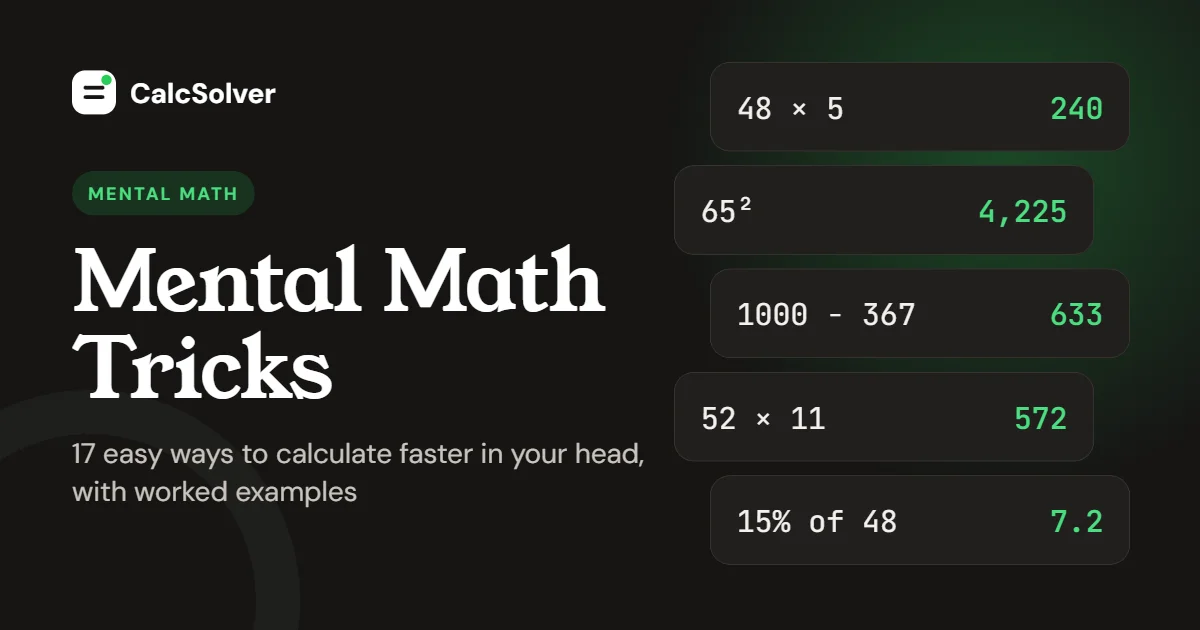
Mental math tricks are shortcuts that turn a hard calculation into two or three easy ones you can hold in your head. Instead of carrying digits like you would on paper, you round, split or reshape the numbers first. With the 17 methods below you can multiply by 5, 9 or 11 in seconds, square numbers ending in 5, subtract from 1,000 without borrowing and work out a tip or discount on the spot.
In short: Mental math is about reshaping numbers into friendly ones. Learn one trick at a time, say the steps out loud, and check each answer on a calculator until the method feels automatic.
In this guide
What Is Mental Math, and Why Does It Still Matter?
Mental math is doing arithmetic in your head by using what you know about numbers, rather than following the column method you learned for paper. A strong mental calculator does not hold more digits in memory than anyone else. They simply choose an easier route: 49 × 6 becomes 50 × 6 minus 6, and 25 × 16 becomes 100 × 4.
Researchers call this flexibility number sense. Stanford math education professor Jo Boaler describes it as using numbers flexibly, such as working out 7 × 8 as 10 × 7 minus two 7s, and argues that it matters more than memorising facts under time pressure. Cognitive research also shows why tricks help: multi-digit mental multiplication depends heavily on working memory updating, so any method that reduces how many numbers you juggle at once makes the task easier.
Calculators are everywhere, but mental math still pays off every day. It lets you spot a wrong answer before you hand it in, compare prices in a shop, split a bill, estimate a tip and follow along in a lesson without reaching for a device.
In short: Mental math is the skill of choosing an easier route through a calculation. It builds number sense, lowers the load on working memory and helps you catch mistakes, even when a calculator is nearby.
All 17 Mental Math Tricks at a Glance
Use this table as a cheat sheet. Each trick is explained step by step in the sections below.
| # | Trick | Best for | Example |
|---|---|---|---|
| 1 | Make a ten | Adding single digits | 8 + 7 = 8 + 2 + 5 = 15 |
| 2 | Add left to right | Two-digit addition | 47 + 38 → 70 + 15 = 85 |
| 3 | Round and adjust | Numbers near 10, 100 or 1,000 | 198 + 57 = 257 − 2 = 255 |
| 4 | Add 9 as 10 − 1 | Adding 9, 99 or 999 | 46 + 9 = 56 − 1 = 55 |
| 5 | All from 9, last from 10 | Subtracting from 1,000 | 1,000 − 367 = 633 |
| 6 | Count up to subtract | Making change | 503 − 278 = 22 + 203 = 225 |
| 7 | Halve, then × 10 | Multiplying by 5 | 48 × 5 = 24 × 10 = 240 |
| 8 | × 10, then subtract | Multiplying by 9 | 47 × 9 = 470 − 47 = 423 |
| 9 | Split and add | Multiplying by 11 | 52 × 11 = 5|7|2 = 572 |
| 10 | Double and halve | Even numbers, 25s and 50s | 16 × 25 = 4 × 100 = 400 |
| 11 | Break apart | Any one-digit multiplier | 7 × 36 = 210 + 42 = 252 |
| 12 | Distance from 100 | Numbers near 100 | 97 × 96 = 9,312 |
| 13 | Difference of squares | Numbers equally either side of a round number | 48 × 52 = 2,500 − 4 = 2,496 |
| 14 | Ends in 5 | Squaring 15, 25, 35… | 65² = 42|25 = 4,225 |
| 15 | Square near a round number | Squaring 29, 31, 49, 51… | 49² = 2,500 − 100 + 1 = 2,401 |
| 16 | Double, then ÷ 10 | Dividing by 5 | 340 ÷ 5 = 680 ÷ 10 = 68 |
| 17 | Build from 10% | Percentages, tips, discounts | 15% of 48 = 4.8 + 2.4 = 7.2 |
Addition and Subtraction Tricks
These tricks all work the same way: move part of one number to make a round number, then deal with what is left.
1. Make a Ten
Ten is the easiest number to add to. Borrow just enough from the second number to turn the first into 10, then add the rest.
Example: 8 + 7 → take 2 from the 7 to make 8 into 10 → 10 + 5 = 15. The same idea scales up: 58 + 7 = 60 + 5 = 65.
2. Add From Left to Right
Paper addition starts on the right, but your head works better from the left, because you keep the biggest, most important part of the answer first.
- Add the tens: 40 + 30 = 70.
- Add the ones: 7 + 8 = 15.
- Combine: 70 + 15 = 85.
3. Round and Adjust (Compensation)
When a number sits close to a round value, use the round value and then correct for the difference. Pay attention to the direction of the correction, because this is where most mistakes happen.
Example: 198 + 57: use 200 + 57 = 257, then take back the extra 2 → 255.
Example: 83 − 29: subtract 30 to get 53, then give back the 1 you took too many → 54.
4. Add 9 by Adding 10, Then Taking 1
Adding 9 is the most common place where people count on their fingers. Add 10 instead and step back one. The same works for 99 (add 100, take 1) and 999.
Example: 46 + 9 = 56 − 1 = 55. And 54 + 29 = 54 + 30 − 1 = 83.
5. Subtract From 1,000: All From 9, the Last From 10
Subtracting from 100, 1,000 or 10,000 usually needs a chain of borrowing. Skip it: take every digit away from 9, except the last digit, which you take from 10.
Example: 1,000 − 367 → 9 − 3 = 6, 9 − 6 = 3, 10 − 7 = 3 → 633. It is also the quickest way to work out change from a round note.
6. Count Up to Subtract
To find a difference, start at the smaller number and count up to the bigger one in friendly jumps, the way a shopkeeper counts out change.
Example: 503 − 278: from 278 to 300 is 22, from 300 to 503 is 203, so the difference is 22 + 203 = 225.
In short: For addition and subtraction, make a round number first. Make a ten, add left to right, round and adjust, or count up, and the borrowing disappears.
Multiplication Tricks
Multiplication tricks save the most time, because the paper method needs several rows of working. Most of them turn the problem into a multiplication by 10 or 100, which only adds zeros.
7. Multiply by 5: Halve, Then Multiply by 10
Five is half of ten, so multiplying by 5 is the same as halving and then multiplying by 10.
Example: 48 × 5 → half of 48 is 24 → 24 × 10 = 240. For an odd number such as 37, half is 18.5, so 37 × 5 = 185.
8. Multiply by 9: Multiply by 10, Then Subtract
Nine is one less than ten. Multiply by 10, then subtract one copy of the number.
Example: 47 × 9 = 470 − 47 = 423.
9. Multiply a Two-Digit Number by 11
Split the two digits apart and put their sum in the middle. If the sum is 10 or more, carry the 1 into the first digit.
Example: 52 × 11 → 5 and 2, with 5 + 2 = 7 in the middle → 572.
Example: 87 × 11 → 8 + 7 = 15, so write 5 in the middle and carry 1 to the 8 → 957.
10. Double and Halve
Halving one factor and doubling the other keeps the product the same. Keep going until you reach a pair you know, such as 4 × 25 = 100 or 8 × 125 = 1,000.
Example: 16 × 25 → 8 × 50 → 4 × 100 = 400.
11. Break Apart and Multiply
Split the bigger number by place value, multiply each part, and add the results. This is the distributive property, and it is the method many fast mental calculators rely on for everyday products.
Example: 7 × 36 = 7 × 30 + 7 × 6 = 210 + 42 = 252.
12. Multiply Numbers Close to 100
When both numbers are just below 100, write down how far each one is from 100. Take one distance away from the other number for the first two digits, and multiply the distances for the last two.
- 97 is 3 below 100, and 96 is 4 below.
- First part: 97 − 4 = 93 (or 96 − 3, which is the same).
- Last part: 3 × 4 = 12, written as two digits.
- Answer: 9,312.
For numbers just above 100, add instead: 103 × 104 → 103 + 4 = 107 and 3 × 4 = 12 → 10,712.
13. Use the Difference of Squares
When two numbers sit the same distance either side of a round number, multiply using (a − b)(a + b) = a² − b².
Example: 48 × 52: both are 2 away from 50, so 50² − 2² = 2,500 − 4 = 2,496. Likewise 102 × 98 = 10,000 − 4 = 9,996.
In short: Turn multiplication into multiplying by 10 or 100. Halve for 5, subtract for 9, split for 11, double and halve, or break the number apart.
Squaring Tricks
14. Square Any Number Ending in 5
Multiply the first digit by the next whole number, then write 25 on the end.
Example: 65² → 6 × 7 = 42 → 4,225. And 35² → 3 × 4 = 12 → 1,225, while 85² → 8 × 9 = 72 → 7,225.
15. Square a Number Next to a Round Number
Square the round number, then adjust: subtract twice the round number and add 1 for the number just below, or add twice the round number and add 1 for the number just above.
Example: 49² = 50² − 2 × 50 + 1 = 2,500 − 100 + 1 = 2,401. And 31² = 900 + 60 + 1 = 961.
In short: Numbers ending in 5 square in one step (6 × 7 and add 25), and numbers next to a round number square with a quick plus or minus correction.
Division and Percentage Tricks
16. Divide by 5: Double, Then Divide by 10
Dividing by 5 is the same as doubling and then dividing by 10, which only moves the decimal point.
Example: 340 ÷ 5 → 680 ÷ 10 = 68.
17. Work Out Any Percentage From 10%
Finding 10% only means moving the decimal point one place left. Build every other percentage from that.
| To find | Do this | Example |
|---|---|---|
| 10% | Move the decimal point one place left | 10% of 48 = 4.8 |
| 5% | Half of 10% | 5% of 640 = 32 |
| 15% | 10% plus half of it | 15% of 48 = 4.8 + 2.4 = 7.2 |
| 20% | Double 10% | 20% of 65 = 13 |
| 25% | Halve, then halve again | 25% of 84 = 21 |
| 35% | 30% plus 5% | 35% of 80 = 24 + 4 = 28 |
One more shortcut: x% of y is the same as y% of x. So 8% of 25 is the same as 25% of 8, which is 2. Swap the numbers whenever one way round is easier.
In short: Find 10% by moving the decimal point, then halve, double or add to reach any percentage. Swap the numbers when that makes it easier.
How Do You Check a Mental Math Answer?
Fast is only useful if it is right. Two quick checks catch most slips.
- Estimate first. Round both numbers and see roughly what the answer should be. For 47 × 38, the estimate is 50 × 40 = 2,000, so an answer of 1,786 is reasonable, but 17,860 is not.
- Use digital roots. Add the digits of each number until one digit is left: 47 → 4 + 7 = 11 → 2, and 38 → 3 + 8 = 11 → 2. Multiply them: 2 × 2 = 4. The answer must reduce to the same digit: 1,786 → 1 + 7 + 8 + 6 = 22 → 4. A mistake such as 1,796 reduces to 5, so you know to look again.
- Confirm on a calculator. While you are learning, type the problem into the CalcSolver calculator and compare. It shows the full expression, so you can see exactly where your working went off track.
In short: Estimate first, check the digital root, and confirm on a calculator while you practise. Together they catch almost every mental math mistake.
A 10-Minute Mental Math Practice Plan
Speed comes from short, regular practice, not long sessions. This plan takes about ten minutes a day.
- Pick one trick a week. Start with the table above and work down the list.
- Do five slow examples. Say every step out loud, then check each answer in the calculator.
- Do five fast examples. Use new numbers and try to finish each one in under ten seconds.
- Play one quick game. Turn on Code Mode on the calculator and enter 1001 for Math Sprint or 1005 for Squares and Roots. Your best score is saved in your browser.
- Use it in real life. Work out a price, a discount or a bill split each day before you reach for your phone.
Write your working in the Scratch Notes under the calculator, and use Insert answer to drop the checked result in beside it.
Common Mental Math Mistakes
- Correcting in the wrong direction. If you round a number up, take the extra away at the end; if you round down, add it back.
- Losing the carry with 11. When the two digits add up to 10 or more, the 1 belongs to the first digit: 87 × 11 is 957, not 8157.
- Dropping a zero. In the near-100 trick the last part always has two digits, so 3 × 3 = 9 is written as 09.
- Learning a trick without the reason. If you know why a trick works, you can adapt it to new numbers instead of forgetting it.
Which Mental Math Trick Should You Learn First?
| Level | Start with | Why |
|---|---|---|
| Beginner | Make a ten, add left to right, add 9 | They remove finger counting and borrowing from everyday sums. |
| Intermediate | × 5, × 9, × 11, break apart, 10% rule | They cover most of the multiplication and percentages in daily life. |
| Advanced | Near 100, difference of squares, squaring tricks | They let you do two-digit products and squares that look impossible. |
In short: Start with make-a-ten and left-to-right addition, move on to the multiplication tricks for 5, 9 and 11, and save the near-100 and squaring tricks for last.
Mental Math Tricks: Frequently Asked Questions
What is the fastest way to do mental math?
Turn the problem into easier numbers first. Round to a nearby 10 or 100 and adjust, split numbers by place value, or use a shortcut such as halving for × 5. Working from left to right also keeps the biggest part of the answer in your head first.
Can anyone get good at mental math?
Yes. Mental math is a set of learnable methods, not a special talent. Short, regular practice with one trick at a time is what makes the difference, and each method gets faster the more often you use it.
Do I need to memorise times tables to do mental math?
Knowing the tables up to 10 × 10 makes every trick faster, because most methods break a problem down into small facts. You do not need to memorise anything beyond that, since the tricks build bigger products from those facts.
How do I multiply two-digit numbers in my head?
Break one number apart by place value and multiply each part, for example 7 × 36 = 210 + 42 = 252. For numbers near 100 use the distance-from-100 trick, and for numbers either side of a round number use the difference of squares.
How do I work out percentages in my head?
Find 10% by moving the decimal point one place left, then build from it: halve it for 5%, double it for 20%, and add 10% and 5% together for 15%. You can also swap the numbers, because 8% of 25 is the same as 25% of 8.
Is mental math still useful when calculators exist?
Yes. It helps you spot a wrong answer, estimate before you calculate, handle money quickly and follow along in class. It also builds the number sense that algebra and problem solving rely on.
Sources and Further Reading
- Jo Boaler, Cathy Williams and Amanda Confer, Fluency Without Fear, youcubed, Stanford University (2015).
- Stanford News, Learn math without fear, Stanford expert says (January 29, 2015).
- Han, Yang, Lin and Yen, Memory Updating and Mental Arithmetic, Frontiers in Psychology (2016).
Every worked example in this guide was checked on the CalcSolver calculator. Want more practice? Try the free math tools, browse the math formulas cheat sheet or play the math games.
Check your working in seconds
Type any problem from this guide into the free CalcSolver calculator and see the answer, with fractions, instantly.