To solve for x means to find the number that x stands for, so that both sides of the equation are equal. Every linear equation, from x + 4 = 10 to 3(x + 2) − 4 = 2x + 9, can be solved with the same short method. This guide shows that method, then works through one-step, two-step and multi-step equations, fractions, decimals, negative answers and equations where you solve for y or another letter.
In short: Simplify each side, move the x terms to one side and the numbers to the other, then divide by the number in front of x. Check by putting your answer back into the equation.
Need the answer fast? Our free solve for x calculator shows every step and checks itself. Use it alongside this guide to practise the method.
In this guide
What Does “Solve for x” Mean?
An equation says two amounts are equal. Solving for x means finding the value of x that makes that true, and writing it as x = a number. In x + 4 = 10, the answer is x = 6, because 6 + 4 really is 10.
You find it by keeping the equation balanced. Whatever you do to one side, you do to the other side too. Each step uses the opposite operation to peel something away from x: subtraction undoes addition, and division undoes multiplication.
In short: Solving for x means getting x on its own, in the form x = number, by doing the same opposite operation to both sides.
The 5-Step Method to Solve Any Linear Equation
A linear equation is one where x has no power, root or division by x. All of them follow the same steps. Skip any step that does not apply.
- Clear brackets and fractions. Multiply out brackets, and multiply every term by the lowest common denominator to remove fractions.
- Combine like terms on each side separately.
- Move the x terms to one side by adding or subtracting them on both sides.
- Move the plain numbers to the other side the same way.
- Divide both sides by the coefficient (the number in front of x), then check the answer.
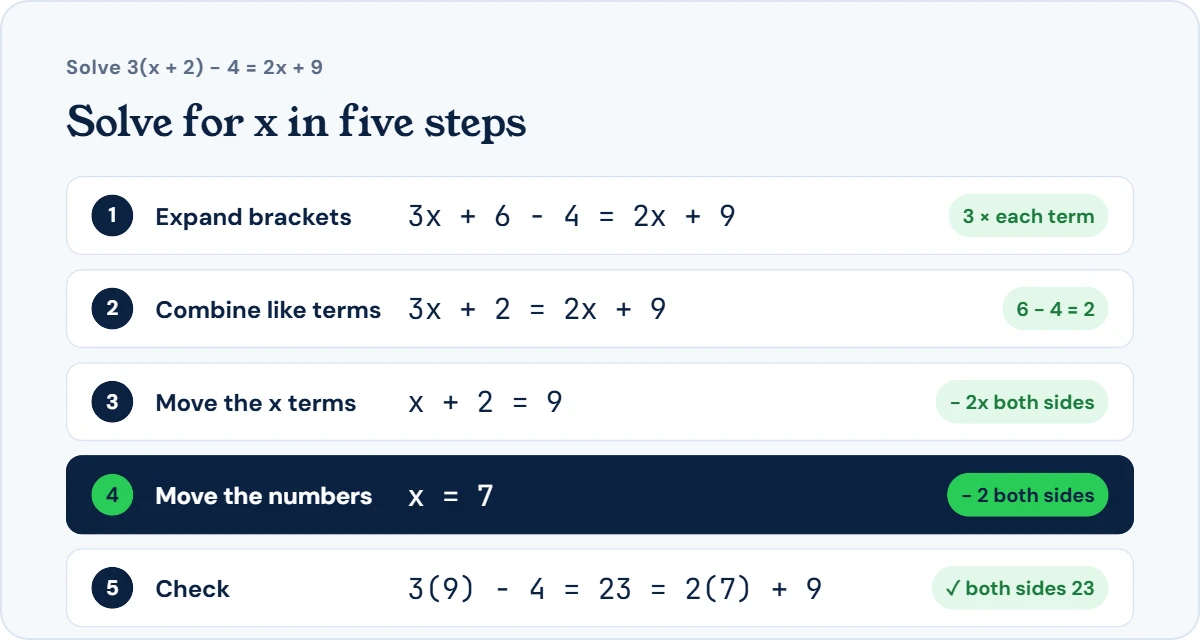
In short: Clear brackets and fractions, combine like terms, gather x on one side and numbers on the other, divide, then check.
How to Solve One-Step Equations
A one-step equation needs one opposite operation. Look at what is being done to x, then undo it on both sides.
| Equation | What is done to x | Undo it | Answer |
|---|---|---|---|
| x + 4 = 10 | 4 is added | Subtract 4 from both sides | x = 6 |
| x − 3 = 8 | 3 is subtracted | Add 3 to both sides | x = 11 |
| 5x = 35 | x is multiplied by 5 | Divide both sides by 5 | x = 7 |
| x ÷ 4 = 6 | x is divided by 4 | Multiply both sides by 4 | x = 24 |
How to Solve Two-Step Equations
A two-step equation has a number added or subtracted and a number multiplying or dividing x. Undo the adding or subtracting first, then the multiplying or dividing.
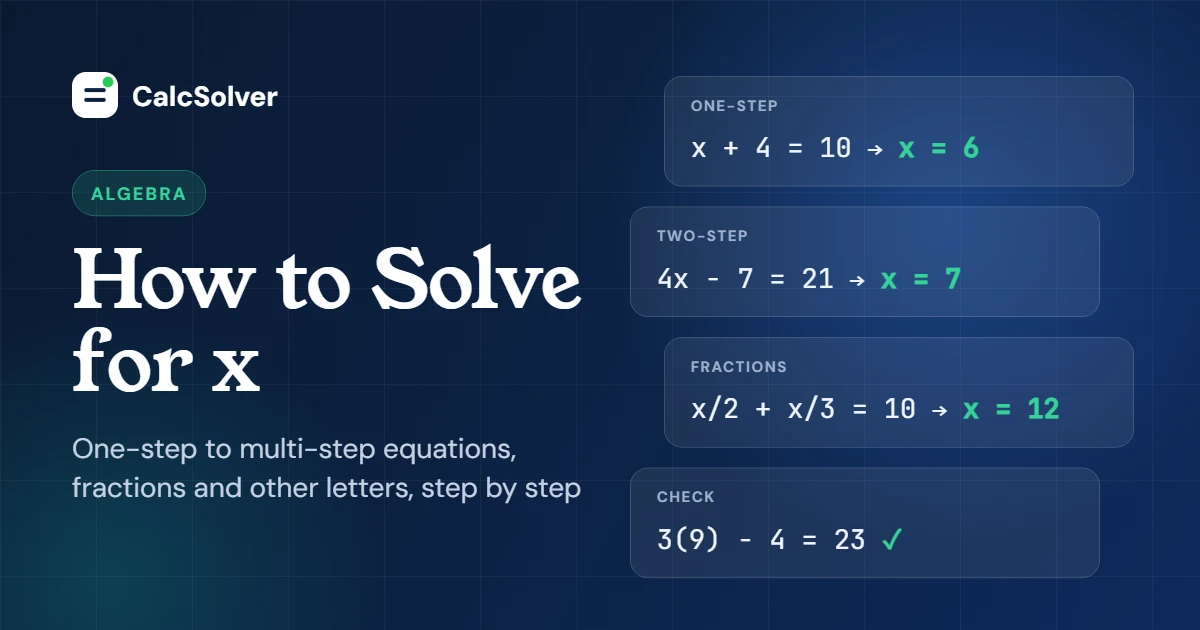
Example: 4x − 7 = 21 → add 7 to both sides: 4x = 28 → divide both sides by 4: x = 7.
Example: x/3 + 5 = 9 → subtract 5 from both sides: x/3 = 4 → multiply both sides by 3: x = 12.
In short: In a two-step equation, undo + or − first, then × or ÷. It is the order of operations run backwards.
How to Solve Multi-Step Equations
Multi-step equations have brackets or several x terms. Tidy each side first, and the equation turns into a two-step one.
- Start with 3(x + 2) − 4 = 2x + 9.
- Multiply out the brackets: 3x + 6 − 4 = 2x + 9.
- Combine like terms on the left: 3x + 2 = 2x + 9.
- Subtract 2x from both sides: x + 2 = 9.
- Subtract 2 from both sides: x = 7.
Check: the left side is 3(7 + 2) − 4 = 27 − 4 = 23, and the right side is 2(7) + 9 = 23. Both sides match.
How to Solve Equations With x on Both Sides
Move the smaller x term so that x stays positive. It is not required, but it means fewer minus signs to track.
Example: 6x + 5 = 2x + 25 → subtract 2x from both sides: 4x + 5 = 25 → subtract 5: 4x = 20 → divide by 4: x = 5. Check: 6(5) + 5 = 35 and 2(5) + 25 = 35.
How to Solve for x With Fractions and Decimals
Fractions are the step that trips most people up, so remove them first. Multiply every term on both sides by the lowest common denominator (LCD).
Example: x/2 + x/3 = 10 → the LCD of 2 and 3 is 6, so multiply every term by 6: 3x + 2x = 60 → 5x = 60 → x = 12. Check: 12/2 + 12/3 = 6 + 4 = 10.
Example: (2x − 1)/3 = 5 → multiply both sides by 3: 2x − 1 = 15 → add 1: 2x = 16 → x = 8.
Decimals work the same way. Multiply every term by 10, 100 or 1,000 to make whole numbers.
Example: 0.4x + 1.2 = 3.6 → multiply every term by 10: 4x + 12 = 36 → 4x = 24 → x = 6.
In short: Multiply every term by the lowest common denominator, or by 10 or 100 for decimals, and the equation becomes an ordinary one.
What If x Is Negative or a Fraction?
Answers do not have to be whole or positive. Keep the sign with its number, and leave an answer as a fraction if it does not divide evenly.
Example: 7 − 2x = 15 → subtract 7 from both sides: −2x = 8 → divide by −2: x = −4. Check: 7 − 2(−4) = 7 + 8 = 15.
Example: 3x + 1 = 3 → subtract 1: 3x = 2 → divide by 3: x = 2/3.
When an Equation Has No Solution or Infinitely Many
Sometimes the x terms cancel out completely. What is left tells you the answer.
| Equation | After simplifying | Meaning |
|---|---|---|
| 2(x + 3) = 2x + 5 | 6 = 5 (false) | No solution. No number makes it true. |
| 3(x − 1) = 3x − 3 | 0 = 0 (always true) | Infinitely many solutions. Every number works. |
| 4x + 1 = 2x + 9 | x = 4 | One solution. Only x = 4 works. |
How to Solve for y or Any Other Letter
Solving for y, m, r or any letter works exactly like solving for x. An equation with several letters is called a literal equation. Treat every other letter as if it were a number, and isolate the one you want.
Example: Solve 2x + 3y = 12 for y → subtract 2x from both sides: 3y = 12 − 2x → divide by 3: y = 4 − (2/3)x. This is how you “solve for y in terms of x”.
Example: Solve y = mx + b for m → subtract b: y − b = mx → divide by x: m = (y − b)/x.
Example: Solve ax + b = c for x → subtract b: ax = c − b → divide by a: x = (c − b)/a. This one formula solves every equation of that shape.
In short: To solve for any letter, treat the other letters as numbers and use the same opposite operations until your letter is alone.
How to Check Your Answer
Substitute your answer for x in the original equation and work out each side. If the two sides match, the answer is right. If they do not, retrace your steps and look for a sign error first.
The CalcSolver calculator makes this quick. For 3(x + 2) − 4 = 2x + 9 with x = 7, type 3×(7+2)−4 and press =, then type 2×7+9. Both give 23, so x = 7 is correct. The calculator works with numbers, not letters, so it checks your algebra rather than doing it for you.
Common Mistakes When Solving for x
- Changing only one side. Every step must happen to both sides, or the equation is no longer balanced.
- Multiplying only the first term in brackets. 3(x + 2) is 3x + 6, not 3x + 2.
- Missing a term when clearing fractions. Multiply every term by the LCD, including whole numbers.
- Dropping the minus sign. In −2x = 8, divide by −2, not by 2, so x = −4.
- Dividing before subtracting. In 4x − 7 = 21, add 7 first. Dividing first gives fractions you do not need.
Practice Problems (With Answers)
Work each one out, then open it to compare. Check your answer by substitution.
1. x − 9 = 4
x = 13. Add 9 to both sides.
2. 7x = 63
x = 9. Divide both sides by 7.
3. 5x + 8 = 43
x = 7. Subtract 8 to get 5x = 35, then divide by 5.
4. 2(x − 4) + 3 = 11
x = 8. Expand to 2x − 8 + 3 = 11, so 2x − 5 = 11, 2x = 16 and x = 8.
5. 9x − 2 = 4x + 18
x = 4. Subtract 4x to get 5x − 2 = 18, add 2 to get 5x = 20, then divide by 5.
6. x/4 + x/2 = 9
x = 12. Multiply every term by 4: x + 2x = 36, so 3x = 36 and x = 12.
7. 10 − 3x = 25
x = −5. Subtract 10 to get −3x = 15, then divide by −3.
8. Solve 4x − 2y = 8 for y
y = 2x − 4. Subtract 4x to get −2y = 8 − 4x, then divide every term by −2.
Solve for x: Frequently Asked Questions
What does solve for x mean?
It means finding the value of x that makes the equation true. You rearrange the equation, doing the same thing to both sides, until it reads x = a number.
What is the first step to solve for x?
Clear any brackets and fractions first, then combine like terms on each side. After that, move the x terms to one side and the numbers to the other.
How do you solve for x when there are fractions?
Multiply every term on both sides by the lowest common denominator. The fractions disappear and you solve the equation as normal. For x/2 + x/3 = 10, multiply by 6 to get 3x + 2x = 60, so x = 12.
How do you solve for x when it is on both sides?
Subtract the smaller x term from both sides so that x appears on one side only. Then move the numbers to the other side and divide by the coefficient of x.
How do you solve for y in terms of x?
Get the y term alone on one side by moving everything else to the other side, then divide by the number in front of y. For 2x + 3y = 12, that gives y = 4 − (2/3)x.
What does it mean when an equation has no solution?
If the x terms cancel and leave a false statement such as 6 = 5, no value of x can make the equation true. If they cancel and leave a true statement such as 0 = 0, every value of x works.
Sources and Further Reading
- OpenStax, Elementary Algebra 2e, Chapter 2: Solving Linear Equations and Inequalities, Rice University.
- LibreTexts Mathematics, Literal Equations.
Every answer in this guide was checked by substitution on the CalcSolver calculator. New to algebra? Start with our algebra basics guide, learn to evaluate and simplify expressions, or move on to functions and f(x).
Check your working in seconds
Type any problem from this guide into the free CalcSolver calculator and see the answer, with fractions, instantly.