Algebra is math with a missing number. Instead of writing a blank, you use a letter such as x, then use a few simple rules to find what that letter stands for. This guide explains algebra basics in plain words: the key terms, the difference between an expression and an equation, how to simplify, and how to solve for x step by step.
In short: Algebra uses letters for unknown numbers. You simplify expressions by combining like terms, and you solve equations by doing the same thing to both sides until the letter is on its own.
In this guide
What Is Algebra?
Algebra is the part of math that uses letters, called variables, to stand for numbers you do not know yet. If you know that a number plus 7 makes 12, you can write it as x + 7 = 12 and work out that x is 5.
The most useful idea in algebra is the balance. An equation is like a pair of scales: both sides weigh the same. As long as you do exactly the same thing to both sides, the scales stay level and the equation stays true.
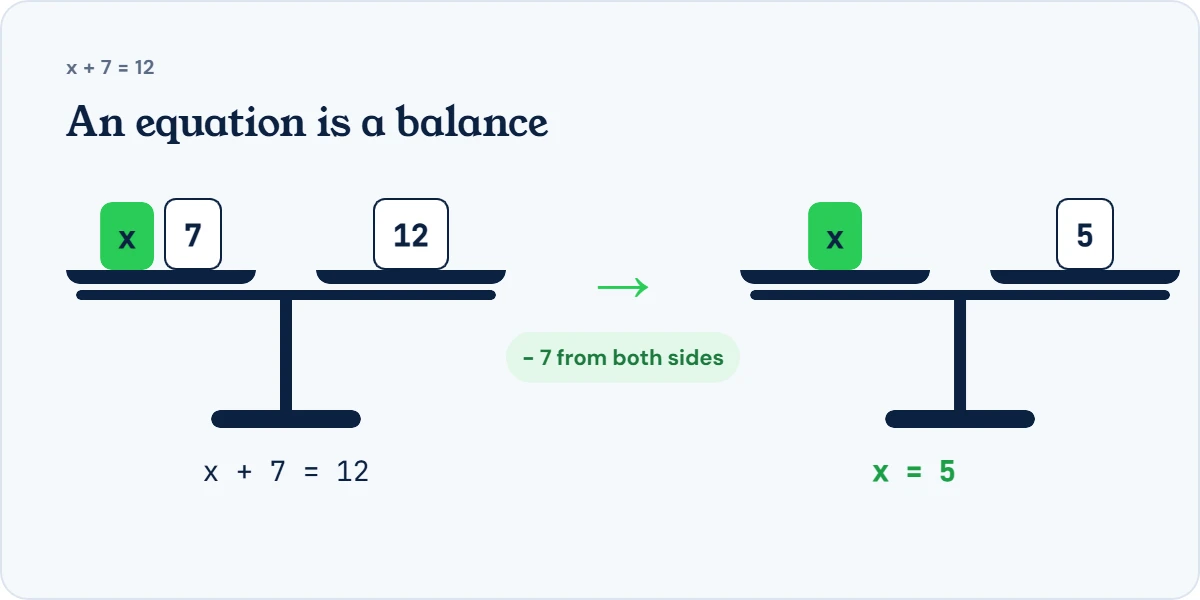
In short: Algebra is arithmetic with an unknown number written as a letter. An equation is a balance, so whatever you do to one side, you do to the other.
Key Algebra Words You Need to Know
Here is every part of the equation 3x + 5 = 20, named:
| Word | Meaning | In 3x + 5 = 20 |
|---|---|---|
| Variable | A letter that stands for an unknown number | x |
| Coefficient | The number multiplying a variable | 3 |
| Constant | A number on its own, with no variable | 5 and 20 |
| Term | One piece of an expression, separated by + or − | 3x and 5 |
| Like terms | Terms with exactly the same variable part | 3x and 7x are like terms; 3x and 3x² are not |
| Expression | Terms joined by + or −, with no equals sign | 3x + 5 |
| Equation | Two expressions joined by an equals sign | 3x + 5 = 20 |
What Is the Difference Between an Expression and an Equation?
An expression has no equals sign, so you cannot solve it. You can only simplify it or evaluate it for a given value. An equation has an equals sign, so you can solve it to find the value of the variable.
| Expression | Equation | |
|---|---|---|
| Example | 4x + 3 + 2x − 1 | 3x + 5 = 20 |
| Equals sign? | No | Yes |
| What you do | Simplify it: 6x + 2 | Solve it: x = 5 |
In short: No equals sign means it is an expression, so simplify it. An equals sign means it is an equation, so solve it.
How Do You Simplify an Algebraic Expression?
1. Combine Like Terms
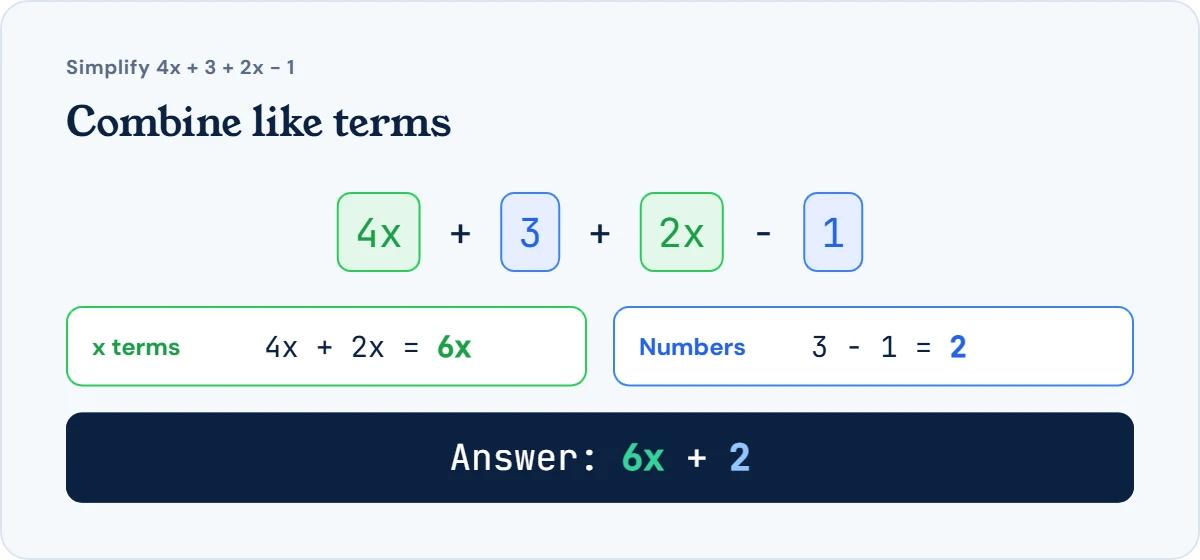
Add or subtract terms that have the same variable part, and add the plain numbers separately.
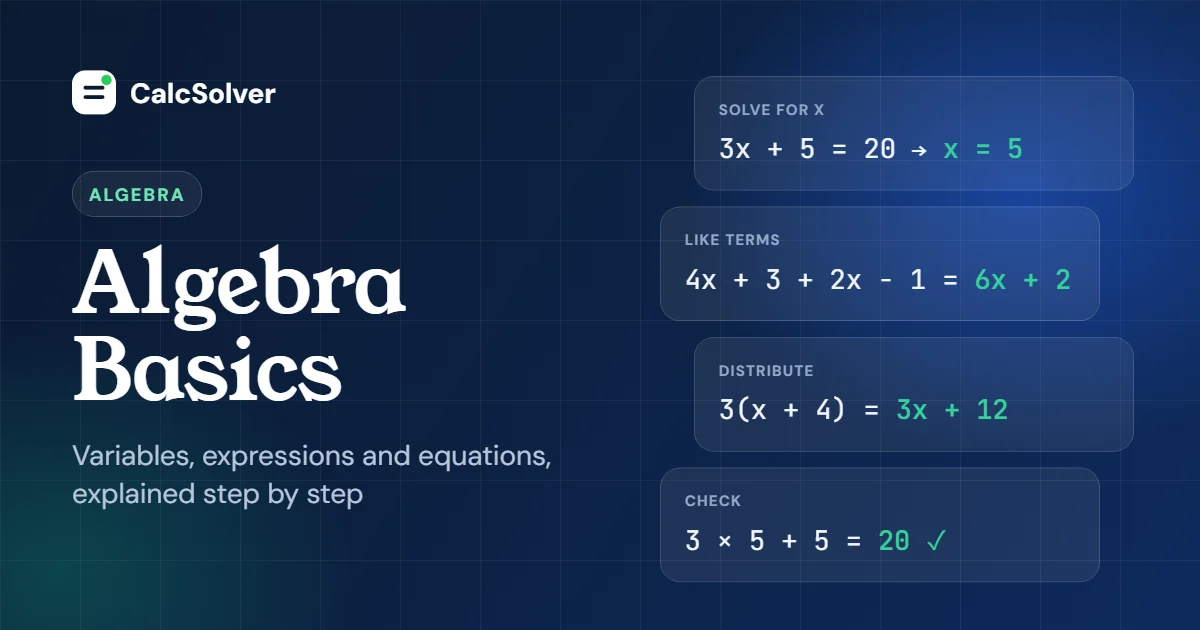
Example: 4x + 3 + 2x − 1 → (4x + 2x) + (3 − 1) = 6x + 2.
2. Use the Distributive Property
A number outside brackets multiplies every term inside: a(b + c) = ab + ac.
Example: 3(x + 4) = 3x + 12. With a minus sign: 2(x − 5) − (x + 1) = 2x − 10 − x − 1 = x − 11.
3. Follow the Order of Operations
Work in this order: brackets, then powers, then multiplication and division from left to right, then addition and subtraction. You may know it as PEMDAS or BODMAS.
Example: 2 + 3 × 4 = 2 + 12 = 14, but (2 + 3) × 4 = 20. And 2 × 3² = 2 × 9 = 18, not 36.
In short: To simplify, open brackets with the distributive property, follow the order of operations, then combine like terms.
For more practice with substitution, powers and negative signs, read our guide to evaluating and simplifying algebraic expressions.
How Do You Solve a Simple Equation?
To solve for x, undo whatever is being done to x, one step at a time, using the opposite operation. Addition undoes subtraction, and division undoes multiplication. Always do the step to both sides.
One-Step Equations
Example: x + 7 = 12 → subtract 7 from both sides → x = 5.
Example: 4x = 28 → divide both sides by 4 → x = 7.
Two-Step Equations
- Start with 3x + 5 = 20.
- Subtract 5 from both sides: 3x = 15.
- Divide both sides by 3: x = 5.
Undo the addition or subtraction first, then the multiplication or division. It is the order of operations in reverse.
Variables on Both Sides
Example: 5x − 4 = 2x + 11 → subtract 2x from both sides: 3x − 4 = 11 → add 4: 3x = 15 → divide by 3: x = 5.
Equations With Brackets
Example: 2(x − 3) = 10 → divide both sides by 2: x − 3 = 5 → add 3: x = 8. You could also expand first: 2x − 6 = 10, so 2x = 16 and x = 8.
In short: Undo each operation with its opposite, on both sides, in reverse order: deal with + and − first, then × and ÷, until x is alone.
Equations with fractions, decimals, negative answers or other letters are covered in our step-by-step guide to solving for x. To check any equation instantly, use the solve for x calculator.
How Do You Check Your Answer?
Put your answer back into the original equation. If both sides come out equal, your answer is right.
Example: For 3x + 5 = 20 with x = 5: 3 × 5 + 5 = 15 + 5 = 20. Both sides are 20, so x = 5 is correct.
You can do this check in the CalcSolver calculator: type 3×5+5 and press =. If you get 20, your answer works. CalcSolver is a numeric calculator, so it checks your answer rather than solving the letters for you, which is exactly what builds algebra skill.
In short: Substitute your answer into the original equation. If the two sides match, the answer is correct.
Basic Algebra Rules to Remember
- Keep the balance: whatever you do to one side of an equation, do to the other.
- Use opposite operations: + undoes −, and × undoes ÷.
- Multiply every term in brackets: a(b + c) = ab + ac.
- Only combine like terms: 2x + 3x = 5x, but 2x + 3 stays as it is.
- Watch the signs: subtracting a negative is adding, so 5 − (−2) = 7.
- Never divide by zero: it has no answer.
Common Beginner Mistakes
- Combining unlike terms. 2x + 3 is not 5x. The x term and the plain number must stay separate.
- Only multiplying the first term in brackets. 3(x + 4) is 3x + 12, not 3x + 4.
- Changing one side only. If you subtract 5 on the left, subtract 5 on the right too.
- Losing a minus sign. −(x + 1) is −x − 1, because the minus applies to both terms.
Practice Problems (With Answers)
Try each one, then open it to check. Substitute your answer to prove it.
1. x + 9 = 15
x = 6. Subtract 9 from both sides.
2. 6x = 42
x = 7. Divide both sides by 6.
3. 2x + 7 = 19
x = 6. Subtract 7 to get 2x = 12, then divide by 2.
4. 4(x + 2) = 36
x = 7. Divide by 4 to get x + 2 = 9, then subtract 2.
5. 7x − 3 = 4x + 12
x = 5. Subtract 4x to get 3x − 3 = 12, add 3 to get 3x = 15, then divide by 3.
6. x/3 + 2 = 6
x = 12. Subtract 2 to get x/3 = 4, then multiply both sides by 3.
Algebra Basics: Frequently Asked Questions
What is algebra in simple words?
Algebra is math where a letter, such as x, stands for a number you do not know yet. You use simple rules, like doing the same thing to both sides of an equation, to find that number.
What should I learn first in algebra?
Start with the key words (variable, term, expression and equation), then learn to combine like terms and use the distributive property. After that, practise one-step and two-step equations.
What is a variable in algebra?
A variable is a letter, such as x or y, that stands for a number you do not know yet or a number that can change. In 3x + 5 = 20, x is the variable and its value is 5.
Is algebra hard?
Algebra feels hard when the steps are rushed. If you learn the balance rule and practise a few equations at a time, each new topic builds on the last one and becomes much easier.
Can a calculator or algebra solver do algebra for me?
An algebra solver can rearrange letters, but you learn more by solving the steps yourself and checking the result. A calculator such as CalcSolver is perfect for that check: substitute your answer and confirm both sides are equal.
Sources and Further Reading
- OpenStax, Elementary Algebra 2e, Chapter 2: Solving Linear Equations and Inequalities, Rice University.
- Math is Fun, Introduction to Algebra.
What to Learn Next
- Algebraic expressions: evaluate and simplify with confidence.
- How to solve for x: every type of linear equation, step by step.
- Functions in algebra: f(x), zeros, domain and range.
Every example in this guide was checked by substituting the answer on the CalcSolver calculator. Want quick mental shortcuts too? Read our 17 mental math tricks, or see the basic algebra formulas.
Check your working in seconds
Type any problem from this guide into the free CalcSolver calculator and see the answer, with fractions, instantly.