Algebra
Distributive Property: Definition, Examples and How to Use It
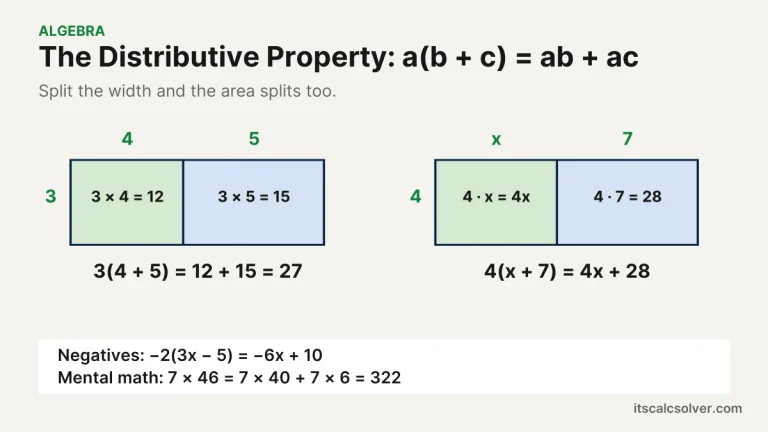
The distributive property a(b + c) = ab + ac explained with an area model and examples with negatives, fractions and variables, plus factoring and practice.
Free algebra guides for beginners: variables, expressions, equations, formulas and polynomials, explained step by step with examples you can check on the calculator.
The distributive property a(b + c) = ab + ac explained with an area model and examples with negatives, fractions and variables, plus factoring and practice.
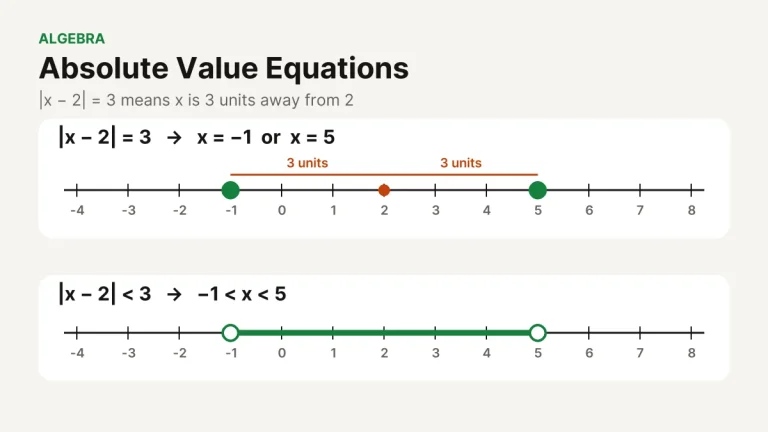
Solve absolute value equations step by step: isolate, split into two cases, check for false answers, no-solution cases, and absolute value inequalities.
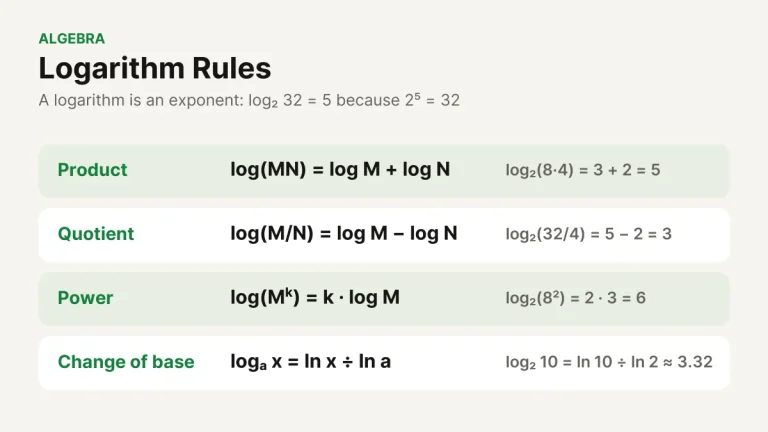
Learn the logarithm rules with examples: product, quotient, power and change of base, expanding and condensing logs, ln vs log, and solving log equations.
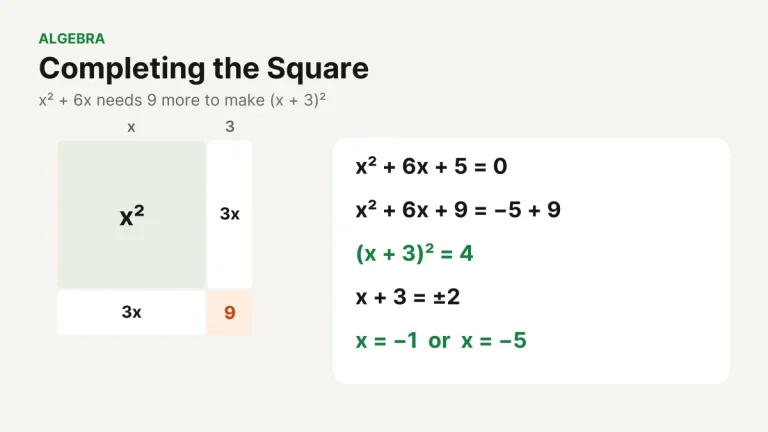
How to complete the square: the (b/2)² rule, solving quadratic equations, a not equal to 1, no real solutions, vertex form and practice with answers.
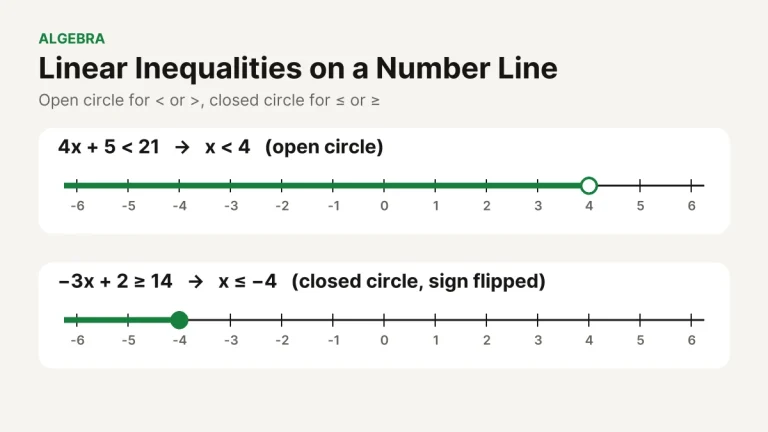
Solve linear inequalities step by step: when to flip the sign, graph on a number line, interval notation, compound inequalities and word problems.
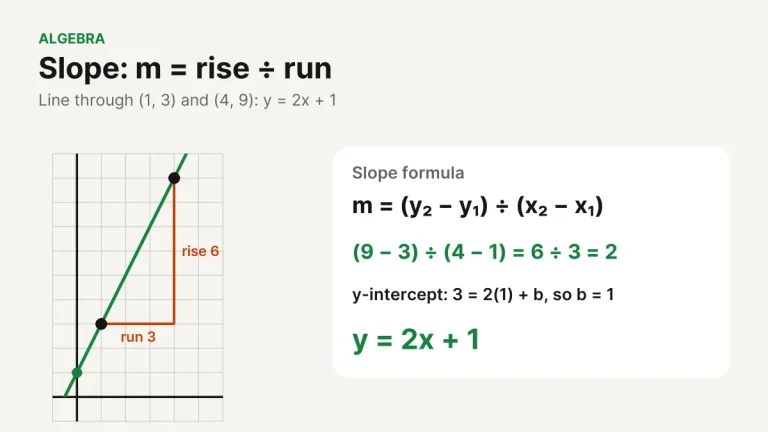
Learn the slope formula and slope-intercept form y = mx + b: find slope from two points, graph a line, write its equation, and parallel lines.
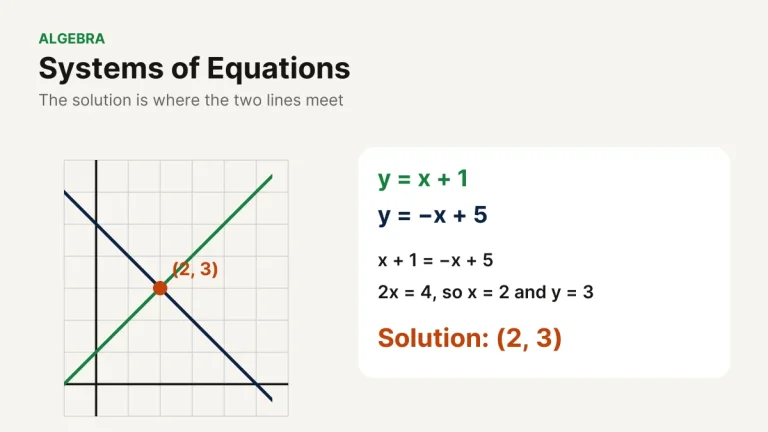
How to solve systems of equations by graphing, substitution and elimination, with no-solution cases, word problems, practice and answers.
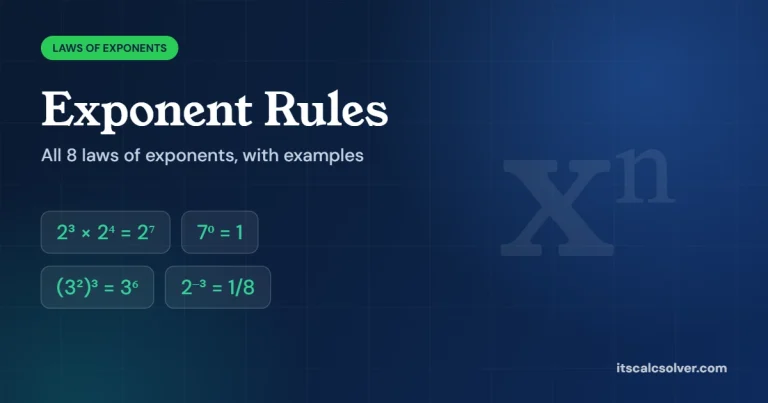
Learn all 8 exponent rules (laws of exponents): product, quotient, power, zero, negative and fractional exponents, with examples, mistakes and practice.
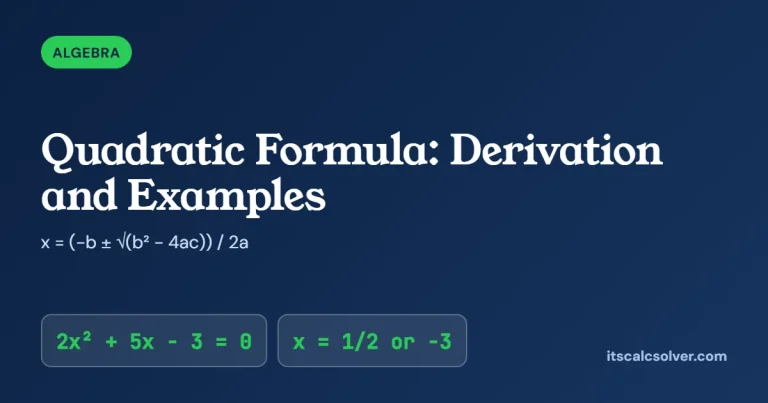
The quadratic formula is x = (−b ± √(b² − 4ac)) / 2a. Learn its derivation, the discriminant and worked examples, with a diagram and practice.
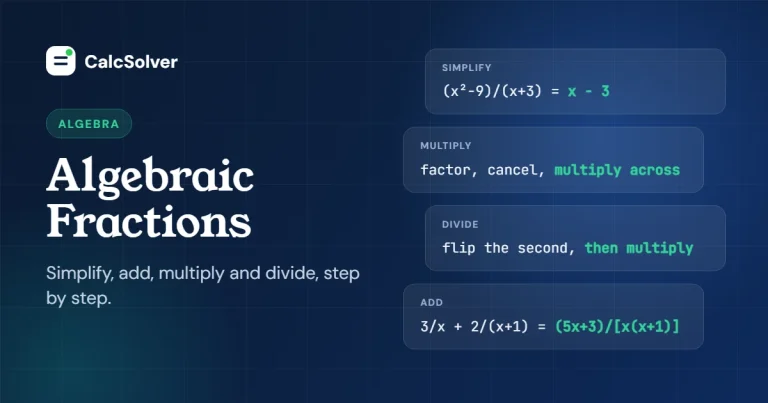
Learn algebraic fractions step by step: simplify, multiply, divide, add and subtract with excluded values, worked examples, practice problems and answers.
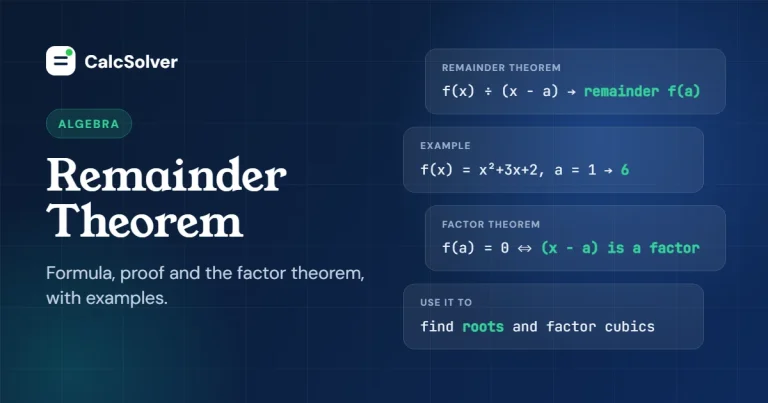
What is the remainder theorem? Learn the formula f(a), a short proof, the factor theorem and worked examples for finding remainders and factoring polynomials.
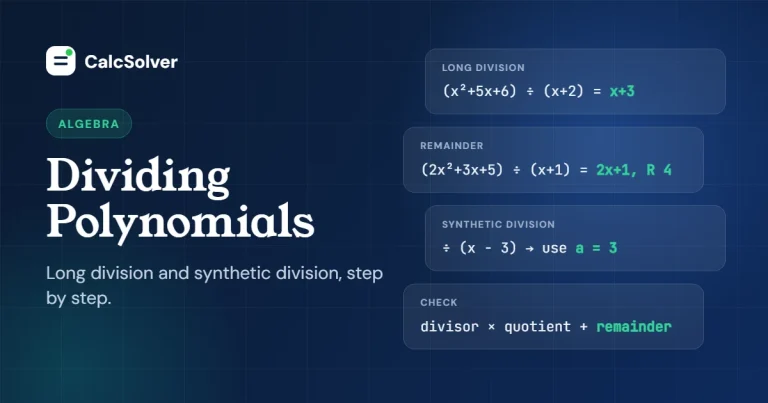
Learn how to divide polynomials with long division and synthetic division. Step-by-step examples with remainders, missing terms and practice problems.
Algebra is the part of math that uses letters, called variables, to stand for numbers you do not know yet. It turns word problems into short equations, such as x + 7 = 12, and gives you a few simple rules to find the missing value. Every topic below, from expressions to polynomials, builds on that one idea.
In short: Algebra is arithmetic with an unknown number written as a letter, solved by keeping both sides of an equation in balance.
New to algebra? Work through these steps in order. Each one links to the guide that covers it, starting with our algebra basics guide.
| Formula | Rule | Example |
|---|---|---|
| Distributive property | a(b + c) = ab + ac | 3(x + 4) = 3x + 12 |
| Square of a sum | (a + b)² = a² + 2ab + b² | (x + 3)² = x² + 6x + 9 |
| Square of a difference | (a − b)² = a² − 2ab + b² | (x − 2)² = x² − 4x + 4 |
| Difference of squares | a² − b² = (a + b)(a − b) | x² − 25 = (x + 5)(x − 5) |
| Slope of a line | m = (y₂ − y₁) ÷ (x₂ − x₁) | (1, 2) to (3, 8): m = 6 ÷ 2 = 3 |
| Quadratic formula | x = (−b ± √(b² − 4ac)) ÷ 2a | x² − 5x + 6 = 0 gives x = 2 or 3 |
See every formula with worked examples in our basic algebra formulas cheat sheet. More formulas for trigonometry, geometry and statistics are on our math formulas cheat sheet.
Substitute your answer for the letter and work out both sides. If they match, the answer is right. For 3x + 5 = 20 with x = 5, type 3×5+5 into the CalcSolver calculator and you get 20, so the answer works. To solve the whole equation step by step, use our free solve for x calculator. It is the fastest way to catch a sign error before you hand in your homework.
In short: Solve the steps yourself, then substitute the answer on a calculator. Matching sides mean a correct answer.
Basic algebra covers variables and expressions, combining like terms, the distributive property, solving linear equations, inequalities, working with formulas and an introduction to polynomials and factoring.
Learn the key words first, then practise a few problems of one type at a time. Say each step out loud, keep both sides of the equation balanced, and check every answer by substitution.
CalcSolver is a free calculator for checking algebra answers: substitute your value and confirm both sides are equal. Our step-by-step guides show the method, so you understand each step instead of only copying a result.