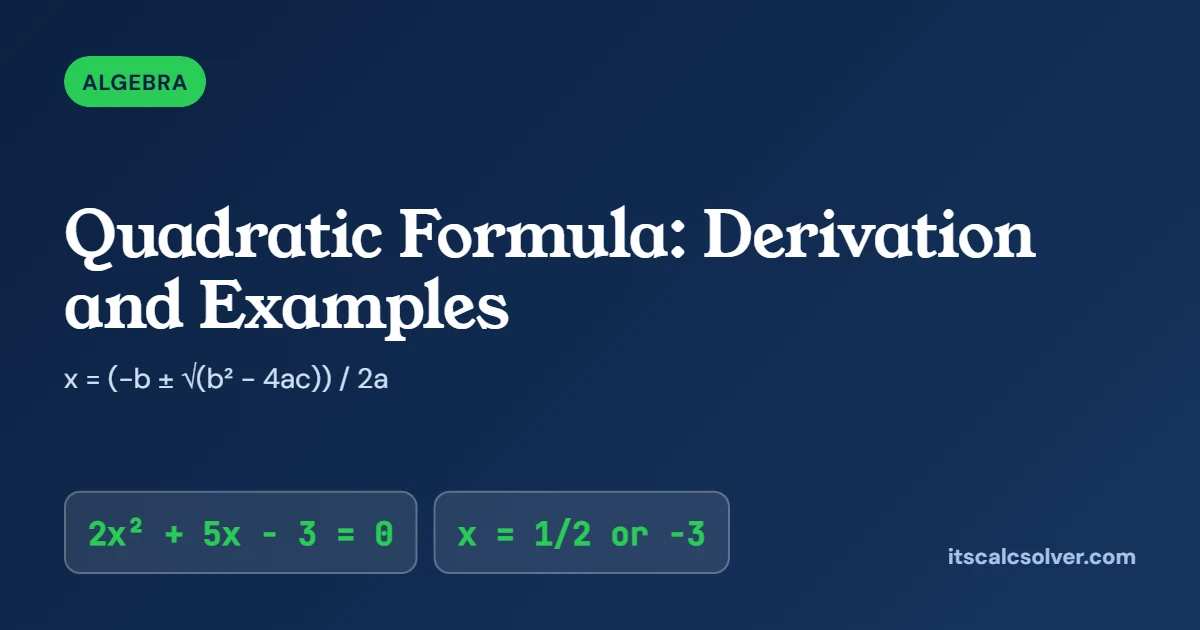
The quadratic formula is x = (−b ± √(b² − 4ac)) / 2a. It gives the solutions of any quadratic equation ax² + bx + c = 0, where a is not 0. Put the three coefficients a, b and c into the formula and you get both roots. The part under the root, b² − 4ac, is the discriminant, and its sign tells you whether there are two real solutions, one, or two complex ones. This guide derives the formula, shows how to use it with worked examples, adds a parabola diagram, a vertex form conversion, practice problems and an FAQ.
In this guide
The Quadratic Formula: Quick Answer
| Item | Answer |
|---|---|
| Equation | ax² + bx + c = 0, with a ≠ 0 |
| Formula | x = (−b ± √(b² − 4ac)) / 2a |
| Discriminant | Δ = b² − 4ac |
| Δ > 0 | Two different real solutions |
| Δ = 0 | One repeated real solution, x = −b/2a |
| Δ < 0 | Two complex solutions (no real solutions) |
Example: for 2x² + 5x − 3 = 0, a = 2, b = 5, c = −3. Then Δ = 25 + 24 = 49 and x = (−5 ± 7) / 4, so x = 1/2 or x = −3.
In short: x = (−b ± √(b² − 4ac)) / 2a. Read off a, b and c, find b² − 4ac, then take both signs.
How to Use the Quadratic Formula
- Write the equation in standard form, ax² + bx + c = 0, with everything on one side and 0 on the other.
- Read off a, b and c, including their signs. If a term is missing its coefficient is 0 (x² − 9 has b = 0).
- Calculate the discriminant Δ = b² − 4ac. Use brackets for negative numbers: (−5)² = 25.
- Substitute into x = (−b ± √Δ) / 2a. The “plus” gives one root and the “minus” gives the other.
- Simplify both answers and check them in the original equation.
Derivation: Where the Quadratic Formula Comes From
The formula comes from completing the square on the general equation ax² + bx + c = 0.
- Divide every term by a: x² + (b/a)x + c/a = 0.
- Move the constant: x² + (b/a)x = −c/a.
- Add (b/2a)² to both sides: x² + (b/a)x + b²/4a² = b²/4a² − c/a.
- The left side is a perfect square: (x + b/2a)² = (b² − 4ac) / 4a².
- Take the square root of both sides: x + b/2a = ± √(b² − 4ac) / 2a.
- Subtract b/2a: x = (−b ± √(b² − 4ac)) / 2a.
The ± appears because both a positive and a negative number square to the same result. The 2a is under the whole expression, so it divides both −b and the square root.
In short: Complete the square on ax² + bx + c = 0 and the result is the quadratic formula.
The Discriminant: How Many Solutions Are There?
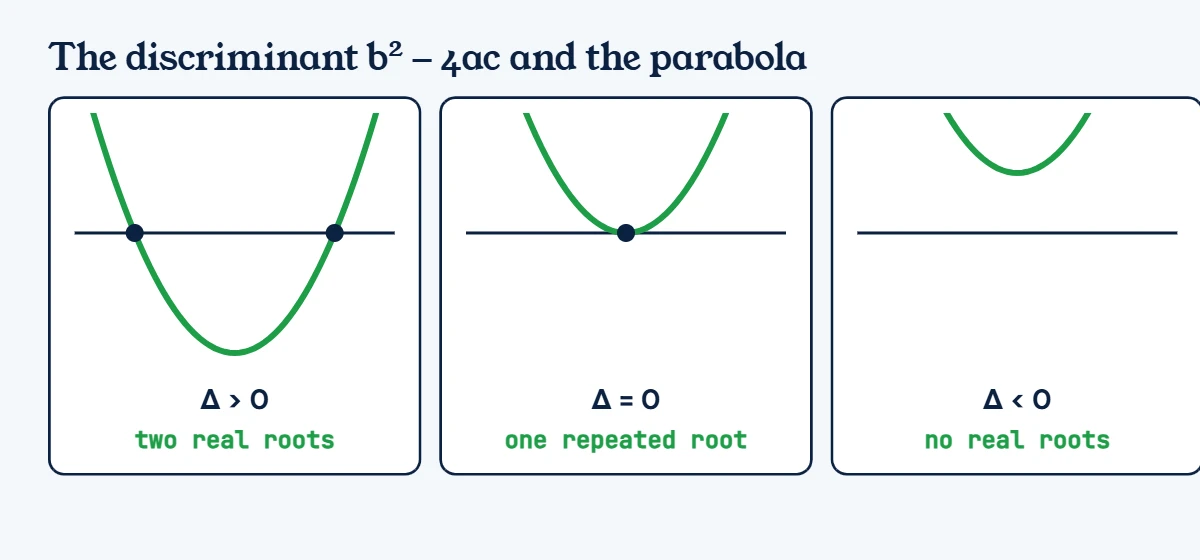
The expression b² − 4ac sits under the square root, so its sign decides what kind of roots you get.
| Discriminant | Roots | Graph of y = ax² + bx + c | Example |
|---|---|---|---|
| Δ > 0 | Two different real roots | Parabola crosses the x-axis twice | x² − 5x + 6 = 0: Δ = 1, x = 2 or 3 |
| Δ = 0 | One repeated real root | Parabola touches the x-axis once | x² − 6x + 9 = 0: Δ = 0, x = 3 |
| Δ < 0 | Two complex roots | Parabola never reaches the x-axis | x² − 4x + 13 = 0: Δ = −36, x = 2 ± 3i |
When a, b and c are rational and Δ is a perfect square, the roots are rational numbers and the equation can be factored over the rationals. In the first row, Δ = 25 − 24 = 1, a perfect square, and x² − 5x + 6 = (x − 2)(x − 3).
In short: Δ > 0: two real roots. Δ = 0: one root. Δ < 0: no real roots.
Diagram: The Discriminant and the Parabola
Worked Examples With Answers
Example 1: Two real roots
Example: 2x² + 5x − 3 = 0. a = 2, b = 5, c = −3. Δ = 5² − 4(2)(−3) = 25 + 24 = 49. x = (−5 ± 7) / 4. So x = 2/4 = 1/2 or x = −12/4 = −3.
Check x = 1/2: 2(1/4) + 5(1/2) − 3 = 0.5 + 2.5 − 3 = 0 ✓.
Example 2: One repeated root
Example: x² − 6x + 9 = 0. a = 1, b = −6, c = 9. Δ = 36 − 36 = 0. x = (6 ± 0) / 2 = 3. It is a perfect square: (x − 3)² = 0.
Example 3: Complex roots
Example: x² − 4x + 13 = 0. a = 1, b = −4, c = 13. Δ = 16 − 52 = −36. √(−36) = 6i. x = (4 ± 6i) / 2 = 2 ± 3i.
Complex roots always come as a conjugate pair, here 2 + 3i and 2 − 3i. The real part is −b/2a = 2 and the imaginary part is √|Δ| / 2a = 3.
Example 4: Irrational roots
Example: x² + 2x − 5 = 0. a = 1, b = 2, c = −5. Δ = 4 + 20 = 24. √24 = 2√6. x = (−2 ± 2√6) / 2 = −1 ± √6, which is about 1.45 or −3.45.
Example 5: Negative leading coefficient
Example: −x² + 4x + 5 = 0. a = −1, b = 4, c = 5. Δ = 16 + 20 = 36. x = (−4 ± 6) / (−2). So x = 2/(−2) = −1 or x = −10/(−2) = 5. Take care with the negative 2a.
Example 6: A real-world use, projectile height
Example: A ball is thrown so that its height in metres after t seconds is h = −5t² + 20t + 25 (a simplified model). When does it hit the ground? Set h = 0: −5t² + 20t + 25 = 0. Divide by −5: t² − 4t − 5 = 0. Δ = 16 + 20 = 36, so t = (4 ± 6) / 2 = 5 or −1. Time cannot be negative, so it lands after 5 seconds.
Equations like these are also covered in how to solve for x, and you can check answers with the solve for x calculator.
Sum and Product of the Roots (Vieta’s Formulas)
For ax² + bx + c = 0 with roots r₁ and r₂, r₁ + r₂ = −b/a and r₁ × r₂ = c/a. This gives a fast check without solving again.
For 2x² + 5x − 3 = 0 the roots are 1/2 and −3. Their sum is 1/2 − 3 = −5/2, and −b/a = −5/2 ✓. Their product is (1/2)(−3) = −3/2, and c/a = −3/2 ✓.
From the Formula to Vertex Form
The turning point (vertex) of y = ax² + bx + c is at h = −b/2a, and k = c − b²/4a is its height. The vertex form is y = a(x − h)² + k.
For y = 2x² + 5x − 3: h = −5/4 and k = −3 − 25/8 = −49/8. So y = 2(x + 5/4)² − 49/8. Expanding confirms it: 2(x² + 5x/2 + 25/16) − 49/8 = 2x² + 5x + 25/8 − 49/8 = 2x² + 5x − 3 ✓. The vertex is at (−5/4, −49/8), and the axis of symmetry is x = −5/4, halfway between the roots 1/2 and −3.
Quadratic Formula, Factoring or Completing the Square?
| Method | Best when | Limit |
|---|---|---|
| Factoring | The numbers are small and Δ is a perfect square | Fails or takes long when roots are irrational |
| Completing the square | You need vertex form or a derivation | Takes more steps |
| Quadratic formula | Always: it works for every quadratic | More arithmetic, so watch the signs |
Learn factoring in factoring polynomials and the structure of these equations in polynomials. The formula is the one method that never fails.
Common Mistakes With the Quadratic Formula
- Forgetting ±. There are usually two roots. Calculate both.
- Dropping the sign on b. If b = −4 then −b = +4. Write −(−4) before simplifying.
- Dividing only the root by 2a. The whole numerator, −b ± √Δ, is divided by 2a.
- Wrong discriminant. b² − 4ac: with a = 1, b = −4, c = 13 it is 16 − 52 = −36, not 16 + 52.
- Using it when a = 0. If a = 0 the equation is linear, not quadratic, and 2a would be zero.
- Not putting the equation in standard form first. Rearrange to ax² + bx + c = 0 before reading a, b and c.
Quadratic Formula Practice Problems (With Answers)
1. Solve x² − 7x + 10 = 0.
x = 2 or x = 5. Δ = 49 − 40 = 9, so x = (7 ± 3) / 2.
2. Solve 3x² − 2x − 1 = 0.
x = 1 or x = −1/3. Δ = 4 + 12 = 16, so x = (2 ± 4) / 6.
3. Solve 4x² − 12x + 9 = 0.
x = 3/2 (repeated). Δ = 144 − 144 = 0, so x = 12/8 = 3/2.
4. Solve x² + 2x + 2 = 0.
x = −1 ± i. Δ = 4 − 8 = −4, so x = (−2 ± 2i) / 2.
5. Solve x² − 16 = 0 using the formula.
x = 4 or x = −4. Here b = 0, so Δ = 64 and x = ± 8 / 2.
6. How many real roots does 5x² + 2x + 1 = 0 have?
None. Δ = 4 − 20 = −16, which is negative.
Quadratic Formula: FAQ
What is the quadratic formula?
The quadratic formula is x = (−b ± √(b² − 4ac)) / 2a. It solves any quadratic equation ax² + bx + c = 0 where a is not zero.
What is the discriminant?
The discriminant is b² − 4ac, the expression under the square root. If it is positive there are two real solutions, if it is zero there is one repeated solution, and if it is negative there are two complex solutions.
Why is there a plus or minus sign?
Both a positive and a negative number give the same square, so taking the square root yields two values. They give the two roots of the equation.
What if a = 0?
Then the equation is linear, bx + c = 0, with the single solution x = −c/b. The quadratic formula does not apply because 2a would be zero.
Can the quadratic formula give an exact answer?
Yes. Keep the square root, as in x = −1 ± √6, for an exact answer. Use a decimal only for the final approximation.
How do I avoid sign errors?
Write a, b and c with their signs, put brackets around negative numbers when squaring and substitute carefully. Then check each root in the original equation.
Sources and Further Reading
- OpenStax, Intermediate Algebra 2e, Section 9.3: Solve Quadratic Equations Using the Quadratic Formula, Rice University.
- Math is Fun, Quadratic Equations.
- Math is Fun, Derivation of Quadratic Formula.
Every value on this page was checked by computer. See also functions in algebra, the remainder theorem, and all algebra guides.
Check your working in seconds
Type any problem from this guide into the free CalcSolver calculator and see the answer, with fractions, instantly.