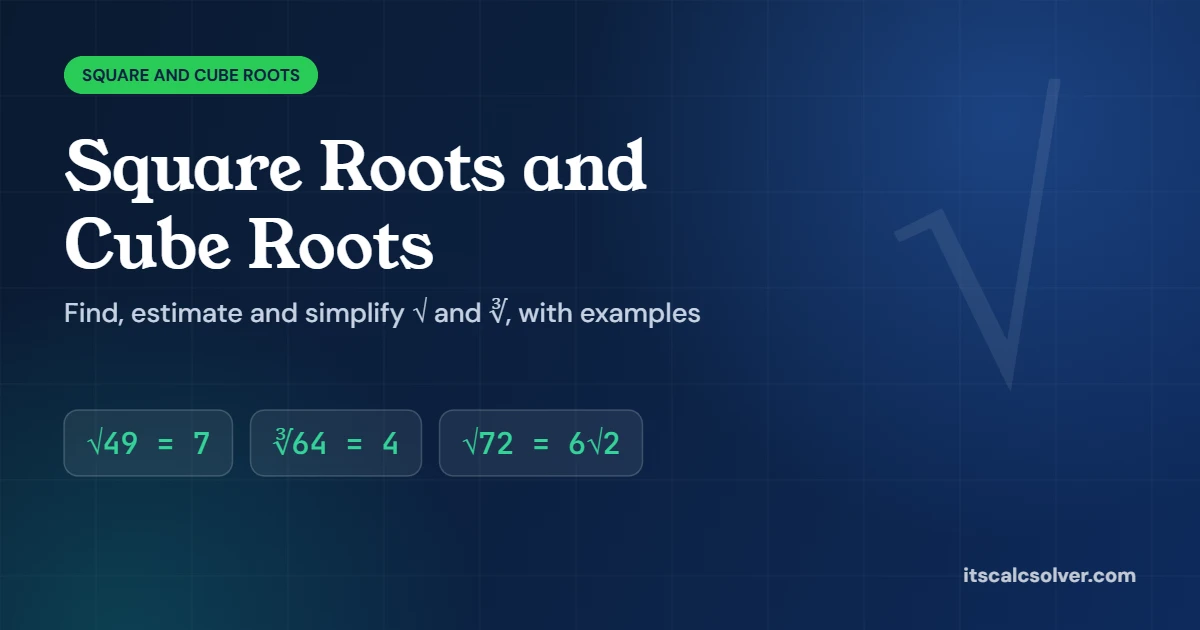
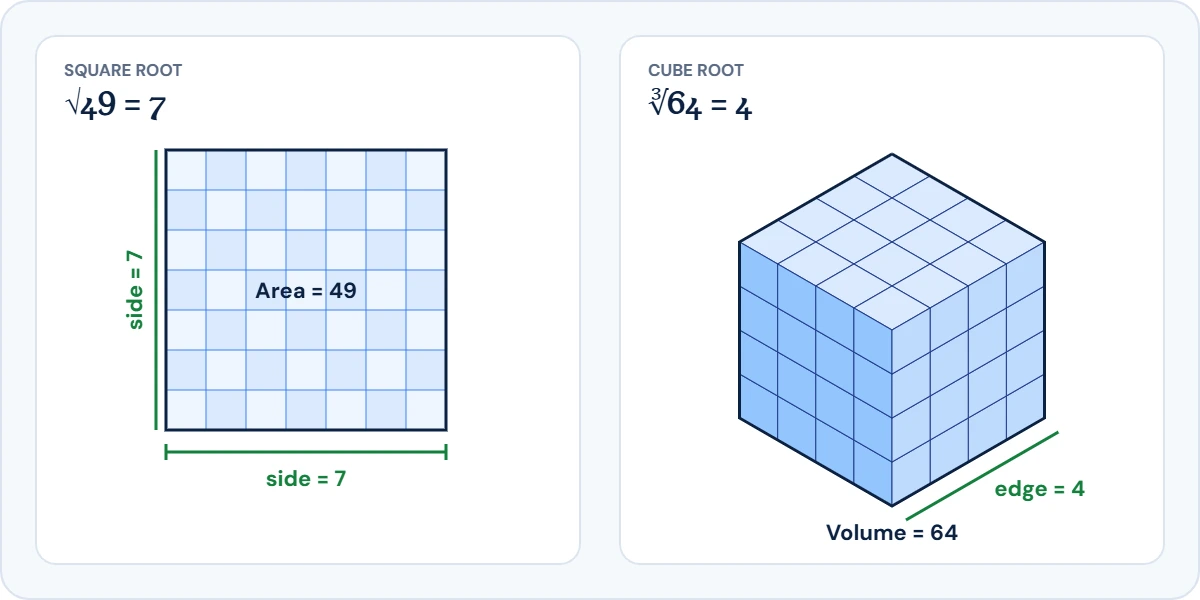
A square root of a number is the value that gives that number when you multiply it by itself, so √49 = 7 because 7 × 7 = 49. A cube root is the value you multiply by itself three times, so ∛64 = 4 because 4 × 4 × 4 = 64. This guide explains both in plain steps: the symbols, perfect squares and cubes, how to estimate a root in your head, how to find one by hand, how to simplify roots like √72, and how to use the √ and ∛ keys on a calculator.
In short: Square root: what number times itself gives n? Cube root: what number used three times gives n? √49 = 7 and ∛64 = 4. Negative numbers have no real square root, but they do have a cube root: ∛(−8) = −2.
In this guide
What Is a Square Root?
Squaring a number means multiplying it by itself: 7² = 7 × 7 = 49. The square root undoes that. It asks: which number, multiplied by itself, gives this number? The symbol is the radical sign √, so √49 = 7.
Every positive number has two square roots, one positive and one negative, because 7 × 7 = 49 and (−7) × (−7) = 49 too. The √ sign always means the positive one, called the principal square root. When you need both, write ±: the solutions of x² = 49 are x = ±7.
A negative number has no real square root. No real number times itself gives −49, because a positive times a positive and a negative times a negative are both positive.
In short: √n is the positive number that squares to n. Positive numbers have two square roots (±), zero has one (0), and negative numbers have none among the real numbers.
What Is a Cube Root?
Cubing a number means using it three times in a multiplication: 4³ = 4 × 4 × 4 = 64. The cube root undoes that, and its symbol is ∛. So ∛64 = 4.
Unlike square roots, cube roots work for negative numbers. A negative number used three times stays negative: (−2) × (−2) × (−2) = −8, so ∛(−8) = −2. Every real number has exactly one real cube root.
In short: ∛n is the number that, used three times in a multiplication, gives n. Cube roots of negative numbers are negative, so ∛(−27) = −3.
Square Root vs Cube Root
| Square root | Cube root | |
|---|---|---|
| Question it answers | What times itself gives n? | What used three times gives n? |
| Symbol | √n | ∛n |
| Exponent form | n1/2 | n1/3 |
| Example | √81 = 9 | ∛27 = 3 |
| Negative numbers | No real square root | Allowed: ∛(−27) = −3 |
| How many real roots | Two for positive n (±) | Always exactly one |
| Geometry | Side of a square from its area | Edge of a cube from its volume |
Perfect Squares and Perfect Cubes
A perfect square is a whole number whose square root is also a whole number, like 1, 4, 9 and 16. A perfect cube has a whole-number cube root, like 1, 8, 27 and 64. Learning these makes estimating and simplifying much faster.
| Perfect squares 1–10 | Perfect squares 11–20 | Perfect cubes 1–10 |
|---|---|---|
| √1 = 1 | √121 = 11 | ∛1 = 1 |
| √4 = 2 | √144 = 12 | ∛8 = 2 |
| √9 = 3 | √169 = 13 | ∛27 = 3 |
| √16 = 4 | √196 = 14 | ∛64 = 4 |
| √25 = 5 | √225 = 15 | ∛125 = 5 |
| √36 = 6 | √256 = 16 | ∛216 = 6 |
| √49 = 7 | √289 = 17 | ∛343 = 7 |
| √64 = 8 | √324 = 18 | ∛512 = 8 |
| √81 = 9 | √361 = 19 | ∛729 = 9 |
| √100 = 10 | √400 = 20 | ∛1000 = 10 |
A quick check: a perfect square never ends in 2, 3, 7 or 8. So 1,000,002 or 47 cannot be perfect squares, which saves you trying.
How to Estimate a Square Root or Cube Root
You can get a good estimate without a calculator by finding the two perfect squares on either side of the number.
- Find the perfect squares around it. 50 is between 49 (7²) and 64 (8²), so √50 is between 7 and 8.
- See how far along it is. 50 is 1 step past 49, out of 15 steps to 64.
- Add that fraction. √50 ≈ 7 + 1/15 ≈ 7.07. The exact value is 7.0711…
Example: Estimate ∛30 → it is between ∛27 = 3 and ∛64 = 4. 30 is 3 steps past 27, out of 37 steps to 64, so ∛30 ≈ 3 + 3/37 ≈ 3.08. The exact value is 3.107…, so the estimate is close.
This estimate is always a little low for square and cube roots, because the gaps between perfect squares and cubes grow as the numbers get bigger. It is still close enough to catch a wrong calculator entry.
In short: Box the number between two perfect squares or cubes, then add how far along it is. √50 ≈ 7.07, and the real answer is 7.071.
How to Find a Square Root or Cube Root by Hand
Method 1: Prime factorization (for perfect squares and cubes)
Break the number into prime factors, then group them. For a square root take one factor from each pair; for a cube root take one from each group of three.
Example: √784 → 784 = 2 × 2 × 2 × 2 × 7 × 7. That is two pairs of 2 and one pair of 7, so √784 = 2 × 2 × 7 = 28.
Example: ∛1728 → 1728 = 2 × 2 × 2 × 2 × 2 × 2 × 3 × 3 × 3. That is two groups of three 2s and one group of three 3s, so ∛1728 = 2 × 2 × 3 = 12.
Method 2: Divide and average (for any square root)
This old method, sometimes called the Babylonian method, gets more accurate with every round:
- Make a guess, g.
- Divide the number by your guess.
- Average the guess and the result: (g + n ÷ g) ÷ 2. That is your new guess.
- Repeat until the guess stops changing.
Example: √10 → guess 3. Round 1: (3 + 10 ÷ 3) ÷ 2 = 3.1667. Round 2: (3.1667 + 10 ÷ 3.1667) ÷ 2 = 3.1623. A calculator gives 3.16228, so two rounds already match to four decimal places.
In short: Use prime factors for perfect squares and cubes. For any other square root, divide and average: two or three rounds give four correct decimal places.
How to Simplify Square Roots
A square root is in simplest form when no perfect square divides the number under the √ sign. To simplify, use the product rule: √(a × b) = √a × √b for numbers that are 0 or more.
- Find the largest perfect square that divides the number.
- Split the root into two roots.
- Take the square root of the perfect square and write it in front.
| Root | Split | Simplified |
|---|---|---|
| √50 | √25 × √2 | 5√2 |
| √72 | √36 × √2 | 6√2 |
| √48 | √16 × √3 | 4√3 |
| √200 | √100 × √2 | 10√2 |
| ∛54 | ∛27 × ∛2 | 3∛2 |
| ∛16 | ∛8 × ∛2 | 2∛2 |
Cube roots simplify the same way, using perfect cubes (8, 27, 64, 125…) instead of perfect squares. Simplified roots show up all the time in the quadratic formula, where answers like x = 1 ± √2 are normal.
In short: Pull the largest perfect square out of the root: √72 = √36 × √2 = 6√2. For cube roots, pull out perfect cubes: ∛54 = 3∛2.
Square Roots of Fractions and Decimals
For a fraction, take the root of the top and the bottom separately: √(a/b) = √a ÷ √b.
| Problem | Working | Answer |
|---|---|---|
| √(9/16) | √9 ÷ √16 = 3 ÷ 4 | 3/4 |
| ∛(8/27) | ∛8 ÷ ∛27 = 2 ÷ 3 | 2/3 |
| √0.25 | √(25/100) = 5 ÷ 10 | 0.5 |
| √0.09 | √(9/100) = 3 ÷ 10 | 0.3 |
| ∛0.001 | ∛(1/1000) = 1 ÷ 10 | 0.1 |
Notice that the square root of a number between 0 and 1 is bigger than the number: √0.25 = 0.5. That surprises many people, but 0.5 × 0.5 really is 0.25.
How to Find Square Roots and Cube Roots on a Calculator
On the free CalcSolver calculator, press the √ key, type the number and close the bracket: √(144) gives 12. For a cube root, use the ∛ key: ∛(125) gives 5. You can also use powers, because a square root is a power of 1/2 and a cube root is a power of 1/3: 125^(1/3) also gives 5.
For a negative cube root, type ∛(−8) and you get −2. Typing √(−9) gives a message that the square root of a negative is not real, which is the correct answer for real numbers.
| Where | Square root | Cube root |
|---|---|---|
| CalcSolver calculator | √(144) | ∛(125) or 125^(1/3) |
| Excel | =SQRT(144) | =125^(1/3) |
| Phone calculator (scientific mode) | √x key | ∛x key if it has one, or x^y with 1/3 |
One Excel trap: =(-8)^(1/3) returns a #NUM! error instead of −2. Work out the cube root of 8, then add the minus sign yourself.
Roots also have a fixed place in the order of operations: they count as exponents, so they are worked out before multiplication. In 2√9, find √9 = 3 first, then multiply to get 6.
Common Mistakes With Square Roots and Cube Roots
- Splitting a root over addition. √(9 + 16) is √25 = 5, not √9 + √16 = 7. The product rule works for multiplication only.
- Forgetting the ± when solving. x² = 25 has two answers, x = 5 and x = −5. The √ sign alone gives only 5.
- Taking the square root of a negative. √(−9) is not a real number. ∛(−27) = −3 is fine, because cube roots allow negatives.
- Mixing up √x² and (√x)². √((−5)²) = √25 = 5, so √(x²) = |x|, the absolute value.
- Confusing the root with halving. √16 is 4, not 8. Halving and square-rooting give the same answer only for 0 and 4.
Practice Problems (With Answers)
Try each one in your head or on paper, then open it to check. You can confirm every answer on the CalcSolver calculator.
1. √169
13, because 13 × 13 = 169.
2. ∛343
7, because 7 × 7 × 7 = 343.
3. Simplify √98
7√2. 98 = 49 × 2, and √49 = 7.
4. Estimate √30 to two decimal places
About 5.45. 30 is between 25 and 36, and it is 5 of the 11 steps along, so 5 + 5/11 ≈ 5.45. The exact value is 5.477…
5. ∛(−125)
−5, because (−5) × (−5) × (−5) = −125.
6. √(49/64)
7/8. Take √49 = 7 on top and √64 = 8 underneath.
Square Roots and Cube Roots: FAQ
What is the square root of 2?
The square root of 2 is about 1.41421356. It is an irrational number, so its decimals go on forever without repeating, and it cannot be written as an exact fraction.
Can you take the square root of a negative number?
Not with real numbers. No real number multiplied by itself gives a negative result. In more advanced math, √(−1) is defined as the imaginary number i, so √(−9) = 3i.
Can you take the cube root of a negative number?
Yes. A negative number used three times in a multiplication stays negative, so every negative number has a negative cube root. For example, ∛(−64) = −4.
What is the difference between a square root and a cube root?
A square root is the number that gives n when multiplied by itself once, as in √36 = 6. A cube root is the number that gives n when used three times, as in ∛216 = 6.
How do you find a square root without a calculator?
For a perfect square, use prime factors and take one from each pair. For any other number, estimate it between two perfect squares, then improve the guess with the divide-and-average method.
What is the cube root of 27?
The cube root of 27 is 3, because 3 × 3 × 3 = 27.
Sources and Further Reading
- OpenStax, Elementary Algebra 2e, Section 9.1: Simplify and Use Square Roots, Rice University.
- OpenStax, Elementary Algebra, Section 9.2: Simplify Square Roots, Rice University.
- OpenStax, Intermediate Algebra 2e, Section 8.1: Simplify Expressions with Roots, Rice University.
Every answer in this guide was checked on the CalcSolver calculator. Keep going with our mental math tricks, including the quick way to square numbers that end in 5, or see how roots solve equations in the solve for x calculator.
Check your working in seconds
Type any problem from this guide into the free CalcSolver calculator and see the answer, with fractions, instantly.