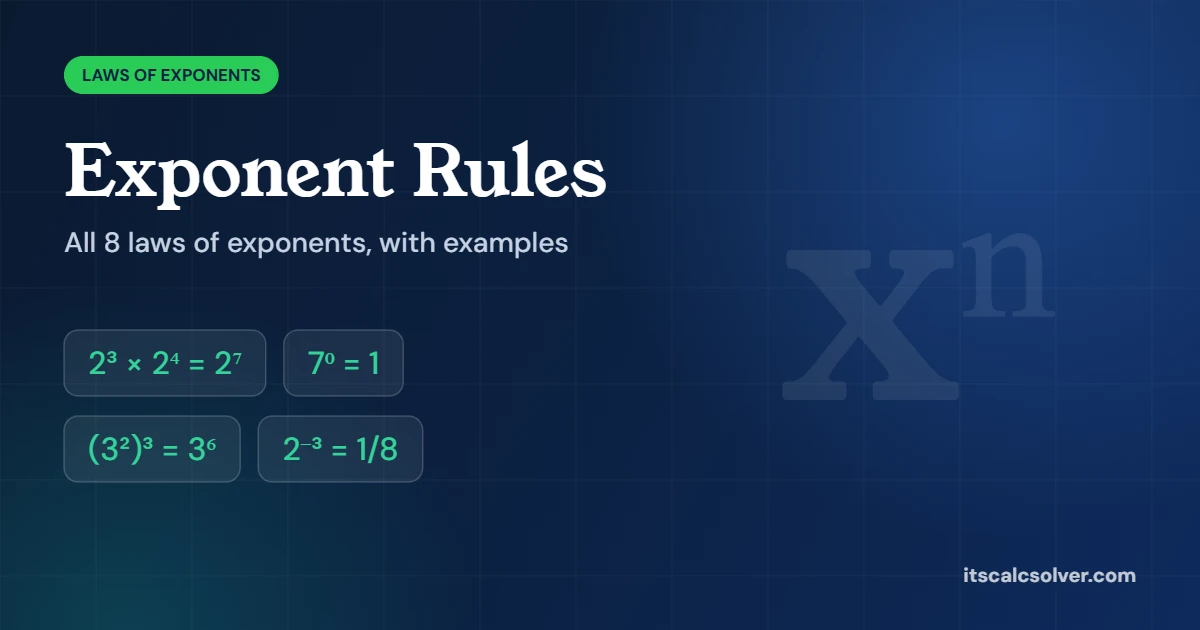
Exponent rules, also called the laws of exponents, are shortcuts for multiplying, dividing and raising powers without writing out every factor. There are eight of them: the product rule, quotient rule, power of a power, power of a product, power of a quotient, zero exponent, negative exponent and fractional exponent rules. This guide lists all eight in one table, shows why each one works, and gives worked examples, common mistakes and practice problems with answers.
In short: Multiply powers with the same base: add the exponents. Divide them: subtract. Raise a power to a power: multiply. Any nonzero number to the power 0 is 1, and a negative exponent means “one over”: 2⁻³ = 1/8.
In this guide
What Is an Exponent?
An exponent tells you how many times to use a number in a multiplication. In 2⁵, the base is 2 and the exponent (or power) is 5, so 2⁵ = 2 × 2 × 2 × 2 × 2 = 32. You read it as “2 to the power of 5” or “2 to the fifth”.
The same idea works with letters: x³ means x × x × x. That is why exponent rules matter so much in algebra, from simplifying algebraic expressions to finding the degree of polynomials.
The 8 Exponent Rules (Laws of Exponents)
Each rule assumes the bases are the same and are not zero where you would divide by them.
| Rule | Formula | Example |
|---|---|---|
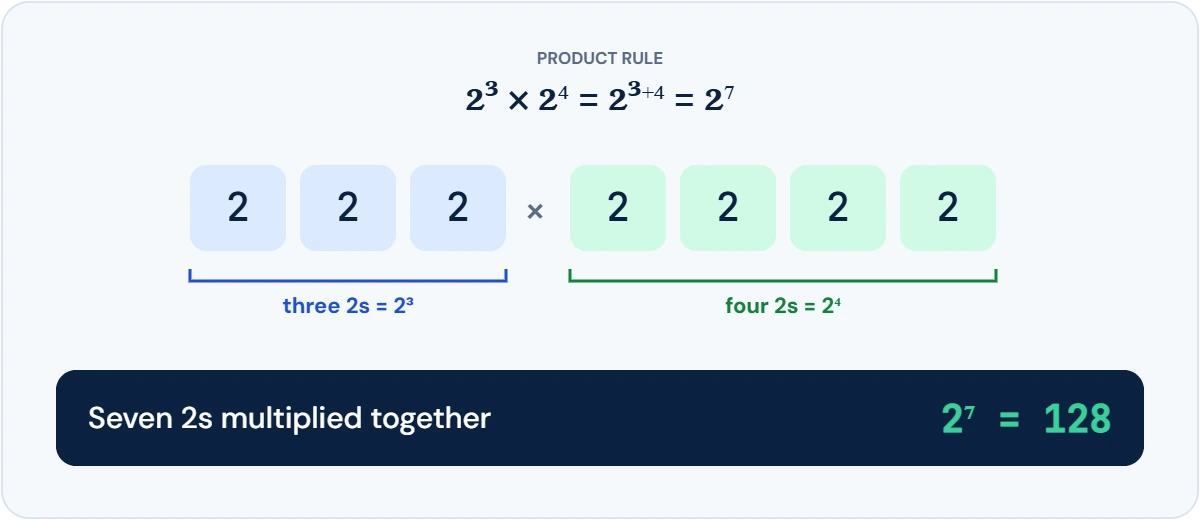
| 1. Product rule | aᵐ × aⁿ = aᵐ⁺ⁿ | 2³ × 2⁴ = 2⁷ = 128 |
| 2. Quotient rule | aᵐ ÷ aⁿ = aᵐ⁻ⁿ | 5⁶ ÷ 5⁴ = 5² = 25 |
| 3. Power of a power | (aᵐ)ⁿ = aᵐⁿ | (3²)³ = 3⁶ = 729 |
| 4. Power of a product | (ab)ⁿ = aⁿbⁿ | (2x)³ = 8x³ |
| 5. Power of a quotient | (a/b)ⁿ = aⁿ/bⁿ | (2/3)² = 4/9 |
| 6. Zero exponent | a⁰ = 1, for a ≠ 0 | 7⁰ = 1 |
| 7. Negative exponent | a⁻ⁿ = 1/aⁿ | 2⁻³ = 1/8 |
| 8. Fractional exponent | am/n = (ⁿ√a)ᵐ | 82/3 = (∛8)² = 4 |
In short: Same base, multiply: add the exponents. Same base, divide: subtract. Power of a power: multiply. a⁰ = 1, a⁻ⁿ = 1/aⁿ and am/n is a root.
Each Exponent Rule Explained
1. Product rule: add the exponents
When you multiply powers with the same base, add the exponents: x⁴ × x³ = x⁷. It works because you are just counting factors: four x’s and three x’s make seven.
2. Quotient rule: subtract the exponents
When you divide powers with the same base, subtract the bottom exponent from the top one: y⁹ ÷ y⁴ = y⁵. Four of the y’s on top cancel with the four underneath, leaving five.
3. Power of a power: multiply the exponents
(m³)⁴ means m³ used four times: m³ × m³ × m³ × m³ = m¹². So multiply: 3 × 4 = 12.
4. Power of a product: share the exponent
An exponent outside brackets applies to every factor inside: (3a²b)² = 3² × (a²)² × b² = 9a⁴b². Forgetting to square the 3 is one of the most common slips.
5. Power of a quotient: top and bottom
The same goes for fractions: (x/5)³ = x³/125. Raise the top and the bottom to the power.
6. Zero exponent: always 1
Any nonzero number to the power 0 equals 1: 7⁰ = 1, (−4)⁰ = 1 and x⁰ = 1. The next section shows why.
7. Negative exponent: flip it
A negative exponent means “one over the positive power”: 4⁻² = 1/4² = 1/16. A negative exponent does not make the answer negative. It also flips back: 1/x⁻³ = x³.
8. Fractional exponent: a root
The bottom of the fraction is a root and the top is a power: 272/3 = (∛27)² = 3² = 9. So x1/2 is the square root of x and x1/3 is the cube root. Taking the root first keeps the numbers small.
Why Is Any Number to the Power of 0 Equal to 1?
Look at the pattern. Each time the exponent drops by 1, the answer is divided by 2:
| Power | 2³ | 2² | 2¹ | 2⁰ | 2⁻¹ | 2⁻² |
|---|---|---|---|---|---|---|
| Value | 8 | 4 | 2 | 1 | 1/2 | 1/4 |
Continuing the pattern gives 2⁰ = 1, and going further explains negative exponents too. The quotient rule says the same thing: 5³ ÷ 5³ = 5⁰, and anything divided by itself is 1.
The one exception is 0⁰. Most algebra textbooks treat it as undefined, because 0⁰ would mean 0 ÷ 0. Some calculators and programming languages return 1 for convenience.
In short: a⁰ = 1 because each step down in the exponent divides by the base, and a³ ÷ a³ must equal 1. Only 0⁰ is left undefined.
How to Simplify Using Several Exponent Rules
Real problems mix the rules. Work in this order: expand brackets with the power rules, then combine like bases with the product and quotient rules, then rewrite negative exponents.
Example: Simplify (2x³y⁻²)² × x⁻¹ ÷ (4x²). Power of a product: 4x⁶y⁻⁴. Multiply by x⁻¹: 4x⁵y⁻⁴. Divide by 4x²: x³y⁻⁴. Rewrite the negative exponent: x³/y⁴.
Example: Simplify (a⁴b)³ ÷ (a²b⁵). Power of a product: a¹²b³. Quotient rule: a¹²⁻²b³⁻⁵ = a¹⁰b⁻². Final answer: a¹⁰/b².
Check an answer by picking numbers. With x = 2 and y = 3, both (2x³y⁻²)² × x⁻¹ ÷ (4x²) and x³/y⁴ equal 8/81, so the simplification is right.
How to Use Exponents on a Calculator
On the CalcSolver calculator, use the xʸ key or type ^: 2^10 gives 1024. Brackets matter in two places:
- Fractional exponents need brackets. Type
8^(2/3)to get 4. Typing8^2/3gives 64 ÷ 3 = 21.33, a different problem. - Negative bases need brackets.
(−2)^4is 16, but−2^4is −16, because the exponent is worked out before the minus sign, following the order of operations.
Common Mistakes With Exponent Rules
- Adding exponents when the bases differ. 2³ × 3² is 8 × 9 = 72. You cannot combine it into one power.
- Adding exponents when you add powers. 2³ + 2⁴ = 8 + 16 = 24, not 2⁷ = 128. The product rule is for multiplication only.
- Multiplying the bases. 2³ × 2⁴ is 2⁷, not 4⁷. Keep the base and add the exponents.
- Spreading an exponent over addition. (a + b)² is a² + 2ab + b², not a² + b². The power-of-a-product rule only works for multiplication.
- Reading a negative exponent as a negative answer. 2⁻³ = 1/8, which is positive.
Exponent Rules Practice Problems (With Answers)
Simplify each one, then open it to check. You can test the number problems on the CalcSolver calculator.
1. x⁵ × x³
x⁸. Product rule: 5 + 3 = 8.
2. y⁹ ÷ y⁴
y⁵. Quotient rule: 9 − 4 = 5.
3. (m³)⁴
m¹². Power of a power: 3 × 4 = 12.
4. 4⁻²
1/16. Negative exponent: 1/4² = 1/16.
5. 272/3
9. Take the cube root first, ∛27 = 3, then square it: 3² = 9.
6. (3a²b)²
9a⁴b². Square every factor: 3² = 9, (a²)² = a⁴ and b².
Exponent Rules: FAQ
What are the 8 exponent rules?
The product rule (add exponents), quotient rule (subtract exponents), power of a power (multiply exponents), power of a product, power of a quotient, zero exponent (a⁰ = 1), negative exponent (a⁻ⁿ = 1/aⁿ) and fractional exponent (a to the m/n is the nth root of a, raised to the power m).
Why is a number to the power of 0 equal to 1?
Because aⁿ ÷ aⁿ = aⁿ⁻ⁿ = a⁰, and any nonzero number divided by itself is 1. The pattern 2³ = 8, 2² = 4, 2¹ = 2, 2⁰ = 1 shows the same thing.
What does a negative exponent mean?
A negative exponent means one over the positive power. For example, 5⁻² = 1/5² = 1/25. It makes the number smaller, not negative.
What is 0 to the power of 0?
Most algebra courses treat 0⁰ as undefined, because it would mean dividing 0 by 0. Some calculators and programming languages return 1 for convenience.
How do you multiply exponents with different bases?
If the exponents are the same, multiply the bases and keep the exponent: 2³ × 5³ = 10³ = 1000. If the bases and the exponents are both different, work out each power first: 2³ × 3² = 8 × 9 = 72.
What is the difference between (−2)⁴ and −2⁴?
(−2)⁴ means −2 used four times, which is 16. −2⁴ means the negative of 2⁴, which is −16. The brackets decide whether the minus sign is part of the base.
Sources and Further Reading
- OpenStax, College Algebra 2e, Section 1.2: Exponents and Scientific Notation, Rice University.
- OpenStax, College Algebra 2e, Section 1.3: Radicals and Rational Exponents, Rice University.
Every example in this guide was checked on the CalcSolver calculator. For all the other formulas in one place, see the basic algebra formulas cheat sheet, or start from the algebra basics guide.
Check your working in seconds
Type any problem from this guide into the free CalcSolver calculator and see the answer, with fractions, instantly.