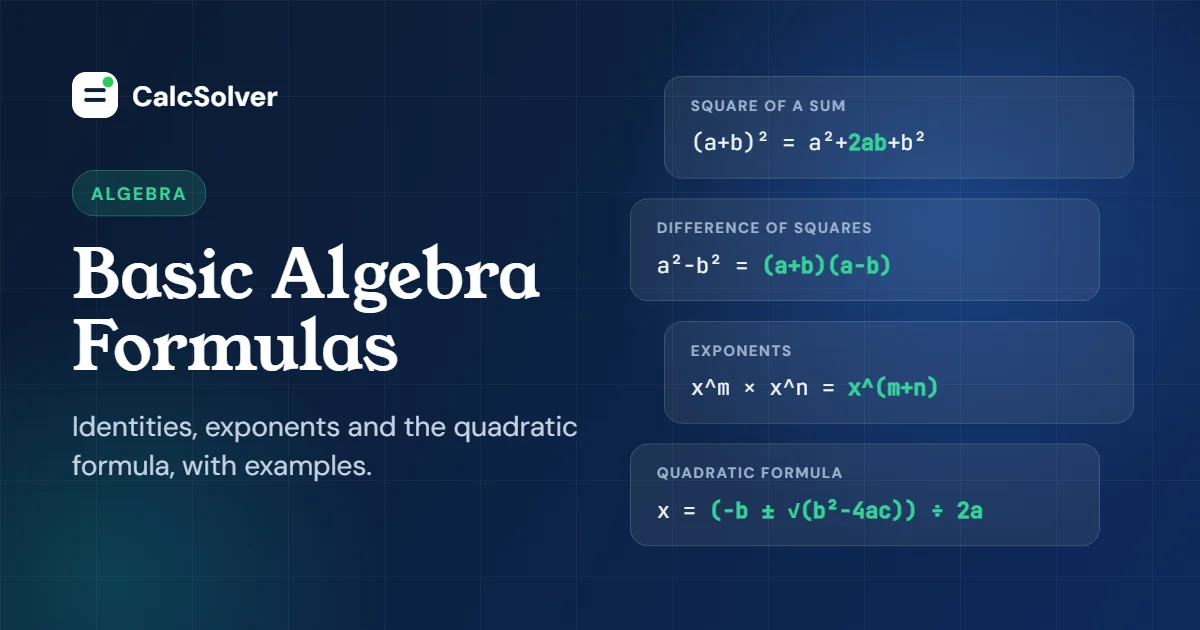
Basic algebra formulas are the short rules you use again and again: the algebraic identities such as (a + b)² = a² + 2ab + b², the laws of exponents, the properties of operations, the linear equation rule and the quadratic formula. This page lists every formula in one cheat sheet and then explains each group with worked examples, the conditions that apply, and the mistakes to avoid.
In this guide
Basic Algebra Formulas Cheat Sheet
Here are the formulas you will meet most often in school algebra. Each group has its own section below with examples.
| Group | Formula | Example |
|---|---|---|
| Square of a sum | (a + b)² = a² + 2ab + b² | (x + 5)² = x² + 10x + 25 |
| Square of a difference | (a − b)² = a² − 2ab + b² | (2x − 3)² = 4x² − 12x + 9 |
| Difference of squares | a² − b² = (a + b)(a − b) | x² − 36 = (x + 6)(x − 6) |
| Cube of a sum | (a + b)³ = a³ + 3a²b + 3ab² + b³ | (x + 2)³ = x³ + 6x² + 12x + 8 |
| Cube of a difference | (a − b)³ = a³ − 3a²b + 3ab² − b³ | (x − 1)³ = x³ − 3x² + 3x − 1 |
| Sum of cubes | a³ + b³ = (a + b)(a² − ab + b²) | x³ + 8 = (x + 2)(x² − 2x + 4) |
| Difference of cubes | a³ − b³ = (a − b)(a² + ab + b²) | x³ − 27 = (x − 3)(x² + 3x + 9) |
| Distributive property | a(b + c) = ab + ac | 3(x + 4) = 3x + 12 |
| Product rule (exponents) | aᵐ × aⁿ = aᵐ⁺ⁿ | x³ × x⁴ = x⁷ |
| Quotient rule (exponents) | aᵐ ÷ aⁿ = aᵐ⁻ⁿ (a ≠ 0) | x⁸ ÷ x³ = x⁵ |
| Power rule (exponents) | (aᵐ)ⁿ = aᵐⁿ | (x²)⁵ = x¹⁰ |
| Zero and negative exponents | a⁰ = 1 (a ≠ 0), a⁻ⁿ = 1/aⁿ | 2⁻³ = 1/8 |
| Linear equation | ax + b = 0 gives x = −b/a (a ≠ 0) | 3x + 12 = 0 gives x = −4 |
| Quadratic formula | x = (−b ± √(b² − 4ac)) ÷ 2a | x² − 5x + 6 = 0 gives x = 2 or 3 |
| Slope | m = (y₂ − y₁) ÷ (x₂ − x₁) | (1, 2) to (3, 8): m = 3 |
In short: Learn the three squares and cubes patterns, the exponent laws, and the quadratic formula first. They cover most of what school algebra asks.
Algebraic Identities (Special Products)
An algebraic identity is an equation that is true for every value of its variables. The identities below are also called special products, because they give the answer to a common multiplication without expanding it term by term. Read them from left to right to expand, and from right to left to factor.
Square of a sum and a difference
Square the first term, square the last term, and add twice their product in the middle.
Example: (x + 5)² = x² + 2(x)(5) + 5² = x² + 10x + 25.
Example: (2x − 3)² = (2x)² − 2(2x)(3) + 3² = 4x² − 12x + 9.
Difference of squares
Two brackets that differ only in the middle sign multiply to a difference of squares, and the middle terms cancel.
Example: (x + 6)(x − 6) = x² − 36. The same idea makes mental math easy: 49 × 51 = (50 − 1)(50 + 1) = 2500 − 1 = 2499. See more shortcuts in our mental math tricks.
Cubes
The cube of a binomial has four terms with the coefficients 1, 3, 3, 1. The sum and difference of cubes factor into a binomial and a trinomial, and the signs follow the pattern same, opposite, always positive.
Example: (x + 2)³ = x³ + 3(x²)(2) + 3(x)(4) + 8 = x³ + 6x² + 12x + 8.
Example: x³ − 27 = (x − 3)(x² + 3x + 9).
In short: Squares add or subtract a middle term of 2ab. A difference of squares has no middle term. Cubes use the coefficients 1, 3, 3, 1, and the sum or difference of cubes factors using same, opposite, always positive.
Why (a + b)² Is Not a² + b²: The Area Model
The most common algebra mistake is writing (a + b)² = a² + b². A picture shows why it is wrong. A square with side a + b is made of four parts: a square of area a², a square of area b², and two rectangles of area ab. Those two rectangles are the middle term 2ab.
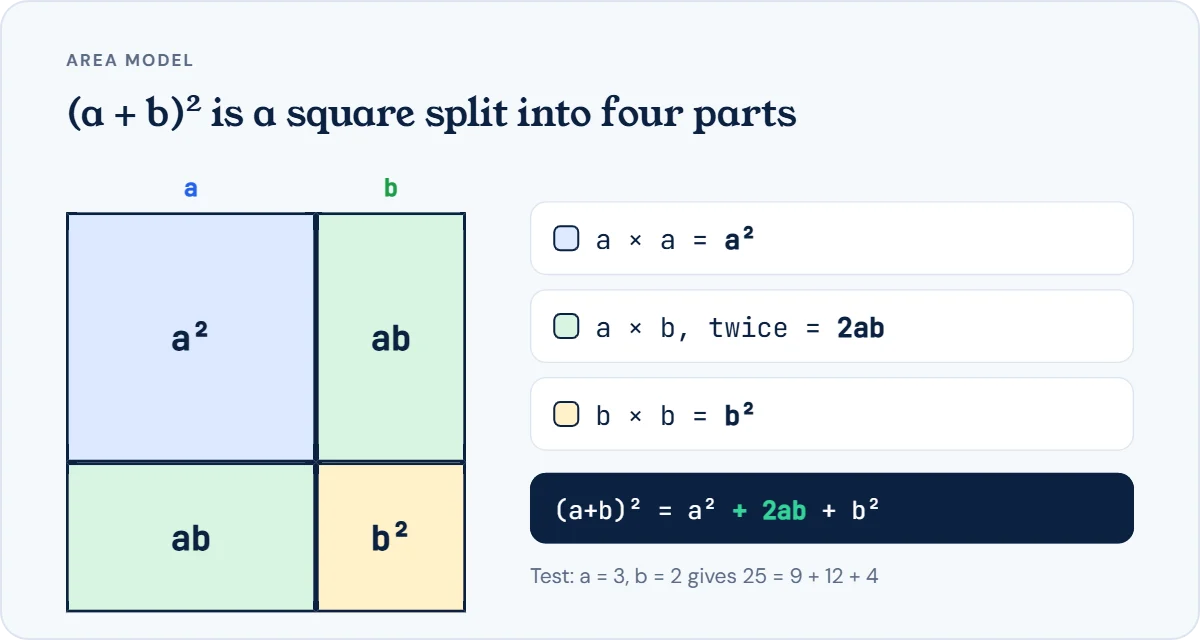
Check it with numbers. For a = 3 and b = 2, (3 + 2)² = 25, while a² + b² = 9 + 4 = 13. The missing 12 is exactly 2ab = 2 × 3 × 2.
Properties of Operations
| Property | Rule | Example |
|---|---|---|
| Commutative (addition) | a + b = b + a | x + 5 = 5 + x |
| Commutative (multiplication) | a × b = b × a | 3 × x = x × 3 |
| Associative (addition) | (a + b) + c = a + (b + c) | (x + 2) + 3 = x + (2 + 3) |
| Associative (multiplication) | (a × b) × c = a × (b × c) | (2 × x) × 4 = 2 × (x × 4) = 8x |
| Distributive | a(b + c) = ab + ac | 5(x + 2) = 5x + 10 |
| Identity | a + 0 = a and a × 1 = a | x + 0 = x |
| Inverse | a + (−a) = 0 and a × (1/a) = 1 | x + (−x) = 0 |
These properties are why you can reorder and regroup terms when you simplify an algebraic expression. Note that subtraction and division are not commutative: 5 − 2 is not 2 − 5.
In short: You can reorder and regroup in addition and multiplication, but not in subtraction or division. The distributive property links multiplication with addition.
Laws of Exponents
| Law | Rule | Example |
|---|---|---|
| Product | aᵐ × aⁿ = aᵐ⁺ⁿ | x³ × x⁴ = x⁷ |
| Quotient | aᵐ ÷ aⁿ = aᵐ⁻ⁿ (a ≠ 0) | x⁸ ÷ x³ = x⁵ |
| Power of a power | (aᵐ)ⁿ = aᵐⁿ | (x²)⁵ = x¹⁰ |
| Power of a product | (ab)ⁿ = aⁿbⁿ | (2x)³ = 8x³ |
| Power of a quotient | (a/b)ⁿ = aⁿ/bⁿ (b ≠ 0) | (x/3)² = x²/9 |
| Zero exponent | a⁰ = 1 (a ≠ 0) | 5⁰ = 1 |
| Negative exponent | a⁻ⁿ = 1/aⁿ (a ≠ 0) | 2⁻³ = 1/8 |
| Fractional exponent | a^(m/n) = (ⁿ√a)ᵐ | 8^(2/3) = 2² = 4 |
Two rules cause most of the errors. First, you add exponents when you multiply powers of the same base, but you multiply exponents when you raise a power to a power. Second, the rules need the same base: 2³ × 3⁴ cannot be combined.
Example: 2⁵ × 2³ = 2⁸ = 256, and (x³)⁴ = x¹².
In short: Same base, multiply: add the exponents. Same base, divide: subtract them. Power of a power: multiply them. Anything (except 0) to the power 0 is 1, and a negative exponent means a reciprocal.
Linear Equation Formula
Any equation that can be written as ax + b = 0 with a ≠ 0 has exactly one solution: x = −b/a. This comes from subtracting b from both sides and then dividing by a.
Example: 3x + 12 = 0 gives x = −12/3 = −4. Check: 3(−4) + 12 = 0. ✓
If a = 0, the formula breaks. The equation 0x + b = 0 has no solution when b ≠ 0, and every number is a solution when b = 0. For the full method with fractions and brackets, read how to solve for x.
Quadratic Formula
A quadratic equation has the form ax² + bx + c = 0 with a ≠ 0. Its solutions are given by the quadratic formula:
x = (−b ± √(b² − 4ac)) ÷ 2a
The part under the root, D = b² − 4ac, is the discriminant. It tells you how many real solutions to expect before you finish.
| Discriminant | Real solutions | Example |
|---|---|---|
| D > 0 | Two different | x² − 5x + 6 = 0: D = 1, so x = 2 or 3 |
| D = 0 | One (repeated) | x² − 6x + 9 = 0: D = 0, so x = 3 |
| D < 0 | None | x² + 2x + 5 = 0: D = −16, no real solution |
Example: 2x² + 3x − 2 = 0. Here a = 2, b = 3, c = −2, so D = 9 + 16 = 25 and x = (−3 ± 5) ÷ 4. That gives x = 1/2 or x = −2.
Use the solve for x calculator to check a quadratic: it shows the discriminant and every step.
In short: Write the equation as ax² + bx + c = 0, find a, b and c, then work out D = b² − 4ac. If D is negative there are no real solutions; otherwise put it in the formula.
Slope, Midpoint and Distance Formulas
| Formula | Rule | Example |
|---|---|---|
| Slope | m = (y₂ − y₁) ÷ (x₂ − x₁) | (1, 2) and (3, 8): m = 6 ÷ 2 = 3 |
| Midpoint | ((x₁ + x₂) ÷ 2, (y₁ + y₂) ÷ 2) | (2, 4) and (6, 10): (4, 7) |
| Distance | d = √((x₂ − x₁)² + (y₂ − y₁)²) | (0, 0) and (3, 4): d = √25 = 5 |
Slope is explained with graphs in our guide to functions in algebra.
Which Algebra Formula Should You Use?
| If you see… | Use |
|---|---|
| A bracket squared, like (x + 5)² | Square of a sum or difference |
| Two brackets with opposite middle signs | Difference of squares |
| A number or letter times a bracket | Distributive property |
| The same base with powers | Laws of exponents |
| ax + b = 0 | x = −b/a |
| ax² + bx + c = 0 that will not factor | Quadratic formula |
| x³ ± 8 or x³ ± 27 | Sum or difference of cubes |
Common Mistakes With Algebra Formulas
- (a + b)² = a² + b². It is a² + 2ab + b². The middle term is two rectangles.
- (a − b)² = a² − b². It is a² − 2ab + b². The last sign is always plus.
- Adding exponents when adding powers. x² + x³ cannot be combined, and x² × x³ = x⁵.
- Forgetting a ≠ 0. The linear and quadratic formulas need a ≠ 0.
- Dividing only part of the quadratic formula. The whole numerator, −b ± √D, is divided by 2a.
- Dropping the sign of b. In x² − 5x + 6 = 0, b = −5, so −b = 5.
Algebra Formulas Practice Problems (With Answers)
1. Expand (x + 7)².
x² + 14x + 49.
2. Expand (3x − 2)(3x + 2).
9x² − 4. A difference of squares.
3. Use a formula to work out 99².
9801. (100 − 1)² = 10000 − 200 + 1.
4. Simplify 2⁵ × 2³.
256. 2⁸ = 256.
5. Simplify (x³)⁴.
x¹². Multiply the exponents.
6. Solve 5x − 15 = 0.
x = 3. x = −b/a = 15/5.
7. Solve x² + x − 6 = 0 with the quadratic formula.
x = 2 or x = −3. D = 1 + 24 = 25, so x = (−1 ± 5) ÷ 2.
8. Expand (x + 3)³.
x³ + 9x² + 27x + 27.
Basic Algebra Formulas: Frequently Asked Questions
What are the basic algebra formulas?
The basic algebra formulas are the identities (a + b)² = a² + 2ab + b², (a − b)² = a² − 2ab + b² and a² − b² = (a + b)(a − b), the cube formulas, the laws of exponents, the distributive property, x = −b/a for linear equations and the quadratic formula.
What is the formula for (a + b)²?
(a + b)² = a² + 2ab + b². Square the first term, square the last term, and add twice their product. For example, (x + 5)² = x² + 10x + 25.
What is the quadratic formula?
For ax² + bx + c = 0 with a ≠ 0, x = (−b ± √(b² − 4ac)) ÷ 2a. The expression b² − 4ac is the discriminant, and it shows whether there are two, one or no real solutions.
What are the laws of exponents?
To multiply powers of the same base, add the exponents. To divide, subtract them. To raise a power to a power, multiply the exponents. Any non-zero number to the power 0 is 1, and a negative exponent means a reciprocal.
What is the difference of squares formula?
a² − b² = (a + b)(a − b). It has no middle term because the two cross products cancel. For example, x² − 36 = (x + 6)(x − 6).
How do you remember algebra formulas?
Learn the pattern, not just the letters. Draw the area model for (a + b)², test each formula with small numbers such as a = 3 and b = 2, and practise expanding and factoring so you use the formula in both directions.
Sources and Further Reading
- OpenStax, Elementary Algebra 2e, Section 6.4: Special Products, Rice University.
- Math is Fun, Laws of Exponents.
Every example on this page was checked on the CalcSolver calculator. For more formulas in geometry, trigonometry and statistics, see our math formulas cheat sheet, or browse all algebra guides.
Check your working in seconds
Type any problem from this guide into the free CalcSolver calculator and see the answer, with fractions, instantly.