A polynomial is an expression made of terms that add or subtract, where each term is a number times a variable raised to a whole-number power, such as 4x³ − 2x² + 7x − 5. This guide explains what counts as a polynomial, the types of polynomials by terms and by degree, how to find the degree, how to write standard form, and how to add, subtract, multiply and solve polynomials, with worked examples.
In this guide
What Is a Polynomial?
A polynomial is a sum of terms, where every term is a number (the coefficient) multiplied by one or more variables with whole-number exponents (0, 1, 2, 3 and so on). The word comes from “poly”, meaning many, and “nomial”, meaning terms.
Here are the parts of 4x³ − 2x² + 7x − 5:
| Part | Meaning | In 4x³ − 2x² + 7x − 5 |
|---|---|---|
| Terms | Pieces separated by + or −, each with its sign | 4x³, −2x², 7x and −5 |
| Coefficients | Numbers multiplying a variable | 4, −2 and 7 |
| Constant term | The term with no variable | −5 |
| Leading term | The term with the highest power | 4x³ |
| Leading coefficient | The coefficient of the leading term | 4 |
| Degree | The highest power of the variable | 3 |
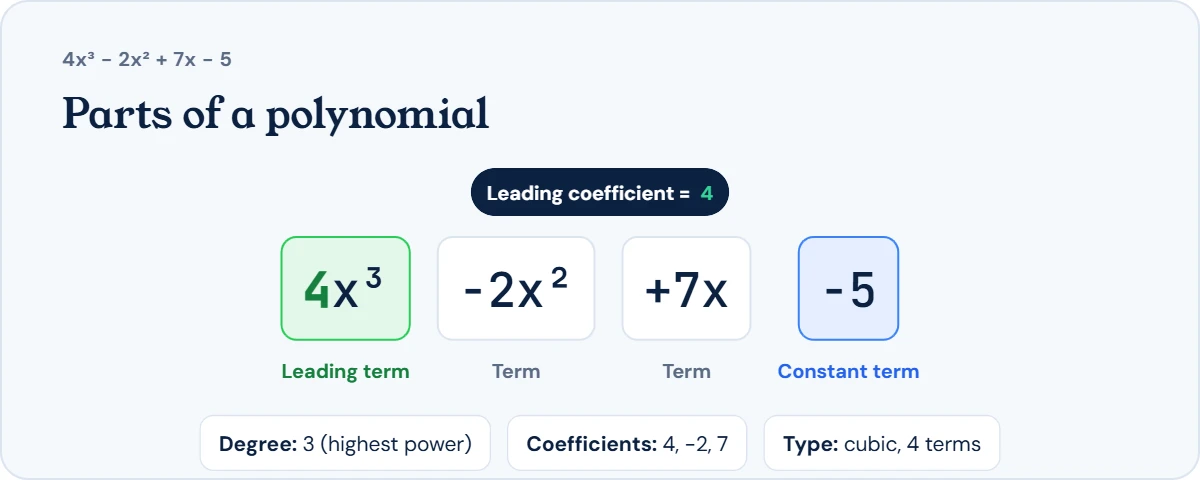
A coefficient and a constant are not the same thing. In 4x³ − 2x² + 7x − 5, the coefficient of x is 7, while −5 is the constant term because it has no variable.
In short: A polynomial adds or subtracts terms of the form number × variable with a whole-number power. Its degree is the highest power, and its leading coefficient is the number in front of that power.
What Is and Isn’t a Polynomial?
An expression is a polynomial only if every exponent on a variable is a whole number and no variable sits in a denominator or under a root.
| Expression | Polynomial? | Why |
|---|---|---|
| x² + 3x − 1 | Yes | Whole-number exponents 2, 1 and 0 |
| 7 | Yes | A constant is a polynomial of degree 0 |
| √2·x + 1 | Yes | The root is on a number, not on the variable |
| x²y + y³ | Yes | Polynomials can have more than one variable |
| 3/x | No | 3/x is 3x⁻¹, and −1 is not a whole number |
| √x + 2 | No | √x is x^(1/2), and 1/2 is not a whole number |
| 2ˣ | No | The variable is in the exponent |
In short: If any variable has a negative or fractional exponent, sits in a denominator or appears in an exponent, the expression is not a polynomial.
Types of Polynomials by Number of Terms
| Name | Number of terms | Examples |
|---|---|---|
| Monomial | 1 | 5x, −3x²y, 8 |
| Binomial | 2 | x + 4, x² − 9 |
| Trinomial | 3 | x² + 5x + 6 |
| Polynomial | 4 or more | x³ − 2x² + x − 7 |
Always simplify first. x² + 3x − x² looks like a trinomial, but it simplifies to 3x, which is a monomial.
Types of Polynomials by Degree
| Degree | Name | Example | Graph shape |
|---|---|---|---|
| 0 | Constant | 7 | Flat line |
| 1 | Linear | 2x + 1 | Straight line |
| 2 | Quadratic | x² − 5x + 6 | Parabola (U shape) |
| 3 | Cubic | x³ − 4x | S-shaped curve |
| 4 | Quartic | x⁴ − 3x² + 2 | W or M shape |
| 5 | Quintic | x⁵ − x | Up to four turns |
The two ways of naming overlap. 5x is a linear monomial, and x² − 9 is a quadratic binomial. The number 0 on its own is called the zero polynomial, and it has no degree.
In short: Name a polynomial by its terms (monomial, binomial, trinomial) and by its degree (linear, quadratic, cubic). Most polynomials have both names at once.
How to Find the Degree of a Polynomial
- Simplify by combining like terms.
- One variable: the degree is the highest exponent.
- Several variables: add the exponents inside each term, then take the highest total.
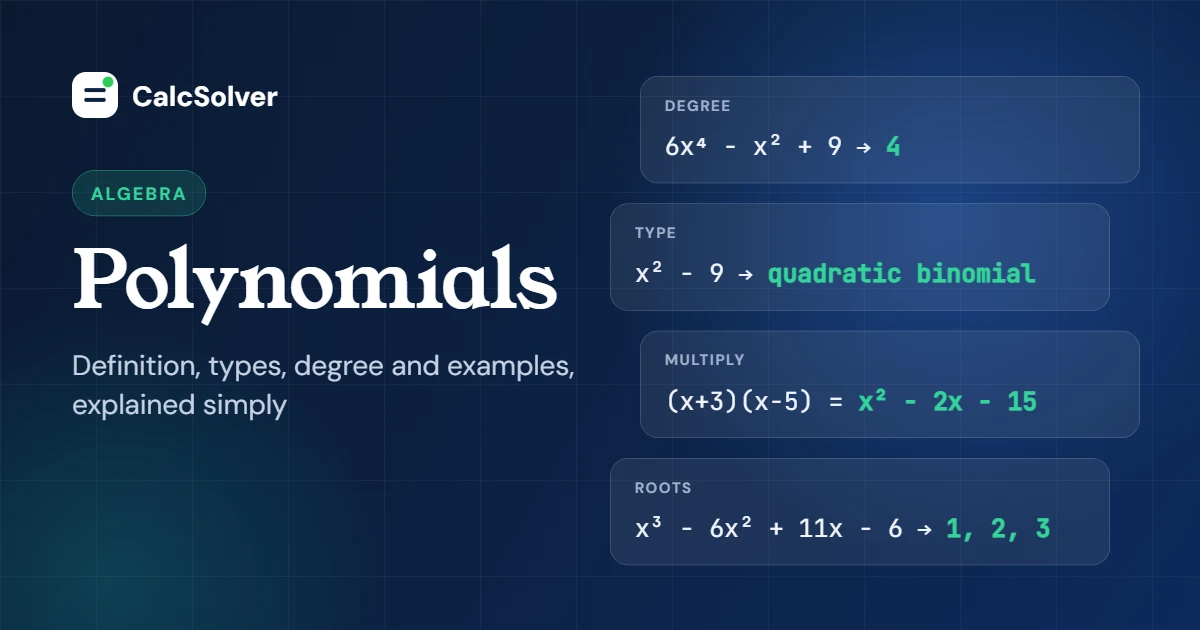
Example: 6x⁴ − x² + 9 → the highest exponent is 4, so the degree is 4.
Example: 3x²y⁴ + 5xy → the first term has 2 + 4 = 6, the second has 1 + 1 = 2, so the degree is 6.
Example: (x² + 1) − x² → this simplifies to 1, so the degree is 0, not 2.
In short: Simplify, then find the term with the largest exponent. With several variables, add the exponents within each term first.
How to Write a Polynomial in Standard Form
Standard form lists the terms from the highest power to the lowest, with like terms combined. The leading coefficient must not be zero.
Example: 5 + 3x³ − x + 2x³ → combine 3x³ + 2x³ = 5x³, then order the terms: 5x³ − x + 5.
How to Evaluate a Polynomial
Polynomials are often written as functions, such as P(x). To evaluate P(2), put 2 in brackets wherever x appears and follow the order of operations. This is the same substitution you use to evaluate an algebraic expression.
Example: P(x) = 2x³ − x + 4. Find P(2) → 2(2)³ − 2 + 4 = 16 − 2 + 4 = 18.
Check it on the CalcSolver calculator: type 2×2^3−2+4 and you get 18.
How to Add and Subtract Polynomials
Adding polynomials is combining like terms: add the coefficients of terms that have the same variable and the same power.
Example: (3x² + 2x − 5) + (x² − 4x + 1) = (3x² + x²) + (2x − 4x) + (−5 + 1) = 4x² − 2x − 4.
To subtract, change the sign of every term in the second polynomial, then add.
Example: (5x² − 3x + 2) − (2x² + x − 6) = 5x² − 3x + 2 − 2x² − x + 6 = 3x² − 4x + 8.
In short: Line up like terms and add their coefficients. When subtracting, flip the sign of every term in the second bracket first.
How to Multiply Polynomials
Multiply every term in the first polynomial by every term in the second, then combine like terms. When you multiply powers of the same variable, add the exponents: x² × x³ = x⁵.
Example: Monomial × polynomial: 2x(3x² − x + 4) = 6x³ − 2x² + 8x.
Example: Binomial × binomial (FOIL: first, outer, inner, last): (x + 3)(x − 5) = x² − 5x + 3x − 15 = x² − 2x − 15.
Example: Binomial × trinomial: (x + 2)(x² − x + 3) = x³ − x² + 3x + 2x² − 2x + 6 = x³ + x² + x + 6.
The degree of a product is the sum of the degrees. The reverse operation is dividing polynomials. A degree-1 polynomial times a degree-2 polynomial gives degree 3, as in the last example.
In short: Multiply each term by each term, add the exponents of matching variables, then combine like terms. The degrees of the factors add up.
Roots of a Polynomial and Solving Polynomial Equations
A root (or zero) of a polynomial is a value of x that makes it equal 0. On a graph, the roots are where the curve crosses the x-axis. A polynomial of degree n has at most n real roots, and the Factor Theorem links each root to a factor.
Example: x³ − 6x² + 11x − 6 = 0 has degree 3 and three roots: x = 1, x = 2 and x = 3. Check x = 2: 8 − 24 + 22 − 6 = 0.
To find roots, set the polynomial equal to 0 and use the right method for its degree: solve for x for linear equations, factoring or the quadratic formula for quadratics, and the rational root test for cubics. Many polynomial equations are quickest to solve once you factor the polynomial. Our guide to functions and zeros shows the method, and the free polynomial equation solver finds the roots of linear, quadratic and cubic equations with every step shown.
In short: Roots are the x values that make a polynomial equal 0. A degree-n polynomial has at most n of them.
Common Mistakes With Polynomials
- Adding exponents when adding terms. x² + x² = 2x², not x⁴. Exponents are added only when you multiply.
- Forgetting to distribute the minus sign. −(2x² + x − 6) is −2x² − x + 6.
- Missing a product. (x + 2)(x² − x + 3) needs six multiplications, one for every pair of terms.
- Finding the degree before simplifying. (x² + 1) − x² has degree 0, not 2.
- Calling 3/x or √x a polynomial. Negative and fractional exponents are not allowed.
Practice Problems (With Answers)
1. What is the degree of 7x⁵ − 2x³ + x − 9?
5. The highest exponent is 5.
2. Name 4x² − 1 by terms and by degree.
Quadratic binomial. It has two terms and degree 2.
3. Write 3 − 2x² + 5x in standard form.
−2x² + 5x + 3. Order the terms from the highest power down.
4. (2x² − 3x + 1) − (x² + 2x − 4)
x² − 5x + 5. Change the signs in the second bracket, then combine like terms.
5. (x − 4)(x + 6)
x² + 2x − 24. x² + 6x − 4x − 24.
6. P(x) = x³ − 2x + 1. Find P(−2).
−3. (−2)³ − 2(−2) + 1 = −8 + 4 + 1.
Polynomials: Frequently Asked Questions
What is a polynomial in simple words?
A polynomial is an expression made by adding or subtracting terms, where each term is a number times a variable raised to a whole-number power, such as 3x² + 2x − 7.
Is a single number a polynomial?
Yes. A number such as 7 is a constant polynomial with degree 0, because it can be written as 7x⁰.
What are the types of polynomials?
By number of terms, polynomials are monomials (one term), binomials (two), trinomials (three) or polynomials with four or more terms. By degree, they are constant, linear, quadratic, cubic, quartic and quintic.
How do you find the degree of a polynomial?
Simplify it, then find the highest exponent of the variable. If a term has more than one variable, add the exponents in that term first. For 3x²y⁴ + 5xy, the degree is 6.
Is √x a polynomial?
No. √x equals x to the power 1/2, and polynomials only allow whole-number exponents. A root of a number, such as √2·x, is allowed.
What is the difference between a polynomial and a polynomial equation?
A polynomial is an expression, such as x² − 5x + 6. A polynomial equation sets it equal to something, such as x² − 5x + 6 = 0, and can be solved to find its roots, here x = 2 and x = 3.
Sources and Further Reading
- OpenStax, College Algebra 2e, Section 1.4: Polynomials, Rice University.
- OpenStax, Elementary Algebra 2e, Section 6.3: Multiply Polynomials, Rice University.
- Math is Fun, Degree of an Expression.
Every example in this guide was checked on the CalcSolver calculator. New to algebra? Start with algebra basics, learn the basic algebra formulas, or browse all our algebra guides.
Polynomials also appear as the top and bottom of algebraic fractions, which you simplify by factoring.
Check your working in seconds
Type any problem from this guide into the free CalcSolver calculator and see the answer, with fractions, instantly.