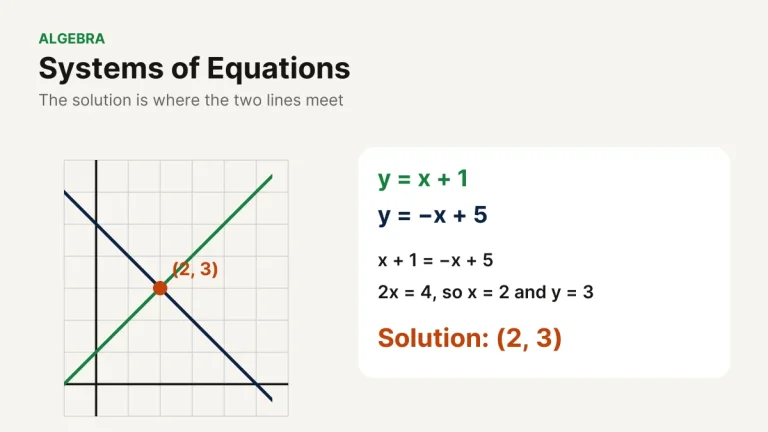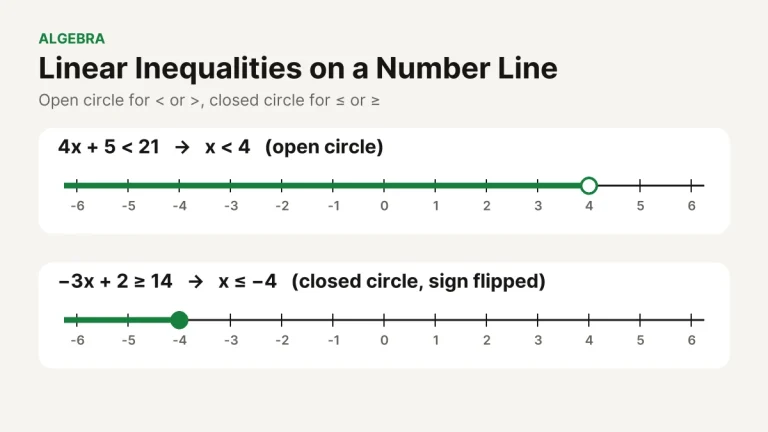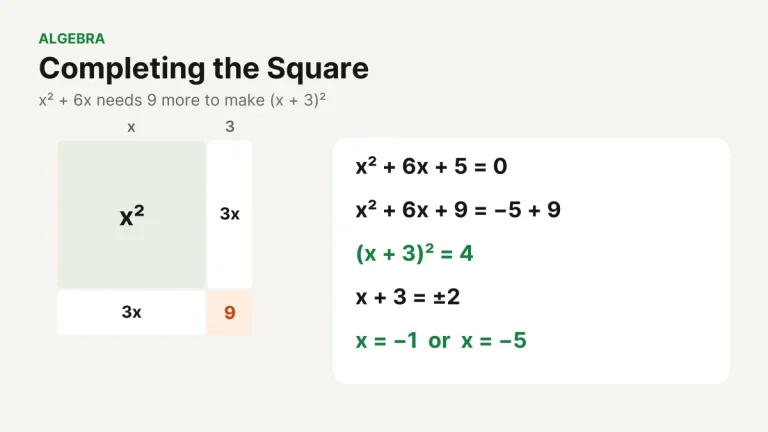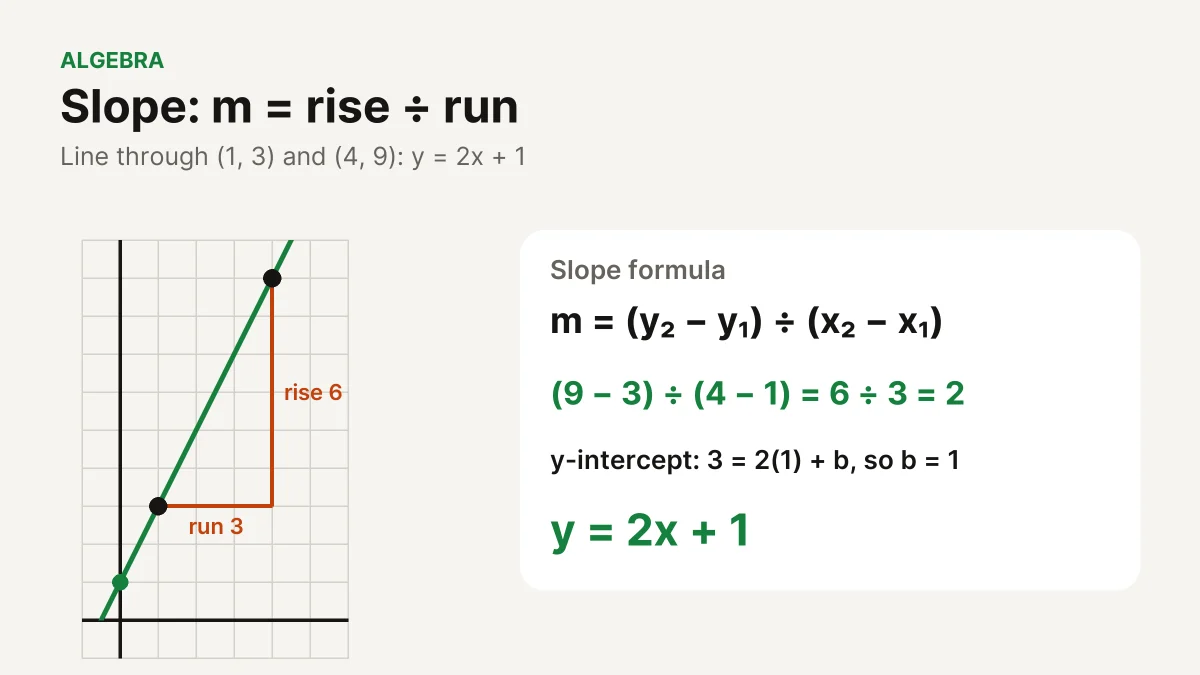
The slope of a line is m = (y2 − y1) ÷ (x2 − x1), the rise divided by the run, and slope-intercept form writes the line as y = mx + b, where b is the y-intercept. For the points (1, 3) and (4, 9), m = 6 ÷ 3 = 2, and 3 = 2(1) + b gives b = 1, so the line is y = 2x + 1.
In short: Slope = rise ÷ run = change in y ÷ change in x. In y = mx + b, m is the slope (steepness) and b is where the line crosses the y-axis.
In this guide
The Slope Formula
Slope measures how steep a line is: how much y changes when x goes up by 1. For any two points (x1, y1) and (x2, y2) on the line:
m = (y2 − y1) ÷ (x2 − x1)
The Four Types of Slope
| Type | What the line does | Example |
|---|---|---|
| Positive | Goes up from left to right | y = 2x + 1 (m = 2) |
| Negative | Goes down from left to right | y = −3x + 4 (m = −3) |
| Zero | Flat (horizontal) | y = 5 (m = 0) |
| Undefined | Straight up and down (vertical) | x = 2 (run is 0, so you cannot divide) |
How to Find the Slope From Two Points
- Label the points (x1, y1) and (x2, y2).
- Subtract the y-values: y2 − y1.
- Subtract the x-values in the same order: x2 − x1.
- Divide and simplify.
Example: (−2, 5) and (3, −5): m = (−5 − 5) ÷ (3 − (−2)) = −10 ÷ 5 = −2.
Example: (2, 7) and (5, 7): m = (7 − 7) ÷ (5 − 2) = 0 ÷ 3 = 0, a horizontal line.
Slope-Intercept Form: y = mx + b
In y = mx + b, m is the slope and b is the y-intercept, the point (0, b) where the line crosses the y-axis. In y = 2x + 1, the slope is 2 and the line crosses the y-axis at (0, 1).
How to Graph y = mx + b
- Plot the y-intercept (0, b).
- Use the slope as rise over run to find a second point.
- Draw a straight line through the two points.
Example: Graph y = (2/3)x − 1. Start at (0, −1). The slope 2/3 means up 2 and right 3, which lands on (3, 1). Join the points.
How to Write the Equation of a Line
From two points: find m, then put one point into y = mx + b to find b.
Example: Through (1, 3) and (4, 9): m = 2. Then 3 = 2(1) + b, so b = 1 and the line is y = 2x + 1. Check with (4, 9): 2(4) + 1 = 9 ✓.
From a slope and a point (point-slope form): use y − y1 = m(x − x1), then simplify.
Example: Slope −1/2 through (4, 6): y − 6 = −1/2(x − 4), so y = −1/2x + 2 + 6 = −1/2x + 8.
From Standard Form to Slope-Intercept Form
Solve the equation for y. This is the same skill as solving for x.
Example: 3x + 2y = 8 → 2y = −3x + 8 → y = −3/2x + 4. The slope is −3/2 and the y-intercept is 4.
Try it
Type an equation such as 2x + 3y = 12 and choose “solve for y” to get y = −2/3x + 4 with every step.
Parallel and Perpendicular Lines
- Parallel lines have the same slope: y = 2x + 1 and y = 2x − 5 never meet.
- Perpendicular lines have slopes that multiply to −1. A line perpendicular to y = 2x + 1 has slope −1/2.
Slope in Real Life
Slope is a rate of change. A taxi charges $3 to start and $2 per kilometer, so the cost is y = 2x + 3. The slope 2 is the price per kilometer and the intercept 3 is the starting fee. A 10 km ride costs 2(10) + 3 = $23.
Common Mistakes
- Mixing the order. If you start with y2 on top, start with x2 on the bottom.
- Putting x over y. Slope is change in y over change in x.
- Dropping the minus sign when subtracting a negative coordinate: 3 − (−2) = 5.
- Calling a vertical line slope 0. Horizontal lines have slope 0; vertical lines have undefined slope.
Practice Problems (With Answers)
1. Find the slope through (2, 1) and (6, 9).
(9 − 1) ÷ (6 − 2) = 8 ÷ 4 = 2.
2. Find the slope through (0, 4) and (2, 0).
(0 − 4) ÷ (2 − 0) = −2.
3. Write the equation of the line through (1, 2) and (3, 8).
m = 6 ÷ 2 = 3. Then 2 = 3(1) + b, so b = −1: y = 3x − 1.
4. Write 4x + 2y = 10 in slope-intercept form.
2y = −4x + 10, so y = −2x + 5.
5. What slope is perpendicular to y = 4x − 7?
−1/4, because 4 × (−1/4) = −1.
FAQ
What is the slope formula?
m = (y₂ − y₁) ÷ (x₂ − x₁). For (1, 3) and (4, 9), m = 6 ÷ 3 = 2.
What do m and b mean in y = mx + b?
m is the slope (how steep the line is) and b is the y-intercept, where the line crosses the y-axis.
How do you find the equation of a line from two points?
Find the slope, then substitute one point into y = mx + b to find b. Through (1, 3) and (4, 9), the line is y = 2x + 1.
What is the slope of a horizontal or vertical line?
A horizontal line has slope 0. A vertical line has an undefined slope because the run is 0.
How do you know if two lines are perpendicular?
Their slopes multiply to −1, such as 2 and −1/2.
Sources and Further Reading
- OpenStax, Elementary Algebra 2e, Section 4.4: Understand Slope of a Line, Rice University.
- OpenStax, Elementary Algebra, Section 4.5: Use the Slope-Intercept Form of an Equation of a Line.
Related: systems of equations, functions in algebra, basic algebra formulas, the math glossary and all free math calculators.
Check your working in seconds
Type any problem from this guide into the free CalcSolver calculator and see the answer, with fractions, instantly.