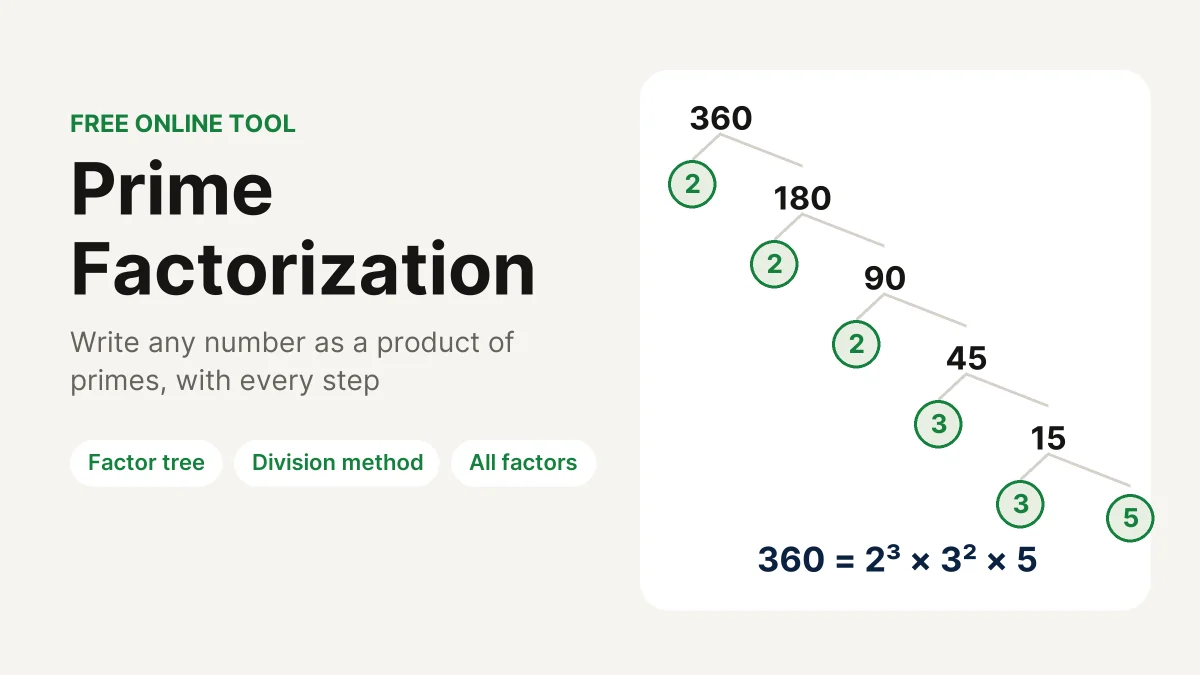
The prime factorization calculator writes any whole number as a product of prime numbers and shows every step. Type a number such as 360 to get 2³ × 3² × 5, with a factor tree, the division method, a list of all its factors and factor pairs, and whether the number is prime or composite. You can enter up to 10 numbers at once.
Prime factorization writes a number as a product of prime numbers, such as 360 = 2³ × 3² × 5. Every whole number above 1 has exactly one prime factorization.
In short: Prime factorization = breaking a number into primes that multiply back to it. Divide by 2 as long as you can, then 3, then 5, 7, 11 and so on, until you reach 1. For 360: 2 × 2 × 2 × 3 × 3 × 5 = 2³ × 3² × 5.
How to Use the Prime Factorization Calculator
- Type a whole number bigger than 1, such as
84. To do several at once, separate them with commas:24, 36, 60. - Press Find prime factors. The answer appears in exponent form (84 = 2² × 3 × 7) and as a full product (2 × 2 × 3 × 7).
- Look at the factor tree and division ladder. They show two ways to get the same primes, so you can copy the method your teacher uses.
- Read the factor list and steps. You also get every factor, the factor pairs and the number of factors.
What Is Prime Factorization?
A prime number has exactly two factors: 1 and itself (2, 3, 5, 7, 11, 13 and so on). A composite number has more than two factors. Prime factorization writes a composite number as a product of primes only.
Every whole number greater than 1 has exactly one prime factorization, apart from the order of the factors. This is called the Fundamental theorem of arithmetic. So whether you start 360 as 36 × 10 or 4 × 90, you always end with 2³ × 3² × 5.
Worked Examples
| Number | Prime factorization | Full product | Number of factors |
|---|---|---|---|
| 48 | 2⁴ × 3 | 2 × 2 × 2 × 2 × 3 | 10 |
| 72 | 2³ × 3² | 2 × 2 × 2 × 3 × 3 | 12 |
| 84 | 2² × 3 × 7 | 2 × 2 × 3 × 7 | 12 |
| 100 | 2² × 5² | 2 × 2 × 5 × 5 | 9 |
| 360 | 2³ × 3² × 5 | 2 × 2 × 2 × 3 × 3 × 5 | 24 |
| 1001 | 7 × 11 × 13 | 7 × 11 × 13 | 8 |
| 97 | 97 (prime) | 97 | 2 |
Example: Prime factorization of 84. 84 ÷ 2 = 42, 42 ÷ 2 = 21, 21 ÷ 3 = 7, and 7 is prime. So 84 = 2 × 2 × 3 × 7 = 2² × 3 × 7.
How Many Factors Does a Number Have?
Once you have the prime factorization, add 1 to each exponent and multiply. For 360 = 2³ × 3² × 5¹: (3 + 1) × (2 + 1) × (1 + 1) = 4 × 3 × 2 = 24 factors. A prime always has exactly 2 factors, and a perfect square such as 100 has an odd number (9).
What Prime Factorization Is Used For
- GCF and LCM. Multiply the shared primes for the greatest common factor, or every prime at its highest power for the least common multiple. The GCF and LCM calculator does both.
- Simplifying fractions. 84/126 = (2² × 3 × 7)/(2 × 3² × 7): cancel 2 × 3 × 7 = 42 to get 2/3. See how to simplify fractions.
- Square roots. 72 = 2² × 2 × 3², so √72 = 2 × 3 × √2 = 6√2. See square roots and cube roots.
Learn More
- How to find the prime factorization of a number: the factor tree and division methods, step by step.
- Prime factorization chart 1 to 100: every number from 2 to 100 written as primes.
- How to find the GCF and how to find the LCM using prime factors.
Need a different tool? See all free math calculators on one page.
Prime Factorization Calculator: FAQ
What is the prime factorization of 360?
360 = 2³ × 3² × 5, which is 2 × 2 × 2 × 3 × 3 × 5.
What is the prime factorization of 72?
72 = 2³ × 3², which is 2 × 2 × 2 × 3 × 3.
Is 1 a prime number?
No. 1 has only one factor, so it is neither prime nor composite, and it has no prime factorization.
Can a prime number be factorized?
A prime number is already its own prime factorization. For example, the prime factorization of 97 is just 97.
Is the prime factorization of a number always the same?
Yes. Apart from the order of the factors, every whole number above 1 has exactly one prime factorization (the fundamental theorem of arithmetic).
How big a number can the calculator factor?
Up to 12 digits. It factored 600851475143 as 71 × 839 × 1471 × 6857.
Is the prime factorization calculator free?
Yes. It is free, needs no sign-up and runs in your browser.
Sources and Further Reading
- OpenStax, Prealgebra, Section 2.5: Prime Factorization and the Least Common Multiple, Rice University.
- Wikipedia, Fundamental theorem of arithmetic.
- Common Core Grade 4: Operations and Algebraic Thinking (4.OA.B.4: prime and composite numbers).
Also try the GCF and LCM calculator, the fraction calculator and the scientific calculator.