To find the prime factorization of a number, keep dividing it by prime numbers until you reach 1, then multiply the primes you used. You can do this with a factor tree or with the division (ladder) method. Both give the same answer: for example, 60 = 2 × 2 × 3 × 5 = 2² × 3 × 5.
In short: Start with the smallest prime, 2. Divide as many times as you can, then try 3, 5, 7, 11 and so on. Stop when the number left is 1 (or a prime). Write repeated primes with exponents.
In this guide
Method 1: The Factor Tree
- Write the number at the top.
- Split it into any two factors, such as 60 = 6 × 10. Draw a branch to each one.
- Keep splitting every factor that is not prime. 6 = 2 × 3 and 10 = 2 × 5.
- Circle the primes at the ends of the branches and multiply them: 60 = 2 × 3 × 2 × 5.
Example: Factor tree for 72. 72 = 8 × 9. Then 8 = 2 × 4 and 4 = 2 × 2, while 9 = 3 × 3. The circled primes are 2, 2, 2, 3 and 3, so 72 = 2³ × 3².
Different first splits give different-looking trees, but the primes at the bottom are always the same. Starting 72 as 2 × 36 or 4 × 18 still ends with three 2s and two 3s.
Method 2: The Division (Ladder) Method
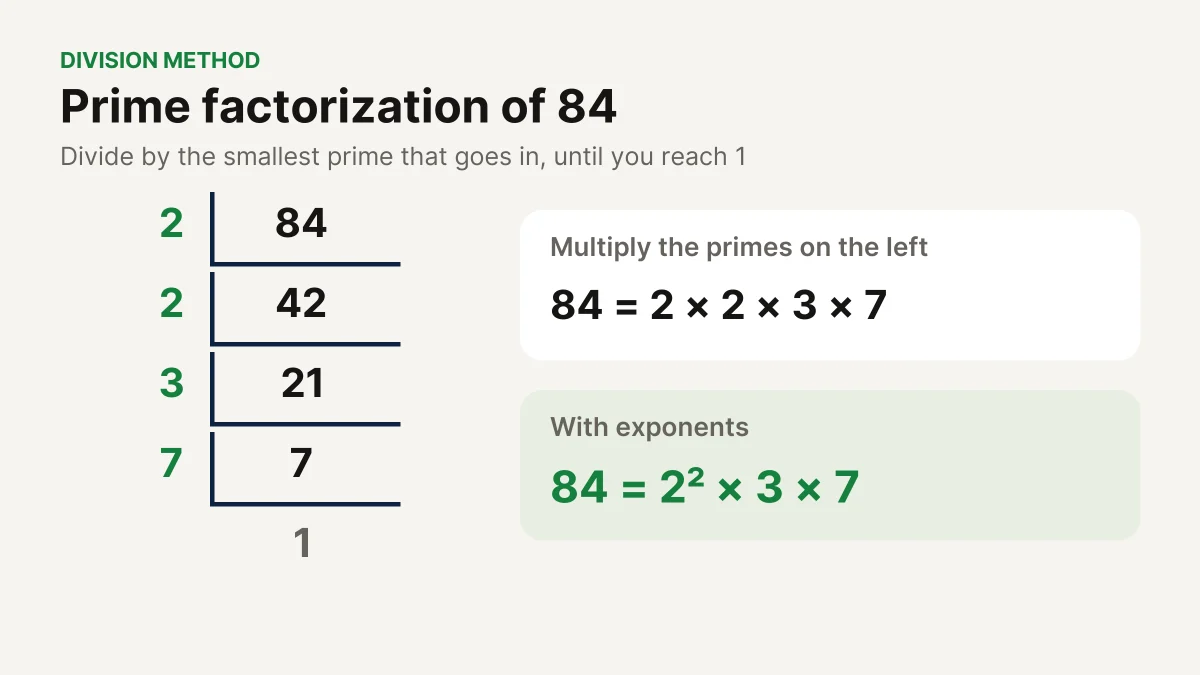
Write the number, divide by the smallest prime that goes in exactly, and write the answer underneath. Repeat with the new number until you get 1. The primes down the left side are the prime factorization.
Example: Prime factorization of 84. 84 ÷ 2 = 42, 42 ÷ 2 = 21, 21 ÷ 3 = 7, 7 ÷ 7 = 1. The divisors were 2, 2, 3 and 7, so 84 = 2² × 3 × 7.
The division method is neat for larger numbers because you never have to guess a factor pair; you just test 2, 3, 5, 7 and so on in order.
Divisibility Rules That Help
| Prime | The number divides by it if… | Example |
|---|---|---|
| 2 | the last digit is even (0, 2, 4, 6, 8) | 84 ends in 4 |
| 3 | the sum of the digits divides by 3 | 1 + 2 + 6 = 9, so 126 divides by 3 |
| 5 | the last digit is 0 or 5 | 345 ends in 5 |
| 7 | double the last digit, subtract it from the rest, and the result divides by 7 | 91: 9 − 2 = 7 |
| 11 | the alternating sum of the digits divides by 11 | 1001: 1 − 0 + 0 − 1 = 0 |
Larger Numbers: When Can You Stop?
You only need to test primes up to the square root of the number that is left. If none of them divides it, what is left is prime.
Example: Prime factorization of 1001. It is odd, the digit sum 2 is not a multiple of 3, and it does not end in 0 or 5. Try 7: 1001 ÷ 7 = 143. Try 11: 143 ÷ 11 = 13, and 13 is prime. So 1001 = 7 × 11 × 13.
Example: Is 97 prime? √97 is just under 10, so test 2, 3, 5 and 7. None of them divides 97, so 97 is prime and its prime factorization is just 97.
Try it
Type any number up to 12 digits to see its factor tree, division ladder and every factor.
Writing the Answer With Exponents
When a prime repeats, write it once with an exponent that counts how many times it appears. 2 × 2 × 2 × 3 × 3 × 5 becomes 2³ × 3² × 5. Write the primes from smallest to largest. If you need a refresher, see the exponent rules.
Common Mistakes
- Stopping at a composite number. 60 = 4 × 15 is not finished; 4 and 15 still split into 2 × 2 and 3 × 5.
- Including 1. 1 is not prime, so it never appears in a prime factorization.
- Losing a factor. Multiply your primes back together to check: 2 × 2 × 3 × 5 = 60 ✓.
Practice Problems (With Answers)
1. Find the prime factorization of 48.
48 = 2⁴ × 3, because 48 = 2 × 2 × 2 × 2 × 3.
2. Find the prime factorization of 100.
100 = 2² × 5², because 100 = 2 × 2 × 5 × 5.
3. Find the prime factorization of 210.
210 = 2 × 3 × 5 × 7, the product of the first four primes.
4. Find the prime factorization of 144.
144 = 2⁴ × 3², because 144 = 12 × 12 = (2² × 3) × (2² × 3).
5. Is 91 prime?
No. 91 = 7 × 13.
FAQ
What is the first step in prime factorization?
Divide the number by the smallest prime that goes into it exactly, usually 2. If it is odd, try 3, then 5, then 7.
What is the prime factorization of 60?
60 = 2² × 3 × 5, which is 2 × 2 × 3 × 5.
Which is better, a factor tree or the division method?
They give the same answer. A factor tree is quick when you can see a factor pair; the division method is tidier for bigger numbers.
Do you include 1 in prime factorization?
No. 1 is not a prime number, so it is never written in a prime factorization.
Sources and Further Reading
- OpenStax, Prealgebra, Section 2.5: Prime Factorization and the Least Common Multiple, Rice University.
- Wikipedia, Fundamental theorem of arithmetic.
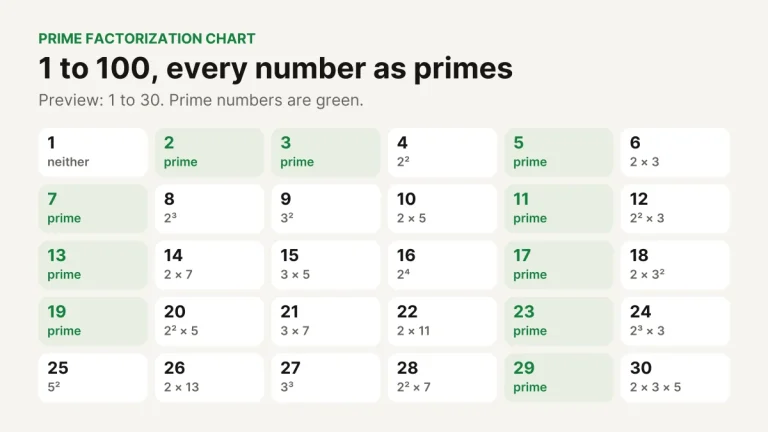
See the prime factorization chart for 1 to 100, or use prime factors to find the GCF and find the LCM. Check any answer with the prime factorization calculator.
Check your working in seconds
Type any problem from this guide into the free CalcSolver calculator and see the answer, with fractions, instantly.