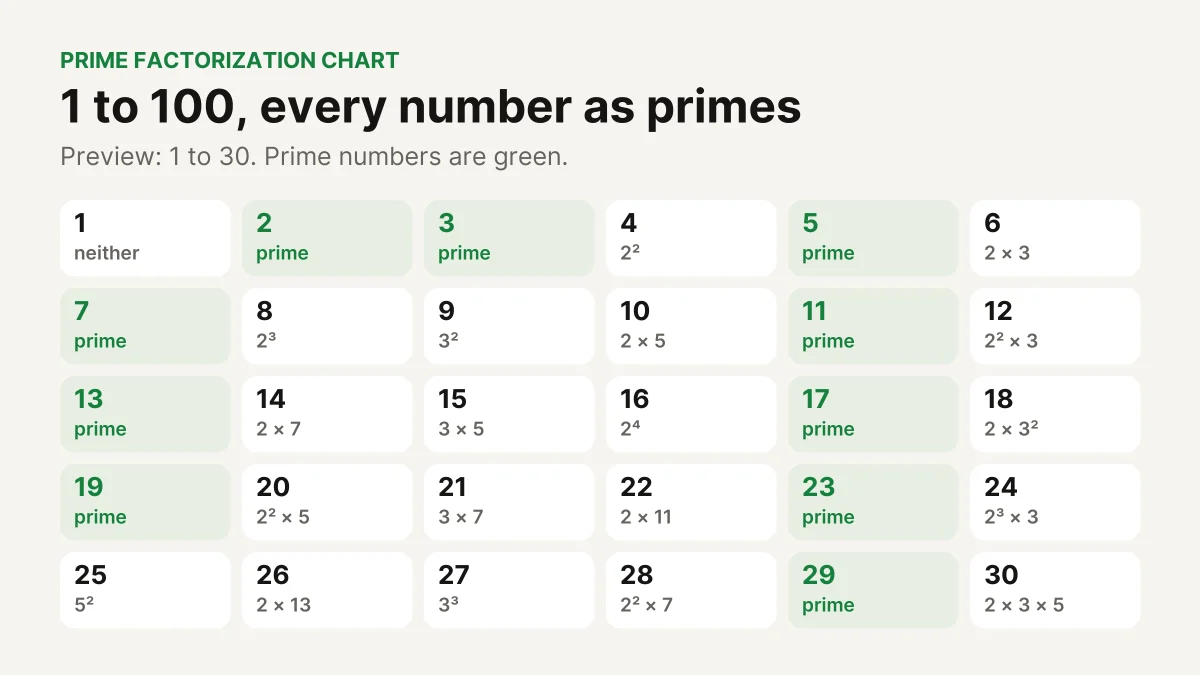
This prime factorization chart lists every whole number from 2 to 100 written as a product of primes. Prime numbers are marked, so you can also use it as a list of the 25 primes under 100. For example, 60 = 2² × 3 × 5 and 97 is prime.
In short: There are 25 prime numbers from 1 to 100: 2, 3, 5, 7, 11, 13, 17, 19, 23, 29, 31, 37, 41, 43, 47, 53, 59, 61, 67, 71, 73, 79, 83, 89, 97. Every other number from 4 to 100 is composite and splits into these primes.
In this guide
Prime Factorization Chart 2 to 100
1 is left out because it is neither prime nor composite.
| Number | Prime factorization | Factors |
|---|---|---|
| 2 | Prime | 2 |
| 3 | Prime | 2 |
| 4 | 2² | 3 |
| 5 | Prime | 2 |
| 6 | 2 × 3 | 4 |
| 7 | Prime | 2 |
| 8 | 2³ | 4 |
| 9 | 3² | 3 |
| 10 | 2 × 5 | 4 |
| 11 | Prime | 2 |
| 12 | 2² × 3 | 6 |
| 13 | Prime | 2 |
| 14 | 2 × 7 | 4 |
| 15 | 3 × 5 | 4 |
| 16 | 2⁴ | 5 |
| 17 | Prime | 2 |
| 18 | 2 × 3² | 6 |
| 19 | Prime | 2 |
| 20 | 2² × 5 | 6 |
| 21 | 3 × 7 | 4 |
| 22 | 2 × 11 | 4 |
| 23 | Prime | 2 |
| 24 | 2³ × 3 | 8 |
| 25 | 5² | 3 |
| 26 | 2 × 13 | 4 |
| 27 | 3³ | 4 |
| 28 | 2² × 7 | 6 |
| 29 | Prime | 2 |
| 30 | 2 × 3 × 5 | 8 |
| 31 | Prime | 2 |
| 32 | 2⁵ | 6 |
| 33 | 3 × 11 | 4 |
| 34 | 2 × 17 | 4 |
| 35 | 5 × 7 | 4 |
| 36 | 2² × 3² | 9 |
| 37 | Prime | 2 |
| 38 | 2 × 19 | 4 |
| 39 | 3 × 13 | 4 |
| 40 | 2³ × 5 | 8 |
| 41 | Prime | 2 |
| 42 | 2 × 3 × 7 | 8 |
| 43 | Prime | 2 |
| 44 | 2² × 11 | 6 |
| 45 | 3² × 5 | 6 |
| 46 | 2 × 23 | 4 |
| 47 | Prime | 2 |
| 48 | 2⁴ × 3 | 10 |
| 49 | 7² | 3 |
| 50 | 2 × 5² | 6 |
| 51 | 3 × 17 | 4 |
| 52 | 2² × 13 | 6 |
| 53 | Prime | 2 |
| 54 | 2 × 3³ | 8 |
| 55 | 5 × 11 | 4 |
| 56 | 2³ × 7 | 8 |
| 57 | 3 × 19 | 4 |
| 58 | 2 × 29 | 4 |
| 59 | Prime | 2 |
| 60 | 2² × 3 × 5 | 12 |
| 61 | Prime | 2 |
| 62 | 2 × 31 | 4 |
| 63 | 3² × 7 | 6 |
| 64 | 2⁶ | 7 |
| 65 | 5 × 13 | 4 |
| 66 | 2 × 3 × 11 | 8 |
| 67 | Prime | 2 |
| 68 | 2² × 17 | 6 |
| 69 | 3 × 23 | 4 |
| 70 | 2 × 5 × 7 | 8 |
| 71 | Prime | 2 |
| 72 | 2³ × 3² | 12 |
| 73 | Prime | 2 |
| 74 | 2 × 37 | 4 |
| 75 | 3 × 5² | 6 |
| 76 | 2² × 19 | 6 |
| 77 | 7 × 11 | 4 |
| 78 | 2 × 3 × 13 | 8 |
| 79 | Prime | 2 |
| 80 | 2⁴ × 5 | 10 |
| 81 | 3⁴ | 5 |
| 82 | 2 × 41 | 4 |
| 83 | Prime | 2 |
| 84 | 2² × 3 × 7 | 12 |
| 85 | 5 × 17 | 4 |
| 86 | 2 × 43 | 4 |
| 87 | 3 × 29 | 4 |
| 88 | 2³ × 11 | 8 |
| 89 | Prime | 2 |
| 90 | 2 × 3² × 5 | 12 |
| 91 | 7 × 13 | 4 |
| 92 | 2² × 23 | 6 |
| 93 | 3 × 31 | 4 |
| 94 | 2 × 47 | 4 |
| 95 | 5 × 19 | 4 |
| 96 | 2⁵ × 3 | 12 |
| 97 | Prime | 2 |
| 98 | 2 × 7² | 6 |
| 99 | 3² × 11 | 6 |
| 100 | 2² × 5² | 9 |
Prime Numbers Under 100
The 25 primes below 100 are 2, 3, 5, 7, 11, 13, 17, 19, 23, 29, 31, 37, 41, 43, 47, 53, 59, 61, 67, 71, 73, 79, 83, 89, 97. Only 2 is even; every other even number divides by 2, so it is composite.
How to Use the Chart
- Look up a number to see its primes. 84 = 2² × 3 × 7.
- Find the GCF of two numbers by multiplying the primes they share: 36 = 2² × 3² and 60 = 2² × 3 × 5 share 2² × 3 = 12. See how to find the GCF.
- Find the LCM by multiplying every prime at its highest power: LCM(36, 60) = 2² × 3² × 5 = 180. See how to find the LCM.
- Simplify a fraction by cancelling shared primes: 36/60 = (2² × 3²)/(2² × 3 × 5) = 3/5.
Patterns in the Chart
- Powers of 2: 2, 4, 8, 16, 32, 64 (2⁶ = 64 has the most prime factors under 100, six of them).
- Perfect squares such as 36 = 2² × 3² and 100 = 2² × 5² have only even exponents, and an odd number of factors.
- Most factors: 60, 72, 84, 90 and 96 each have 12 factors, the most of any number up to 100.
Try it
Need a number above 100? The calculator factors numbers up to 12 digits, with steps.
FAQ
How many prime numbers are there from 1 to 100?
There are 25 prime numbers from 1 to 100, starting 2, 3, 5, 7, 11 and ending 89, 97.
What is the prime factorization of 100?
100 = 2² × 5², which is 2 × 2 × 5 × 5.
Which number under 100 has the most factors?
60, 72, 84, 90 and 96 tie with 12 factors each.
Why is 1 not in the chart?
1 has only one factor, so it is neither prime nor composite and has no prime factorization.
Sources and Further Reading
- OpenStax, Prealgebra, Section 2.5: Prime Factorization and the Least Common Multiple, Rice University.
- Common Core Grade 4: Operations and Algebraic Thinking (4.OA.B.4).
Learn the methods in how to find the prime factorization of a number, or factor any number with the prime factorization calculator.
Check your working in seconds
Type any problem from this guide into the free CalcSolver calculator and see the answer, with fractions, instantly.