Fractions
Fraction Chart: Fractions to Decimals and Percents (Printable)
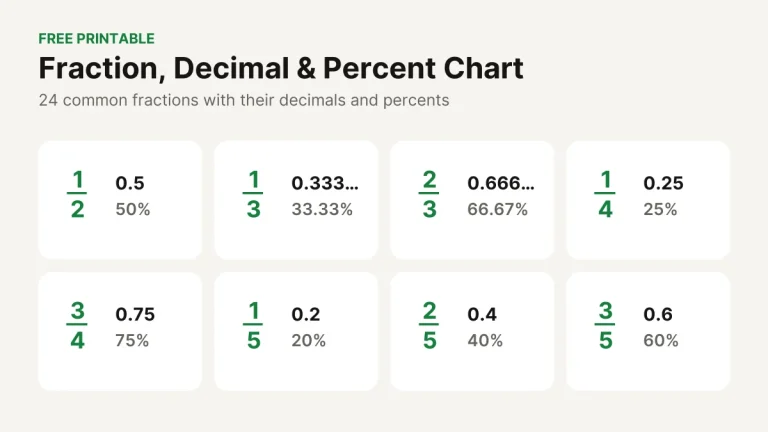
Free printable fraction chart: 24 common fractions with their decimal and percent equivalents, from 1/2 to 1/16, plus how to convert any fraction.
Step-by-step fraction guides: adding, subtracting, multiplying, dividing, simplifying and mixed numbers, with worked examples.
Free printable fraction chart: 24 common fractions with their decimal and percent equivalents, from 1/2 to 1/16, plus how to convert any fraction.
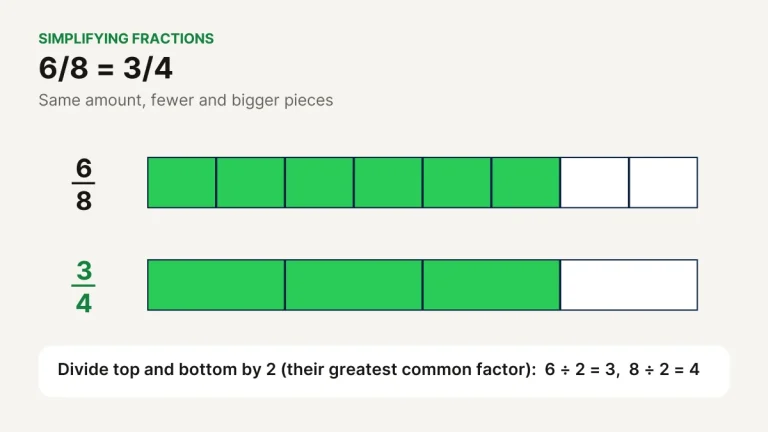
How to simplify fractions to lowest terms using the greatest common factor, with quick divisibility checks and examples like 18/24 = 3/4 and 84/126 = 2/3.
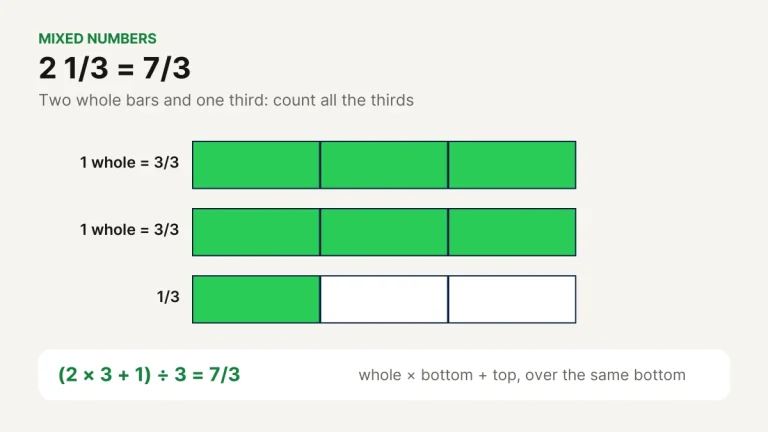
What a mixed number (mixed fraction) is and how to change it to an improper fraction and back, with examples like 4 2/3 = 14/3 and…
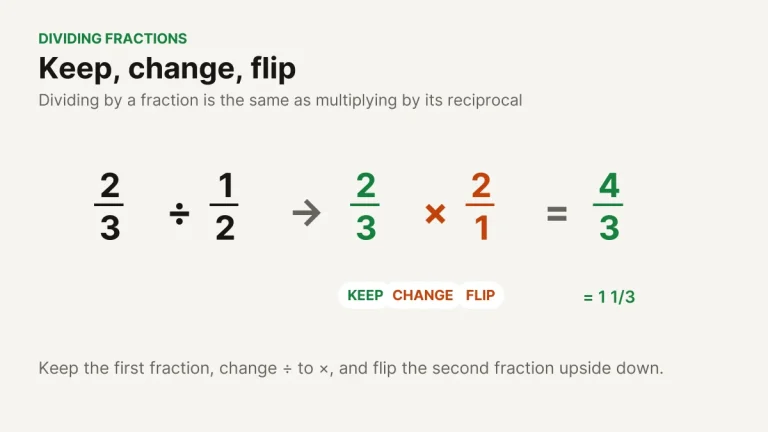
How to divide fractions with keep, change, flip: whole numbers, mixed numbers and examples like 3 1/3 ÷ 2 = 1 2/3 and 2/3 ÷ 1/2…
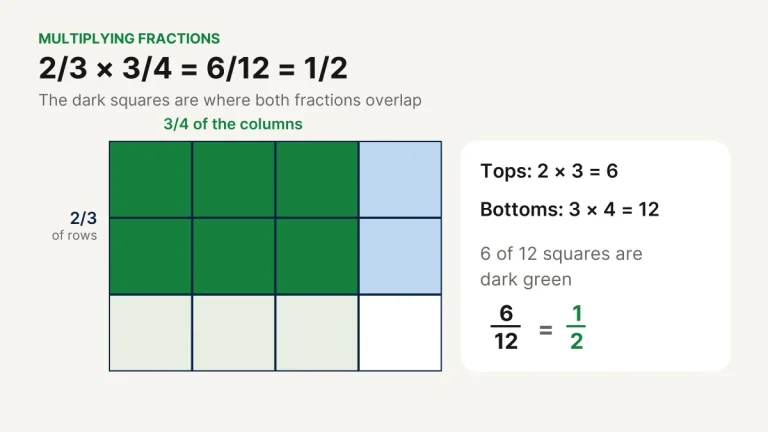
How to multiply fractions: top times top, bottom times bottom. Examples with whole and mixed numbers, like 2/3 times 2 = 4/3 and 1/3 of 1/2…
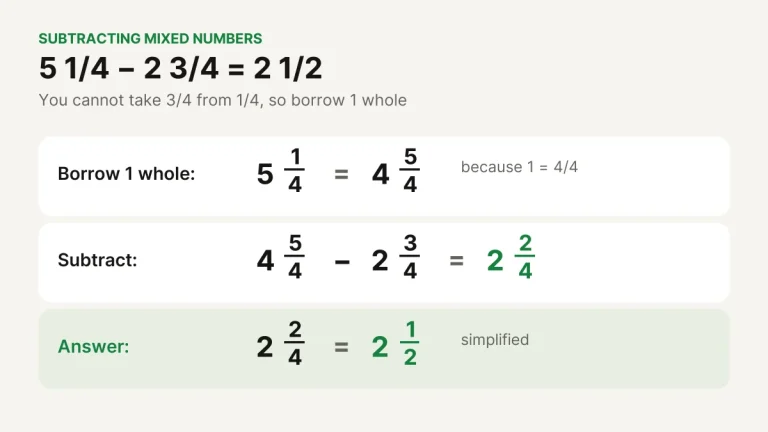
How to subtract fractions: same and different denominators, mixed numbers with borrowing, and examples like 2 1/3 − 2/3 = 1 2/3. Simple steps.
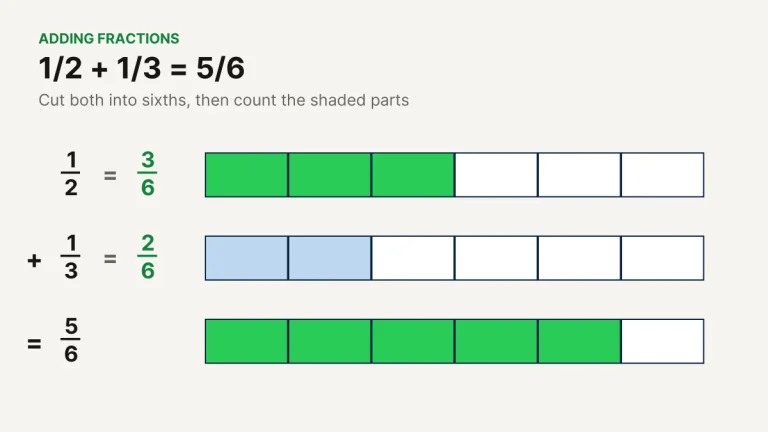
How to add fractions step by step: same and different denominators, mixed numbers and whole numbers, with pictures and examples like 1/2 + 1/3 = 5/6.
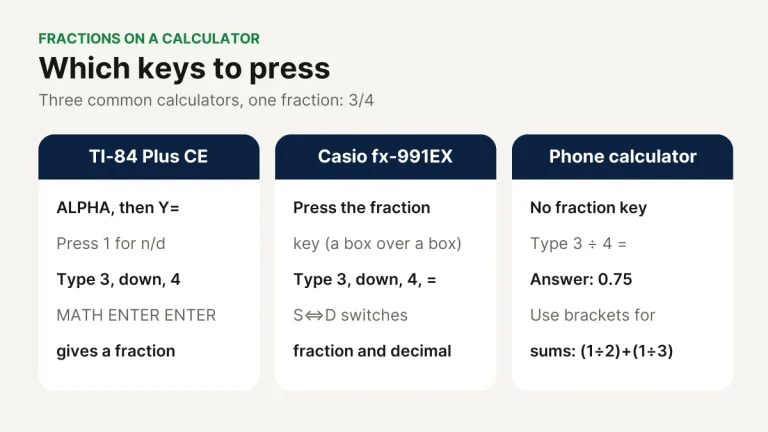
How to do fractions on a calculator: the exact keys for a TI-84 Plus CE, Casio fx-991EX, iPhone and Google, plus how to get a fraction…
A fraction shows part of a whole. The bottom number (the denominator) says how many equal parts the whole is cut into, and the top number (the numerator) says how many of those parts you have. In 3/4, the whole is cut into 4 parts and you have 3 of them. Fractions, decimals and percents are three ways to write the same amount: 3/4 = 0.75 = 75%.
In short: To add or subtract fractions, use a common denominator. To multiply, multiply top by top and bottom by bottom. To divide, flip the second fraction and multiply. Always simplify the answer.
Check any answer with the fraction calculator, which adds, subtracts, multiplies and divides fractions, mixed numbers and whole numbers with every step shown. For equal fractions, use the equivalent fractions calculator, and for percents, the percentage calculator.
Need a common denominator or the number to simplify by? The GCF and LCM calculator finds the LCD and the GCF with steps, and the guides show how to find the GCF and how to find the LCM by hand.