Equivalent fractions are fractions that have the same value even though they have different numerators and denominators. For example, 1/2, 2/4 and 4/8 are equivalent fractions. To find one, multiply or divide the numerator and denominator by the same non-zero number. This guide explains the definition, three ways to find and check equivalent fractions, diagrams, worked examples, a chart of common equivalents, practice problems with answers and an FAQ.
In this guide
What Are Equivalent Fractions?
Two fractions are equivalent if they represent the same part of a whole. Half a pizza is the same amount whether you cut the pizza into 2 slices and take 1, or into 4 slices and take 2, or into 8 slices and take 4. So 1/2 = 2/4 = 4/8.
The numerator (top number) says how many parts you have, and the denominator (bottom number) says how many equal parts make a whole. Equivalent fractions use different numbers of parts to describe the same amount. They also sit at the same point on a number line and have the same decimal value: 1/2, 2/4 and 4/8 all equal 0.5.
In short: Equivalent fractions have different numbers but the same value, such as 1/2 = 2/4 = 3/6.
How to Find Equivalent Fractions
Method 1: Multiply the top and bottom by the same number
This is the main method. Multiply both the numerator and the denominator by the same non-zero whole number.
Example: Find equivalent fractions of 2/3. Multiply by 2: (2 × 2)/(3 × 2) = 4/6. Multiply by 3: 6/9. Multiply by 4: 8/12. So 2/3 = 4/6 = 6/9 = 8/12.
This works because multiplying the top and bottom by the same number n is the same as multiplying the fraction by n/n, and n/n equals 1. Multiplying by 1 never changes a value.
Method 2: Divide the top and bottom by the same number
Division works the same way, as long as both numbers divide exactly. Dividing by a common factor is called simplifying or reducing.
Example: Find an equivalent fraction of 12/18. Both numbers divide by 6: 12 ÷ 6 = 2 and 18 ÷ 6 = 3. So 12/18 = 2/3.
Method 3: Use a missing-number equation
Sometimes you are given one new number and must find the other. Work out what the known number was multiplied by, then do the same to the other one.
Example: 3/5 = ?/20. Since 5 × 4 = 20, multiply the numerator by 4 as well: 3 × 4 = 12. So 3/5 = 12/20.
In short: Multiply or divide the numerator and denominator by the same non-zero number. Never add or subtract.
Diagram: Equivalent Fractions on Bars
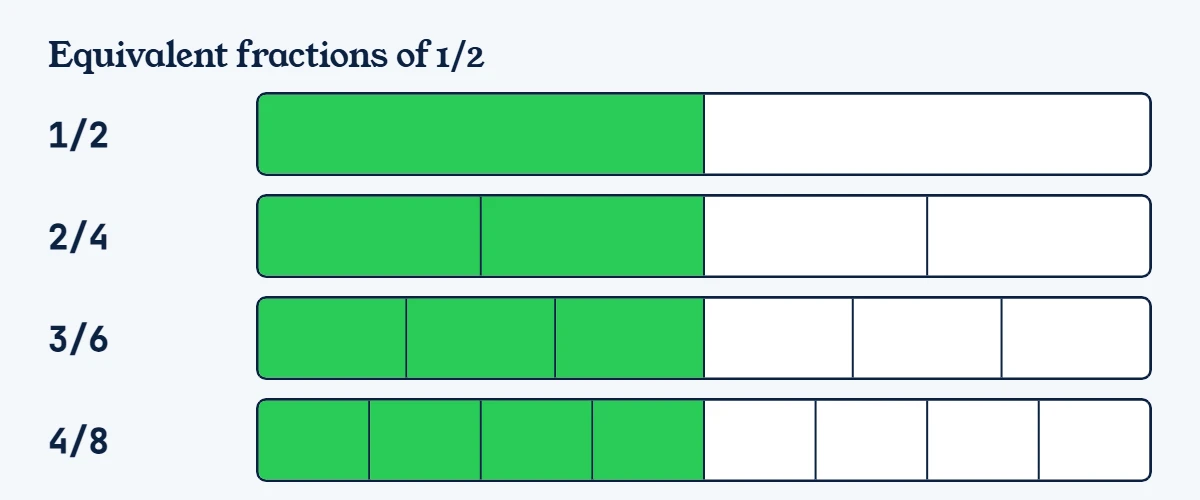
Each bar has the same length, and the shaded part ends at the same point. Splitting the bar into more pieces changes the number of pieces, not the amount shaded.
How to Simplify to the Simplest Form
A fraction is in simplest form (also called lowest terms) when the numerator and denominator share no common factor except 1. Every family of equivalent fractions has exactly one simplest form, and it is the smallest member of the family.
- Find the greatest common factor (GCF) of the numerator and denominator.
- Divide both numbers by the GCF.
- Check that the new numbers have no common factor other than 1.
Example: Simplify 18/24. The factors of 18 are 1, 2, 3, 6, 9, 18 and the factors of 24 are 1, 2, 3, 4, 6, 8, 12, 24. The GCF is 6. 18 ÷ 6 = 3 and 24 ÷ 6 = 4. So 18/24 = 3/4.
If you do not spot the GCF, divide by any common factor and repeat until no common factor is left. 18/24 ÷ 2 = 9/12, then ÷ 3 = 3/4 gives the same result.
In short: To simplify, divide the top and bottom by their GCF. The result is the simplest form.
How to Check if Two Fractions Are Equivalent
Cross-multiplication
Multiply the numerator of each fraction by the denominator of the other. If the two products match, the fractions are equivalent.
Example: Are 3/5 and 9/15 equivalent? 3 × 15 = 45 and 5 × 9 = 45. The products match, so yes.
Example: Are 2/7 and 3/10 equivalent? 2 × 10 = 20 and 7 × 3 = 21. The products differ, so no.
Simplify both fractions
Reduce each fraction to its simplest form. If the results are identical, the fractions are equivalent. 6/8 simplifies to 3/4 and 15/20 simplifies to 3/4, so 6/8 = 15/20.
Compare the decimals
Divide each numerator by its denominator. Equivalent fractions give the same decimal: 3/4 = 0.75 and 12/16 = 0.75.
In short: Cross-multiply: a/b = c/d when a × d = b × c.
Chart of Common Equivalent Fractions
| Simplest form | Equivalent fractions | Decimal | Percent |
|---|---|---|---|
| 1/2 | 2/4, 3/6, 4/8, 5/10, 6/12 | 0.5 | 50% |
| 1/3 | 2/6, 3/9, 4/12, 5/15, 6/18 | 0.333… | 33⅓% |
| 2/3 | 4/6, 6/9, 8/12, 10/15, 12/18 | 0.666… | 66⅔% |
| 1/4 | 2/8, 3/12, 4/16, 5/20, 6/24 | 0.25 | 25% |
| 3/4 | 6/8, 9/12, 12/16, 15/20, 18/24 | 0.75 | 75% |
| 1/5 | 2/10, 3/15, 4/20, 5/25, 6/30 | 0.2 | 20% |
| 2/5 | 4/10, 6/15, 8/20, 10/25, 12/30 | 0.4 | 40% |
| 3/5 | 6/10, 9/15, 12/20, 15/25, 18/30 | 0.6 | 60% |
| 4/5 | 8/10, 12/15, 16/20, 20/25, 24/30 | 0.8 | 80% |
| 1/6 | 2/12, 3/18, 4/24, 5/30, 6/36 | 0.166… | 16⅔% |
| 1/8 | 2/16, 3/24, 4/32, 5/40, 6/48 | 0.125 | 12.5% |
| 1/10 | 2/20, 3/30, 4/40, 5/50, 6/60 | 0.1 | 10% |
See how the same values appear in the fractions as decimals and percents guides, such as 1/3 as a percent and 3/4 as a percent.
Why Equivalent Fractions Matter
- Adding and subtracting: fractions need a common denominator first. 1/2 + 1/3 becomes 3/6 + 2/6 = 5/6.
- Comparing: to compare 3/4 and 5/8, rewrite 3/4 as 6/8. Then 6/8 is larger than 5/8.
- Simplifying answers: teachers and exams usually ask for the answer in simplest form.
- Ratios and percents: 3/5 = 60/100 = 60%, an equivalent fraction with a denominator of 100.
Example: Add 1/2 + 1/3. The common denominator is 6. 1/2 = 3/6 and 1/3 = 2/6. 3/6 + 2/6 = 5/6.
Common Mistakes
- Adding the same number to the top and bottom. Adding 1 to both parts of 1/2 gives 2/3, which is not equal to 1/2. Only multiplication and division keep the value.
- Changing only the numerator or the denominator. Both numbers must be multiplied or divided by the same number.
- Using different multipliers. Multiplying the top of 2/3 by 2 and the bottom by 3 gives 4/9, which is not equal to 2/3. Both numbers need the same factor.
- Stopping simplification too early. 12/18 ÷ 2 = 6/9 is not finished. Divide again by 3 to reach 2/3.
Equivalent Fractions Practice Problems (With Answers)
1. Write three fractions equivalent to 2/5.
4/10, 6/15 and 8/20. Multiply the top and bottom by 2, 3 and 4.
2. Fill in the blank: 3/4 = ?/20.
15. 20 ÷ 4 = 5, and 3 × 5 = 15.
3. Simplify 24/36.
2/3. The GCF of 24 and 36 is 12.
4. Are 5/8 and 15/24 equivalent?
Yes. 5 × 24 = 120 and 8 × 15 = 120.
5. Are 4/9 and 6/12 equivalent?
No. 4 × 12 = 48 but 9 × 6 = 54. (6/12 simplifies to 1/2, and 4/9 is already in simplest form.)
6. Which is larger, 2/3 or 5/8?
2/3. Rewrite both with denominator 24: 2/3 = 16/24 and 5/8 = 15/24.
Equivalent Fraction Guides
Each guide below lists the equivalent fractions of one fraction with a diagram, a table, checks and practice problems.
- What is equivalent to 13/17?
- What is equivalent to 11/17?
- What is equivalent to 11/13?
- What is equivalent to 8/9?
- What is equivalent to 4/7?
- What is equivalent to 1/7?
- What is equivalent to 7/9?
- What is equivalent to 2/9?
- What is equivalent to 3/4?
- What is equivalent to 5/7?
- What is equivalent to 2/3?
- What is equivalent to 1/3?
Check any pair or generate a list with the free equivalent fractions calculator.
Equivalent Fractions: FAQ
What are equivalent fractions?
Equivalent fractions are fractions with different numerators and denominators that have the same value, such as 1/2 and 2/4.
How do you find equivalent fractions?
Multiply or divide the numerator and denominator by the same non-zero number. For example, multiplying 3/4 by 2/2 gives 6/8.
How do you know if two fractions are equivalent?
Cross-multiply. If a × d equals b × c, then a/b and c/d are equivalent. You can also simplify both and compare, or compare their decimals.
How many equivalent fractions can a fraction have?
Infinitely many. You can multiply the top and bottom by any whole number, and each result is equivalent to the original.
What is an equivalent fraction of 1/2?
2/4, 3/6, 4/8, 5/10 and 50/100 are all equivalent to 1/2.
Why can you not add the same number to the top and bottom?
Adding changes the ratio between the parts. 1/2 and 2/3 are different values, so (1 + 1)/(2 + 1) is not equivalent to 1/2. Only multiplying or dividing by the same number keeps the value.
Sources and Further Reading
- Math is Fun, Equivalent Fractions.
- Math is Fun, Simplifying Fractions.
- OpenStax, Prealgebra 2e, Section 4.2: Multiply and Divide Fractions (the Equivalent Fractions Property and simplifying), Rice University.
Every example on this page was checked by exact arithmetic. For fractions as decimals, see the percentages and decimals guides.
Check your working in seconds
Type any problem from this guide into the free CalcSolver calculator and see the answer, with fractions, instantly.