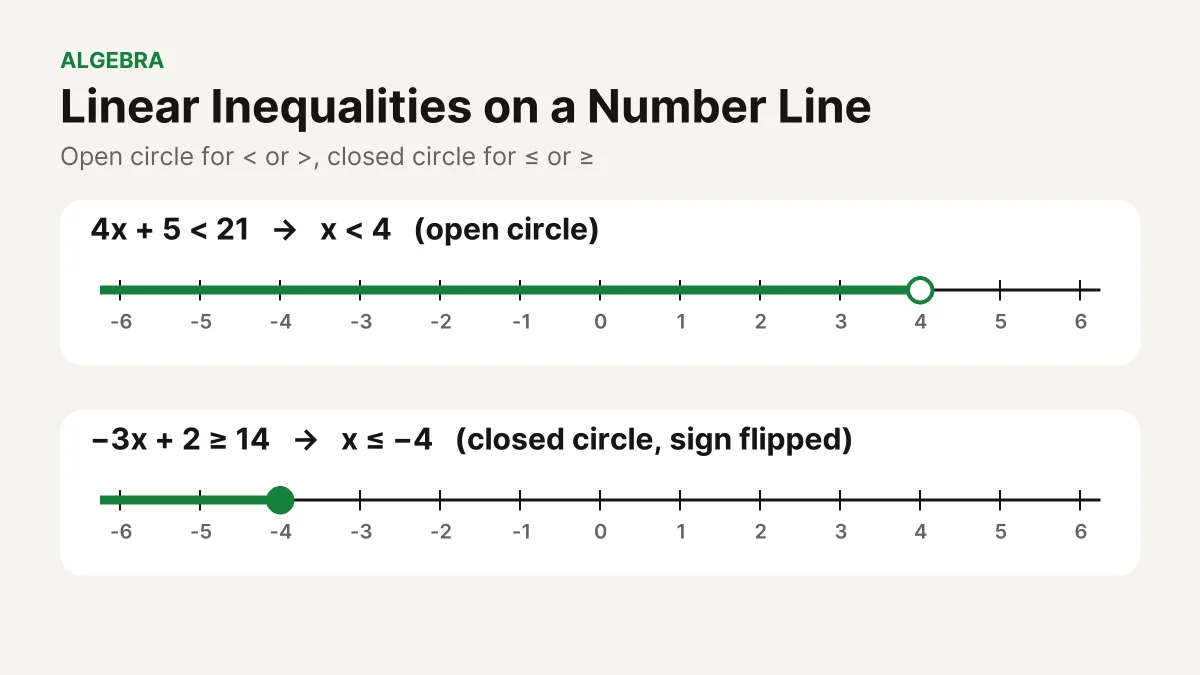
To solve a linear inequality, use the same steps as an equation, but flip the inequality sign whenever you multiply or divide both sides by a negative number. For 4x + 5 < 21, subtract 5 to get 4x < 16, then divide by 4: x < 4. For −3x + 2 ≥ 14, dividing by −3 flips the sign, so the answer is x ≤ −4.
In short: A linear inequality has one variable to the first power and a sign such as <, >, ≤ or ≥. Its answer is a range of numbers, not a single number.
In this guide
Inequality Symbols and What They Mean
| Symbol | Read as | Circle on the number line | Interval notation for x ? 4 |
|---|---|---|---|
| < | less than | Open | (−∞, 4) |
| > | greater than | Open | (4, ∞) |
| ≤ | less than or equal to | Closed (filled) | (−∞, 4] |
| ≥ | greater than or equal to | Closed (filled) | [4, ∞) |
How to Solve a Linear Inequality, Step by Step
- Simplify each side: remove brackets and combine like terms.
- Move the variable terms to one side and the numbers to the other by adding or subtracting.
- Divide (or multiply) to get x by itself. If you divide or multiply by a negative number, flip the sign.
- Write the answer, graph it on a number line, and check one number from the answer.
Adding or subtracting the same number on both sides never changes the direction of the sign. These are the same moves you use to solve for x in an equation.
Worked Examples
Example: One step at a time: 4x + 5 < 21. Subtract 5: 4x < 16. Divide by 4: x < 4.
Example: Dividing by a negative: −3x + 2 ≥ 14. Subtract 2: −3x ≥ 12. Divide by −3 and flip: x ≤ −4. Check x = −5: −3(−5) + 2 = 17, and 17 ≥ 14 ✓.
Example: Variables on both sides: 5x − 3 > 2x + 9. Subtract 2x: 3x − 3 > 9. Add 3: 3x > 12. Divide by 3: x > 4.
Example: With a fraction: x/3 + 2 ≤ 5. Subtract 2: x/3 ≤ 3. Multiply by 3: x ≤ 9.
Example: With brackets: 2(x − 3) ≥ 4x + 2. Expand: 2x − 6 ≥ 4x + 2. Subtract 4x: −2x − 6 ≥ 2. Add 6: −2x ≥ 8. Divide by −2 and flip: x ≤ −4.
Try it
Type an inequality such as 2(x − 3) ≥ 4x + 2 and get the answer with every step.
Why the Sign Flips With a Negative
Start with a true statement: 2 < 5. Multiply both sides by −1 and you get −2 and −5. On the number line −2 is to the right of −5, so −2 > −5. Multiplying by a negative mirrors the numbers around 0, which reverses their order. That is why the sign must flip.
Graphing and Interval Notation
- Draw a circle at the boundary number. Use an open circle for < or > and a closed circle for ≤ or ≥.
- Shade to the left for “less than” and to the right for “greater than”.
- In interval notation, use a round bracket ( ) for open ends and for ∞, and a square bracket [ ] for included ends.
| Answer | Graph | Interval notation |
|---|---|---|
| x < 4 | Open circle at 4, shade left | (−∞, 4) |
| x ≤ −4 | Closed circle at −4, shade left | (−∞, −4] |
| x > 4 | Open circle at 4, shade right | (4, ∞) |
| −2 < x ≤ 3 | Open at −2, closed at 3, shade between | (−2, 3] |
Compound Inequalities (“And” and “Or”)
“And” (three-part) inequalities: do the same step to all three parts.
Example: −3 < 2x + 1 ≤ 7. Subtract 1 from every part: −4 < 2x ≤ 6. Divide by 2: −2 < x ≤ 3, or (−2, 3]. The answer is the overlap between −2 and 3.
“Or” inequalities: solve each part on its own, then keep both answers.
Example: x + 2 < 0 or 3x > 9. The first gives x < −2, the second gives x > 3. Answer: x < −2 or x > 3, written (−∞, −2) ∪ (3, ∞).
When Every Number Works, or None Does
Sometimes the variable cancels out. Look at what is left:
- 2x + 3 < 2x + 7 becomes 3 < 7, which is always true, so every real number is a solution.
- 2x + 5 > 2x + 9 becomes 5 > 9, which is always false, so there is no solution.
How to Check Your Answer
Pick one number inside your answer and one outside it, and put both into the original inequality. The inside number must make it true and the outside number must make it false. For 4x + 5 < 21 (answer x < 4): x = 0 gives 5 < 21 ✓ and x = 5 gives 25 < 21 ✗, so the answer is correct.
Inequality Word Problems
| Words | Symbol |
|---|---|
| at least, no less than, minimum | ≥ |
| at most, no more than, maximum | ≤ |
| more than, greater than | > |
| less than, fewer than | < |
Example: Fair budget: You have $50. Entry costs $8 and each ride costs $3. How many rides can you take? 8 + 3r ≤ 50, so 3r ≤ 42 and r ≤ 14. You can take at most 14 rides.
Example: Test average: Your scores are 78, 85 and 90. What do you need on the fourth test for an average of at least 85? (78 + 85 + 90 + x) ÷ 4 ≥ 85, so 253 + x ≥ 340 and x ≥ 87. You can check averages with our mean, median and mode guide.
Common Mistakes
- Forgetting to flip the sign after multiplying or dividing by a negative.
- Flipping when you should not. Subtracting a number, or dividing by a positive number, keeps the sign the same.
- Using the wrong circle. ≤ and ≥ get a closed circle; < and > get an open one.
- Writing [ next to ∞. Infinity always gets a round bracket.
- In a three-part inequality, changing only the middle part instead of all three.
Practice Problems (With Answers)
1. Solve 3x − 7 > 8.
3x > 15, so x > 5.
2. Solve −2x + 5 ≤ 11.
−2x ≤ 6. Divide by −2 and flip: x ≥ −3.
3. Solve 6x + 1 < 2x − 11.
4x < −12, so x < −3.
4. Solve 1 ≤ 3x − 2 < 10 and write it in interval notation.
Add 2: 3 ≤ 3x < 12. Divide by 3: 1 ≤ x < 4, or [1, 4).
5. Tickets cost $12. How many must you sell to raise at least $150?
12n ≥ 150, so n ≥ 12.5. Tickets are whole numbers, so at least 13 tickets.
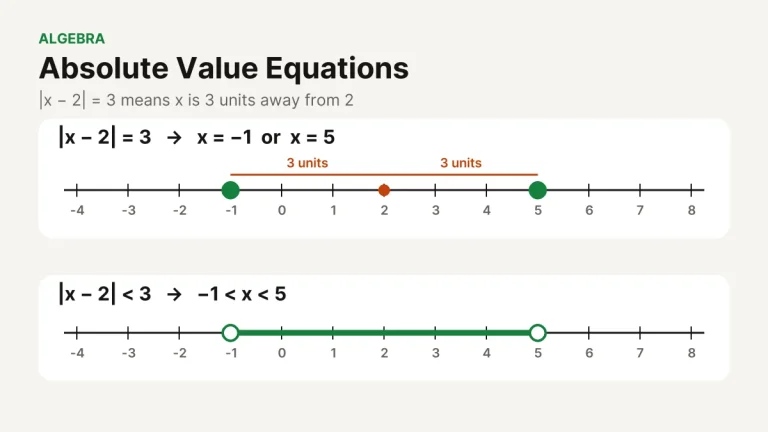
Next step: absolute value equations and inequalities, where |x − 2| < 3 becomes the compound inequality −1 < x < 5.
FAQ
How do you solve a linear inequality?
Solve it like an equation: simplify, move the x terms to one side, then divide. Flip the sign if you multiply or divide by a negative. For 4x + 5 < 21, the answer is x < 4.
When do you flip the inequality sign?
Only when you multiply or divide both sides by a negative number. Adding, subtracting, or dividing by a positive number never flips it.
What is the difference between an open and a closed circle?
An open circle means the number is not included (< or >). A closed circle means it is included (≤ or ≥).
How do you write an inequality in interval notation?
Write the smallest and largest values with brackets: round for not included or infinity, square for included. x ≤ −4 is (−∞, −4].
Can a linear inequality have no solution?
Yes. If the x terms cancel and leave a false statement such as 5 > 9, there is no solution. A true statement such as 3 < 7 means every number works.
Sources and Further Reading
- OpenStax, Elementary Algebra 2e, Section 2.7: Solve Linear Inequalities, Rice University.
- OpenStax, Intermediate Algebra 2e, Section 2.5: Solve Linear Inequalities.
Related: how to solve for x, systems of equations, slope-intercept form, algebra basics, the math glossary and all free math calculators.
Check your working in seconds
Type any problem from this guide into the free CalcSolver calculator and see the answer, with fractions, instantly.