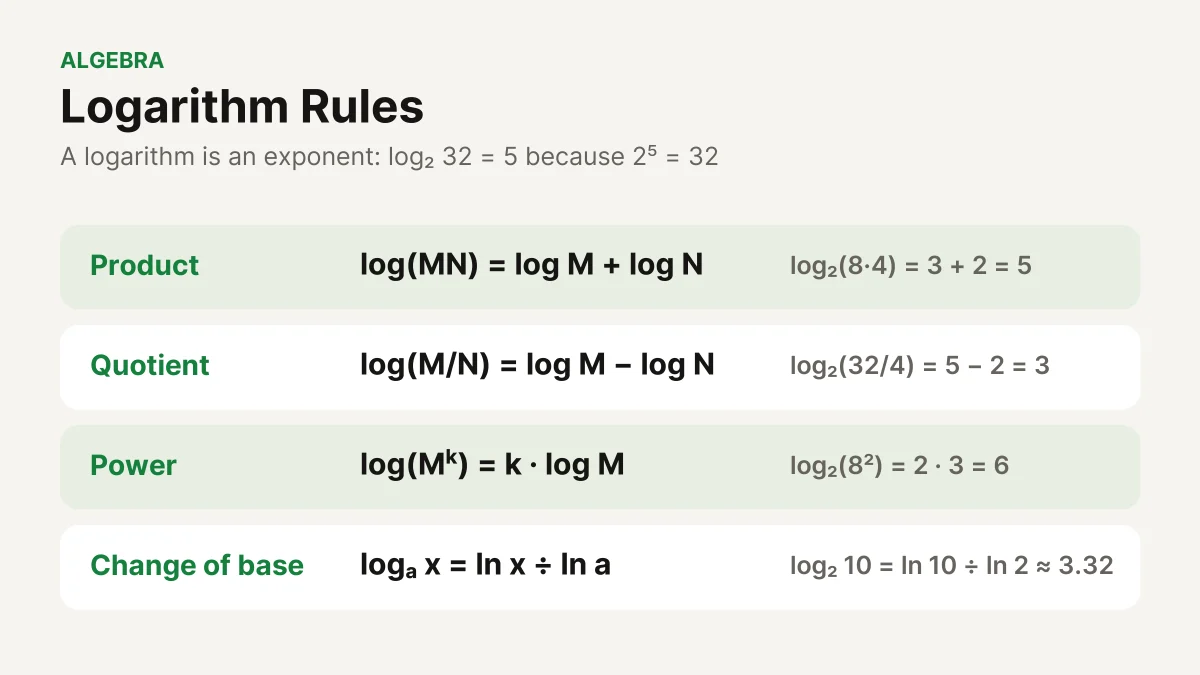
A logarithm answers “what power do I raise the base to?”: logb x = y means by = x. The main logarithm rules are the product rule logb(MN) = logb M + logb N, the quotient rule logb(M/N) = logb M − logb N, the power rule logb(Mk) = k logb M, and the change of base formula logb x = ln x ÷ ln b. For example, log2 32 = 5 because 25 = 32.
In short: Logs turn multiplication into addition, division into subtraction, and powers into multiplication. Every rule comes from an exponent rule.
In this guide
What a Logarithm Means
A logarithm is an exponent. The two forms below say the same thing:
| Exponential form | Logarithm form | In words |
|---|---|---|
| 25 = 32 | log2 32 = 5 | 2 to the power 5 is 32 |
| 103 = 1,000 | log 1,000 = 3 | log with no base means base 10 |
| 34 = 81 | log3 81 = 4 | 3 to the power 4 is 81 |
| e1 = e | ln e = 1 | ln means log base e (about 2.718) |
The base b must be positive and not 1, and you can only take the log of a positive number. log(0) and the log of a negative number are undefined.
The Logarithm Rules
| Rule | Formula | Example |
|---|---|---|
| Product | logb(MN) = logb M + logb N | log2(8 × 4) = 3 + 2 = 5 |
| Quotient | logb(M/N) = logb M − logb N | log2(32 ÷ 4) = 5 − 2 = 3 |
| Power | logb(Mk) = k · logb M | log2(82) = 2 × 3 = 6 |
| Zero | logb 1 = 0 | log7 1 = 0 |
| Identity | logb b = 1 | log 10 = 1 |
| Inverse | logb(bx) = x and blogb x = x | ln(e3) = 3 |
| Change of base | logb x = ln x ÷ ln b | log2 10 ≈ 3.3219 |
Why the Rules Work
Each log rule is an exponent rule in disguise. Since 8 = 23 and 4 = 22, 8 × 4 = 23 + 2 = 25. Multiplying the numbers added the exponents, and logs are exponents, so log2(8 × 4) = 3 + 2. Dividing subtracts exponents (the quotient rule) and raising to a power multiplies them (the power rule).
Expanding Logarithms
To expand, split products into sums, quotients into differences, then bring powers to the front.
Example: log3(9x2 ÷ y) = log3 9 + log3 x2 − log3 y = 2 + 2 log3 x − log3 y.
Condensing Logarithms
To condense, do the reverse: move numbers in front up as powers first, then combine sums and differences into one log.
Example: 2 log x + log 5 − log 2 = log x2 + log 5 − log 2 = log(5x2 ÷ 2).
Change of Base Formula
Most calculators only have log (base 10) and ln (base e). For any other base, use logb x = ln x ÷ ln b (or log x ÷ log b; both give the same answer).
Example: log2 10 = ln 10 ÷ ln 2 ≈ 2.302585 ÷ 0.693147 ≈ 3.3219. Check: 23.3219 ≈ 10.
Example: log5 100 = ln 100 ÷ ln 5 ≈ 2.8614.
Try it
Use the ln and log keys on the scientific calculator to work out any change-of-base problem, such as ln 10 ÷ ln 2.
Natural Log (ln) and Common Log (log)
- log x with no base is the common log, base 10: log 1,000 = 3.
- ln x is the natural log, base e ≈ 2.718: ln e = 1 and ln(e3) = 3.
- All the rules above work the same way for both.
Solving Equations With Logarithms
Example: An exponential equation: 3x = 20. Take ln of both sides: x ln 3 = ln 20, so x = ln 20 ÷ ln 3 ≈ 2.7268.
Example: A log equation: log2 x + log2(x − 2) = 3. Product rule: log2(x(x − 2)) = 3, so x(x − 2) = 23 = 8. Then x2 − 2x − 8 = 0, which factors to (x − 4)(x + 2) = 0. x = −2 would mean taking the log of a negative number, so the only answer is x = 4. Check: log2 4 + log2 2 = 2 + 1 = 3 ✓.
Always check log answers in the original equation and throw out any that make a log of zero or a negative number. For quadratics like the one above, see the quadratic formula.
Common Mistakes
- log(a + b) is not log a + log b. The product rule is for log(a × b).
- log a ÷ log b is not log(a ÷ b). log a ÷ log b is the change of base formula.
- (log x)2 is not 2 log x. The power rule only applies when the power is inside the log: log(x2) = 2 log x.
- Taking the log of 0 or a negative number. It is undefined, so reject such answers.
Practice Problems (With Answers)
1. Find log3 81.
34 = 81, so 4.
2. Simplify log2 16 + log2 4.
4 + 2 = 6 (or log2 64 = 6).
3. Simplify log 500 + log 2.
log(500 × 2) = log 1,000 = 3.
4. Find log2 50 to 4 decimal places.
ln 50 ÷ ln 2 ≈ 5.6439.
5. Solve log x + log(x − 3) = 1.
log(x(x − 3)) = 1, so x(x − 3) = 10 and x2 − 3x − 10 = 0, giving x = 5 or x = −2. Reject −2: x = 5.
FAQ
What are the rules of logarithms?
Product: log(MN) = log M + log N. Quotient: log(M/N) = log M − log N. Power: log(Mᵏ) = k log M. Change of base: logₐ x = ln x ÷ ln a. Also log 1 = 0 and log of the base is 1.
What is a logarithm in simple words?
It is the exponent you need. log₂ 32 = 5 because 2 raised to the power 5 is 32.
What is the difference between log and ln?
log usually means base 10 and ln means base e (about 2.718). log 100 = 2 and ln e = 1. The same rules apply to both.
How do you change the base of a logarithm?
Divide the ln (or log) of the number by the ln (or log) of the base. log₂ 10 = ln 10 ÷ ln 2 ≈ 3.3219.
Can you take the log of a negative number?
Not with real numbers. The log of 0 or a negative number is undefined, so answers that cause it must be rejected.
Sources and Further Reading
- OpenStax, Algebra and Trigonometry 2e, Section 6.5: Logarithmic Properties, Rice University.
- OpenStax, College Algebra with Corequisite Support 2e, Section 6.5: Logarithmic Properties.
Related: exponent rules, scientific notation, quadratic formula, absolute value equations, the math glossary and all free math calculators.
Check your working in seconds
Type any problem from this guide into the free CalcSolver calculator and see the answer, with fractions, instantly.