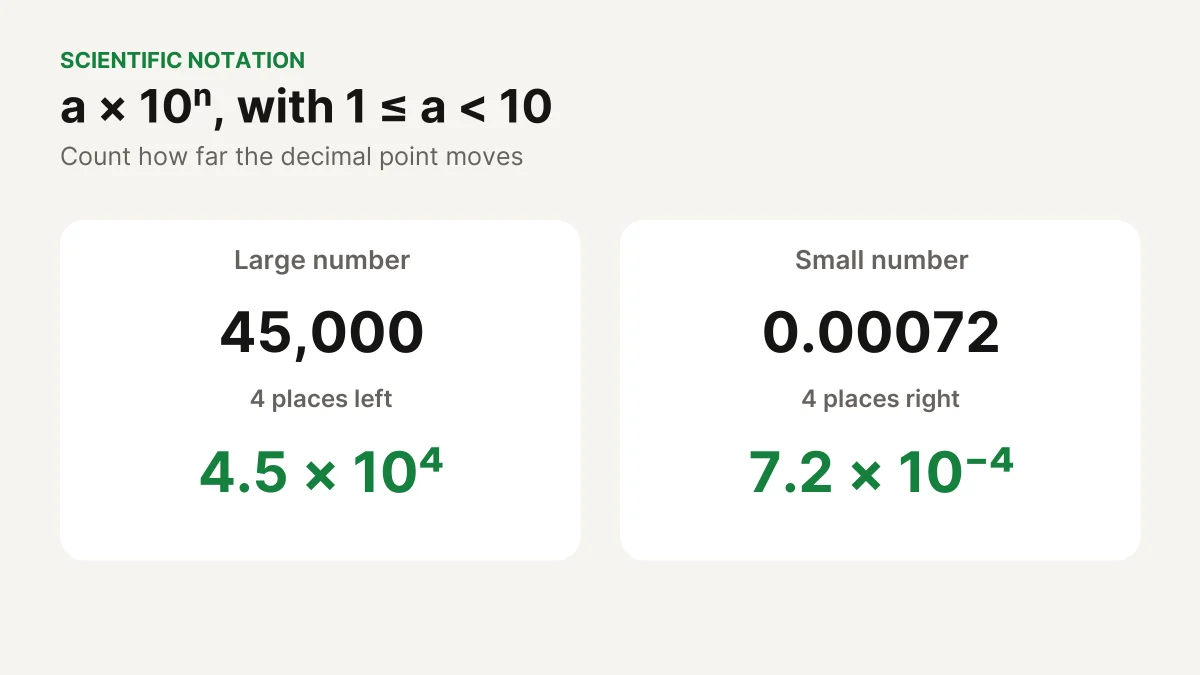
Scientific notation writes a number as a × 10n, where a is at least 1 but less than 10 and n is a whole number. Large numbers get a positive power of 10 and small numbers get a negative one: 45,000 = 4.5 × 10⁴ and 0.00072 = 7.2 × 10⁻⁴.
In short: Move the decimal point until one non-zero digit is in front of it. Count the moves: moving left gives a positive exponent (big number), moving right gives a negative exponent (small number).
In this guide
What Is Scientific Notation? The Rule
| Part | Rule | Example: 3.2 × 10⁶ |
|---|---|---|
| Coefficient (a) | 1 ≤ a < 10 | 3.2 |
| Base | Always 10 | 10 |
| Exponent (n) | Any integer | 6 |
| Standard form | — | 3,200,000 |
So 32 × 105 is not in scientific notation (32 is 10 or more), and neither is 0.32 × 10⁷ (0.32 is less than 1). Both equal 3.2 × 10⁶.
How to Write Large Numbers in Scientific Notation
- Put the decimal point after the first non-zero digit: 45,000 becomes 4.5.
- Count how many places the point moved to the left: 4.
- Write the count as a positive exponent: 4.5 × 10⁴.
Example: 3,200,000. The point moves 6 places left, so 3,200,000 = 3.2 × 10⁶.
How to Write Small Numbers in Scientific Notation
For a number less than 1, move the decimal point to the right until one non-zero digit is in front of it. The exponent is negative.
Example: 0.00072. The point moves 4 places right to give 7.2, so 0.00072 = 7.2 × 10⁻⁴.
Example: One nanometer. 1 nm = 0.000000001 m. The point moves 9 places right, so 1 nm = 1 × 10⁻⁹ m.
How to Convert Scientific Notation to Standard Form
Do the opposite: a positive exponent moves the decimal point right (the number gets bigger), and a negative exponent moves it left (the number gets smaller). Fill gaps with zeros.
| Scientific notation | Move the point | Standard form |
|---|---|---|
| 6.02 × 10³ | 3 places right | 6,020 |
| 2.3 × 10⁵ | 5 places right | 230,000 |
| 5.4 × 10⁻³ | 3 places left | 0.0054 |
How to Multiply and Divide in Scientific Notation
Multiply (or divide) the coefficients, then use the exponent rules for the powers of 10: add the exponents when multiplying and subtract them when dividing. If the new coefficient is 10 or more, or less than 1, adjust it.
Example: (3 × 104) × (2 × 105). 3 × 2 = 6 and 104+5 = 109, so the answer is 6 × 10⁹.
Example: (5 × 103) × (4 × 102). 5 × 4 = 20, giving 20 × 105. Since 20 is not below 10, rewrite it as 2 × 101: the answer is 2 × 10⁶.
Example: (8 × 10⁷) ÷ (2 × 10³). 8 ÷ 2 = 4 and 107−3 = 104, so the answer is 4 × 10⁴.
Example: (1.5 × 10²) ÷ (3 × 10⁵). 1.5 ÷ 3 = 0.5 and 102−5 = 10−3, giving 0.5 × 10−3 = 5 × 10⁻⁴.
How to Add and Subtract in Scientific Notation
You can only add or subtract the coefficients when the powers of 10 are the same. Rewrite one number first so the exponents match.
Example: 3.2 × 10⁴ + 4.5 × 10³. Rewrite 4.5 × 10³ as 0.45 × 10⁴. Then 3.2 + 0.45 = 3.65, so the sum is 3.65 × 10⁴.
Example: 7 × 10⁵ − 2.5 × 10⁴. Rewrite 2.5 × 10⁴ as 0.25 × 10⁵. Then 7 − 0.25 = 6.75, so the difference is 6.75 × 10⁵.
Scientific Notation on a Calculator (E Notation)
Many calculators and spreadsheets show very large or small answers in E notation. The E stands for “× 10 to the power of”.
| Display | Meaning | Standard form |
|---|---|---|
| 3.2E6 | 3.2 × 10⁶ | 3,200,000 |
| 7.2E-4 | 7.2 × 10⁻⁴ | 0.00072 |
On the CalcSolver calculator you can type a power of 10 directly with the ^ key, for example 3.2×10^6. For more on calculator keys, see log vs ln on a calculator.
Try it
Type numbers like 3.2×10^6 or (3×10^4)×(2×10^5) on the free calculator to check your answers.
Real-World Examples
| Quantity | Standard form | Scientific notation |
|---|---|---|
| Speed of light in a vacuum | 299,792,458 m/s | ≈ 3.00 × 10⁸ m/s |
| One nanometer | 0.000000001 m | 1 × 10⁻⁹ m |
| One million | 1,000,000 | 1 × 10⁶ |
| One thousandth | 0.001 | 1 × 10⁻³ |
The speed of light is exactly 299,792,458 m/s, the value used to define the metre. Rounded to three significant figures it is 3.00 × 10⁸ m/s; the zeros after the decimal point show that it is accurate to three figures.
Common Mistakes
- A coefficient that is too big or too small. 12 × 103 should be 1.2 × 10⁴.
- The wrong sign on the exponent. Small numbers (less than 1) always have a negative exponent.
- Adding exponents when adding numbers. Only multiplication adds exponents; for addition, match the exponents first.
- Counting zeros instead of decimal places. Count how far the decimal point moves, not how many zeros there are.
Practice Problems (With Answers)
1. Write 0.0005 in scientific notation.
5 × 10⁻⁴.
2. Write 81,000 in scientific notation.
8.1 × 10⁴.
3. Write 2.3 × 10⁵ in standard form.
230,000.
4. Multiply (6 × 103) × (3 × 104).
18 × 107 = 1.8 × 10⁸.
5. Divide (9 × 10⁶) ÷ (3 × 10²).
3 × 10⁴.
FAQ
What is scientific notation?
It is a way to write a number as a × 10^n, where a is at least 1 and less than 10. For example, 45,000 = 4.5 × 10^4.
How do you write a small number in scientific notation?
Move the decimal point right until one non-zero digit is in front, then use a negative exponent equal to the number of places moved: 0.00072 = 7.2 × 10^−4.
How do you multiply numbers in scientific notation?
Multiply the coefficients and add the exponents: (3 × 10^4) × (2 × 10^5) = 6 × 10^9. Adjust if the coefficient is 10 or more.
What does E mean on a calculator?
E means “times 10 to the power of”. 3.2E6 is 3.2 × 10^6, or 3,200,000.
Is 0.5 × 10^3 in scientific notation?
No, because 0.5 is less than 1. The correct form is 5 × 10^2.
Sources and Further Reading
- OpenStax, Prealgebra, Section 10.5: Integer Exponents and Scientific Notation, Rice University.
- OpenStax, Elementary Algebra, Section 6.7: Integer Exponents and Scientific Notation.
Learn more about powers in the exponent rules guide and square roots and cube roots.
Check your working in seconds
Type any problem from this guide into the free CalcSolver calculator and see the answer, with fractions, instantly.