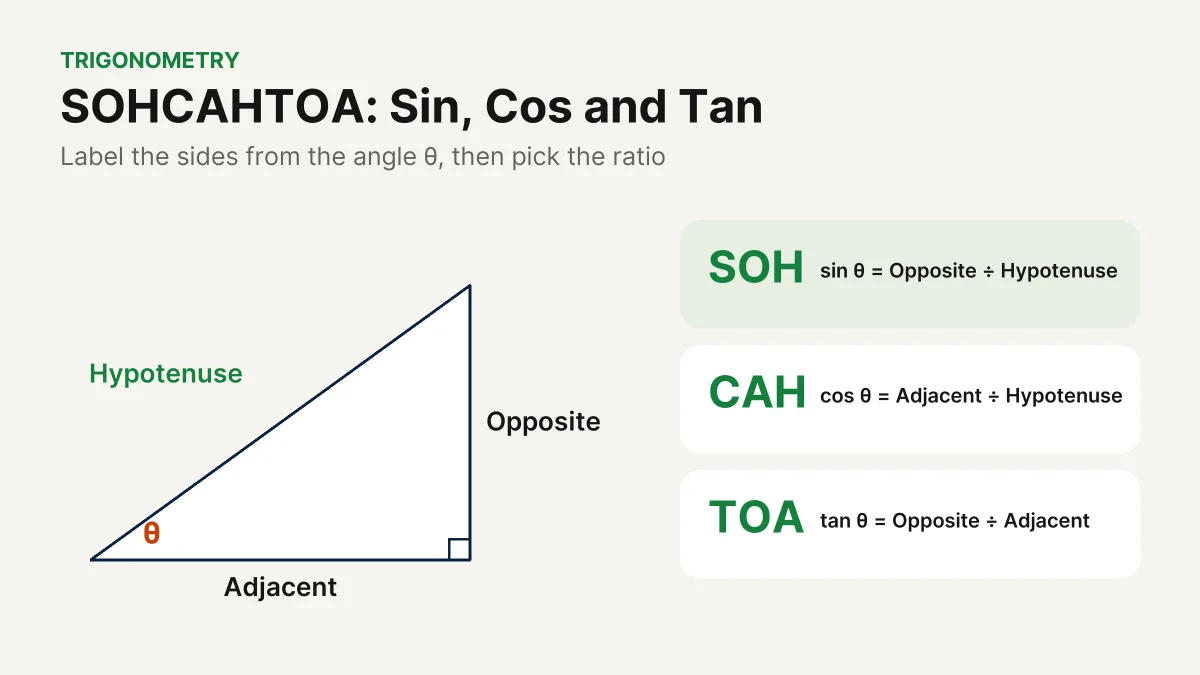
SOHCAHTOA is a memory aid for the three main trig ratios in a right triangle: Sine = Opposite ÷ Hypotenuse (SOH), Cosine = Adjacent ÷ Hypotenuse (CAH) and Tangent = Opposite ÷ Adjacent (TOA). In a 3-4-5 triangle, for the angle opposite the side 3, sin θ = 3/5 = 0.6, cos θ = 4/5 = 0.8 and tan θ = 3/4 = 0.75, so θ ≈ 36.87°.
In short: Label the sides from the angle you are using. Pick the ratio that links the two sides you know (or need). Use sin, cos or tan to find a side, and sin⁻¹, cos⁻¹ or tan⁻¹ to find an angle. Keep the calculator in degree mode.
In this guide
What SOHCAHTOA Means
| Part | Ratio | Formula |
|---|---|---|
| SOH | Sine | sin θ = Opposite ÷ Hypotenuse |
| CAH | Cosine | cos θ = Adjacent ÷ Hypotenuse |
| TOA | Tangent | tan θ = Opposite ÷ Adjacent |
These ratios only work in a right triangle (one 90° angle). For other triangles, use the law of sines or the law of cosines; the triangle calculator does both.
Step 1: Label the Sides
- Hypotenuse: the longest side, across from the right angle. It never changes.
- Opposite: the side across from the angle θ you are working with.
- Adjacent: the side next to θ that is not the hypotenuse.
Opposite and adjacent swap if you switch to the other acute angle, so always label from the angle in the question.
Step 2: Choose Sin, Cos or Tan
| You know or need… | Use |
|---|---|
| Opposite and hypotenuse | sin (SOH) |
| Adjacent and hypotenuse | cos (CAH) |
| Opposite and adjacent | tan (TOA) |
How to Find a Missing Side
Write the ratio, put in the numbers, then rearrange. If the unknown is on top, multiply. If it is on the bottom, divide.
Example: Hypotenuse 10, angle 30°, find the opposite side. sin 30° = x ÷ 10, so x = 10 × sin 30° = 10 × 0.5 = 5.
Example: Hypotenuse 12, angle 40°, find the adjacent side. x = 12 × cos 40° ≈ 9.19.
Example: Adjacent 20, angle 35°, find the opposite side. x = 20 × tan 35° ≈ 14.00.
Example: Opposite 6, angle 25°, find the hypotenuse. sin 25° = 6 ÷ x, so x = 6 ÷ sin 25° ≈ 14.20. The unknown is on the bottom, so you divide.
How to Find a Missing Angle
When you know two sides, find the ratio and use the inverse key: sin⁻¹, cos⁻¹ or tan⁻¹ (often SHIFT + sin on a calculator).
Example: Opposite 7, adjacent 9. tan θ = 7/9, so θ = tan⁻¹(7/9) ≈ 37.87°.
Example: Adjacent 5, hypotenuse 13. cos θ = 5/13, so θ = cos⁻¹(5/13) ≈ 67.38°.
Check: the two acute angles of a right triangle add up to 90°, so the other angle is 90° − 67.38° = 22.62°.
Special Angles Table (0°, 30°, 45°, 60°, 90°)
These exact values come up on tests without a calculator.
| Angle | sin | cos | tan |
|---|---|---|---|
| 0° | 0 | 1 | 0 |
| 30° | 1/2 | √3/2 ≈ 0.866 | √3/3 ≈ 0.577 |
| 45° | √2/2 ≈ 0.707 | √2/2 ≈ 0.707 | 1 |
| 60° | √3/2 ≈ 0.866 | 1/2 | √3 ≈ 1.732 |
| 90° | 1 | 0 | undefined |
Notice that sin 30° = cos 60° and sin 60° = cos 30°. For any angle, sin θ = cos(90° − θ).
Word Problems
Example: Angle of elevation. From 25 m away, the angle up to the top of a tree is 32°. Height = 25 × tan 32° ≈ 15.62 m.
Example: Ladder. A 6 m ladder makes a 70° angle with the ground. It reaches 6 × sin 70° ≈ 5.64 m up the wall.
Example: Ramp. A ramp rises 1 m over a horizontal distance of 12 m. Its angle is tan⁻¹(1/12) ≈ 4.76°.
If you know two sides and need the third, the Pythagorean theorem is often faster than trig.
How to Use Sin, Cos and Tan on a Calculator
- Check that the screen shows DEG (degrees), not RAD.
- For a side, type the number and the ratio, such as
10 × sin(30)= 5. - For an angle, use the inverse key, such as
tan⁻¹(7÷9)= 37.87….
In radian mode, sin(30) gives about −0.988 instead of 0.5, a common reason for wrong answers. The CalcSolver scientific calculator has a DEG/RAD switch.
Try it
Enter two sides, or a side and an angle, of a right triangle and get every side and angle with steps.
Csc, Sec and Cot (Reciprocal Ratios)
Each main ratio has a reciprocal: csc θ = 1 ÷ sin θ, sec θ = 1 ÷ cos θ and cot θ = 1 ÷ tan θ. For example, sec 60° = 1 ÷ 0.5 = 2. Most calculators have no csc key, so you divide 1 by sin instead.
Common Mistakes
- Calculator in radian mode. Switch to degrees for angles given in degrees.
- Labelling from the wrong angle. Opposite and adjacent depend on which angle you use.
- Multiplying when you should divide. If the unknown is on the bottom of the ratio, divide.
- Using sin instead of sin⁻¹ for an angle. Finding an angle needs the inverse key.
- Using SOHCAHTOA on a triangle with no right angle.
Practice Problems (With Answers)
1. Hypotenuse 15, angle 40°. Find the opposite side.
15 × sin 40° ≈ 9.64.
2. Opposite 8, angle 50°. Find the adjacent side.
tan 50° = 8 ÷ x, so x = 8 ÷ tan 50° ≈ 6.71.
3. Opposite 4, hypotenuse 9. Find the angle.
sin⁻¹(4/9) ≈ 26.39°.
4. From 30 m away, the angle of elevation to a roof is 20°. How high is the roof?
30 × tan 20° ≈ 10.92 m.
5. Adjacent 11, hypotenuse 14. Find the angle.
cos⁻¹(11/14) ≈ 38.21°.
FAQ
What does SOHCAHTOA stand for?
Sine = Opposite ÷ Hypotenuse, Cosine = Adjacent ÷ Hypotenuse, Tangent = Opposite ÷ Adjacent.
How do I know whether to use sin, cos or tan?
Look at the two sides involved. Opposite and hypotenuse: sin. Adjacent and hypotenuse: cos. Opposite and adjacent: tan.
How do you find an angle with SOHCAHTOA?
Find the ratio of the two known sides and use the inverse key. For opposite 7 and adjacent 9, the angle is tan⁻¹(7/9) ≈ 37.87°.
Why does my calculator give the wrong sin value?
It is probably in radian mode. In degree mode sin 30° = 0.5; in radian mode sin(30) ≈ −0.988.
Does SOHCAHTOA work for all triangles?
No. It only works for right triangles. Use the law of sines or cosines for other triangles.
Sources and Further Reading
- OpenStax, Precalculus 2e, Section 5.4: Right Triangle Trigonometry, Rice University.
- OpenStax, Contemporary Mathematics, Section 10.8: Right Triangle Trigonometry.
Related: Pythagorean theorem, square roots and cube roots, log vs ln on a calculator and all free math calculators.
Check your working in seconds
Type any problem from this guide into the free CalcSolver calculator and see the answer, with fractions, instantly.