To change a fraction of an inch to a decimal, divide the top number by the bottom number: 5/16″ = 5 ÷ 16 = 0.3125″. To get millimeters, multiply the decimal by 25.4: 0.3125 × 25.4 = 7.9375 mm. The charts below list every fraction from 1/64″ to 1″ in decimal inches and millimeters, so you can read the answer straight off.
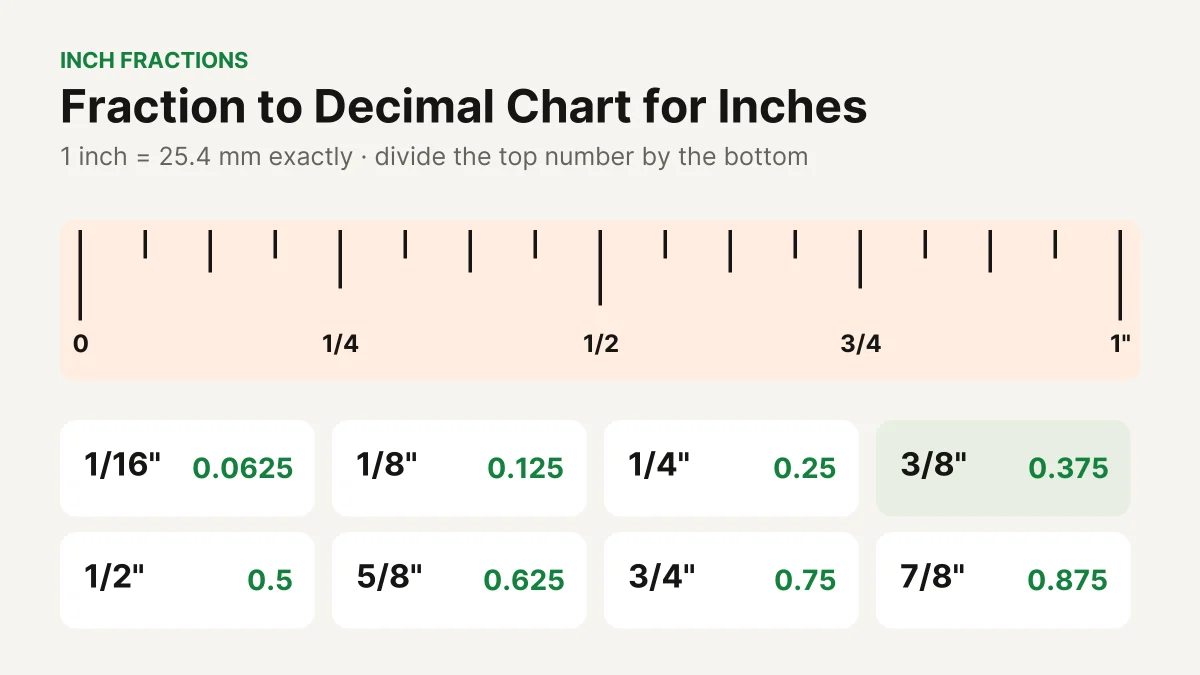
In short: 1/16″ = 0.0625″, 1/8″ = 0.125″, 1/4″ = 0.25″, 3/8″ = 0.375″, 1/2″ = 0.5″, 5/8″ = 0.625″, 3/4″ = 0.75″, 7/8″ = 0.875″. Inches × 25.4 = millimeters.
In this guide
Common Inch Fractions to Decimals (1/16 Chart)
| Fraction | Decimal inches | Millimeters |
|---|---|---|
| 1/16″ | 0.0625″ | 1.587 mm |
| 1/8″ | 0.125″ | 3.175 mm |
| 3/16″ | 0.1875″ | 4.763 mm |
| 1/4″ | 0.25″ | 6.350 mm |
| 5/16″ | 0.3125″ | 7.938 mm |
| 3/8″ | 0.375″ | 9.525 mm |
| 7/16″ | 0.4375″ | 11.113 mm |
| 1/2″ | 0.5″ | 12.700 mm |
| 9/16″ | 0.5625″ | 14.287 mm |
| 5/8″ | 0.625″ | 15.875 mm |
| 11/16″ | 0.6875″ | 17.462 mm |
| 3/4″ | 0.75″ | 19.050 mm |
| 13/16″ | 0.8125″ | 20.637 mm |
| 7/8″ | 0.875″ | 22.225 mm |
| 15/16″ | 0.9375″ | 23.812 mm |
| 1″ | 1″ | 25.400 mm |
Every fraction of an inch with 2, 4, 8, 16, 32 or 64 on the bottom gives a decimal that ends. That is because these denominators only have 2 as a prime factor.
Full Fraction to Decimal Chart (1/64″ to 1″) With MM
Use this chart for drill bits, machining and anything measured in 64ths. Fractions are shown in lowest terms, so 2/64 appears as 1/32.
| Fraction (in) | Decimal (in) | Millimeters |
|---|---|---|
| 1/64″ | 0.015625 | 0.397 |
| 1/32″ | 0.03125 | 0.794 |
| 3/64″ | 0.046875 | 1.191 |
| 1/16″ | 0.0625 | 1.587 |
| 5/64″ | 0.078125 | 1.984 |
| 3/32″ | 0.09375 | 2.381 |
| 7/64″ | 0.109375 | 2.778 |
| 1/8″ | 0.125 | 3.175 |
| 9/64″ | 0.140625 | 3.572 |
| 5/32″ | 0.15625 | 3.969 |
| 11/64″ | 0.171875 | 4.366 |
| 3/16″ | 0.1875 | 4.763 |
| 13/64″ | 0.203125 | 5.159 |
| 7/32″ | 0.21875 | 5.556 |
| 15/64″ | 0.234375 | 5.953 |
| 1/4″ | 0.25 | 6.350 |
| 17/64″ | 0.265625 | 6.747 |
| 9/32″ | 0.28125 | 7.144 |
| 19/64″ | 0.296875 | 7.541 |
| 5/16″ | 0.3125 | 7.938 |
| 21/64″ | 0.328125 | 8.334 |
| 11/32″ | 0.34375 | 8.731 |
| 23/64″ | 0.359375 | 9.128 |
| 3/8″ | 0.375 | 9.525 |
| 25/64″ | 0.390625 | 9.922 |
| 13/32″ | 0.40625 | 10.319 |
| 27/64″ | 0.421875 | 10.716 |
| 7/16″ | 0.4375 | 11.113 |
| 29/64″ | 0.453125 | 11.509 |
| 15/32″ | 0.46875 | 11.906 |
| 31/64″ | 0.484375 | 12.303 |
| 1/2″ | 0.5 | 12.700 |
| 33/64″ | 0.515625 | 13.097 |
| 17/32″ | 0.53125 | 13.494 |
| 35/64″ | 0.546875 | 13.891 |
| 9/16″ | 0.5625 | 14.287 |
| 37/64″ | 0.578125 | 14.684 |
| 19/32″ | 0.59375 | 15.081 |
| 39/64″ | 0.609375 | 15.478 |
| 5/8″ | 0.625 | 15.875 |
| 41/64″ | 0.640625 | 16.272 |
| 21/32″ | 0.65625 | 16.669 |
| 43/64″ | 0.671875 | 17.066 |
| 11/16″ | 0.6875 | 17.462 |
| 45/64″ | 0.703125 | 17.859 |
| 23/32″ | 0.71875 | 18.256 |
| 47/64″ | 0.734375 | 18.653 |
| 3/4″ | 0.75 | 19.050 |
| 49/64″ | 0.765625 | 19.447 |
| 25/32″ | 0.78125 | 19.844 |
| 51/64″ | 0.796875 | 20.241 |
| 13/16″ | 0.8125 | 20.637 |
| 53/64″ | 0.828125 | 21.034 |
| 27/32″ | 0.84375 | 21.431 |
| 55/64″ | 0.859375 | 21.828 |
| 7/8″ | 0.875 | 22.225 |
| 57/64″ | 0.890625 | 22.622 |
| 29/32″ | 0.90625 | 23.019 |
| 59/64″ | 0.921875 | 23.416 |
| 15/16″ | 0.9375 | 23.812 |
| 61/64″ | 0.953125 | 24.209 |
| 31/32″ | 0.96875 | 24.606 |
| 63/64″ | 0.984375 | 25.003 |
| 1″ | 1 | 25.400 |
How to Convert a Fraction of an Inch to a Decimal
- Divide the numerator (top) by the denominator (bottom).
- For a mixed number such as 1 7/8″, convert the fraction and add the whole inches: 7 ÷ 8 = 0.875, so 1 7/8″ = 1.875″.
- For millimeters, multiply the decimal inches by 25.4. 1.875 × 25.4 = 47.625 mm.
Example: 3/8″ = 3 ÷ 8 = 0.375″ = 0.375 × 25.4 = 9.525 mm.
Our fraction to decimal calculator shows the long division; for the method in more detail, see how to convert fractions to decimals.
How to Convert a Decimal to the Nearest Fraction of an Inch
Multiply the decimal by the precision you want (16, 32 or 64), round to the nearest whole number, and put it over that number. Then simplify.
| 0.61″ to the nearest… | Working | Answer |
|---|---|---|
| 1/16 | 0.61 × 16 = 9.76 → 10/16 | 5/8″ (0.625) |
| 1/32 | 0.61 × 32 = 19.52 → 20/32 | 5/8″ (0.625) |
| 1/64 | 0.61 × 64 = 39.04 → 39/64 | 39/64″ (0.609375) |
Example: 0.8″ to the nearest 16th: 0.8 × 16 = 12.8 → 13, so 0.8″ ≈ 13/16″ (0.8125″).
To go from a decimal to an exact fraction (not rounded), see how to convert a decimal to a fraction.
How to Read Fractions on a Tape Measure
Most tape measures mark each inch in 16ths. The longest mark in the middle is 1/2″, the next longest are 1/4″ and 3/4″, then the 8ths, and the shortest marks are 16ths.
Example: The end of a board is 11 small marks past the 2-inch line. That is 2 11/16″, or 2 + 11 ÷ 16 = 2.6875″.
Always simplify: 12/16″ is 3/4″ and 6/32″ is 3/16″. The simplifying fractions guide explains how.
How to Convert Millimeters to a Fraction of an Inch
Divide millimeters by 25.4 to get decimal inches, then round to the nearest fraction as above.
Example: 10 mm ÷ 25.4 ≈ 0.3937″. To the nearest 64th: 0.3937 × 64 ≈ 25.2 → 25/64″. To the nearest 16th it is 3/8″, slightly smaller than 10 mm.
Try it
Type any fraction or mixed number, such as 1 7/8, and get the decimal, the percent and the long-division steps.
Common Mistakes
- Dividing the wrong way. 5/16 is 5 ÷ 16 = 0.3125, not 16 ÷ 5.
- Forgetting the whole inches in a mixed number like 2 11/16″.
- Using 25 instead of 25.4. The inch is defined as exactly 25.4 mm.
- Rounding too early. Keep the full decimal (0.3125) until the last step when converting to millimeters.
- Not simplifying. 8/16″ should be written as 1/2″.
Practice Problems (With Answers)
1. Convert 7/16″ to a decimal.
7 ÷ 16 = 0.4375″.
2. Convert 9/32″ to millimeters.
9 ÷ 32 = 0.28125″, and 0.28125 × 25.4 = 7.14375 mm.
3. Round 0.3″ to the nearest 16th.
0.3 × 16 = 4.8 → 5, so 5/16″.
4. Round 0.71″ to the nearest 64th.
0.71 × 64 = 45.44 → 45, so 45/64″.
5. Write 1 3/16″ as a decimal.
1 + 3 ÷ 16 = 1.1875″.
FAQ
What is 1/16 of an inch as a decimal?
1/16″ = 0.0625″, which is 1.5875 mm.
What is 5/8 of an inch in decimal and mm?
5/8″ = 0.625″ = 15.875 mm.
How do you convert a fraction of an inch to a decimal?
Divide the top number by the bottom number. For example, 3/8″ = 3 ÷ 8 = 0.375″.
How do you convert a decimal to the nearest 16th of an inch?
Multiply by 16, round to a whole number and write it over 16. 0.61 × 16 = 9.76, which rounds to 10, so 0.61″ ≈ 10/16″ = 5/8″.
How many millimeters are in an inch?
Exactly 25.4 mm. Multiply decimal inches by 25.4 to get millimeters.
Sources and Further Reading
- NIST: Unit Conversion (1 inch = 25.4 mm exactly).
- NIST Handbook 44, Appendix C: General Tables of Units of Measurement.
- OpenStax Prealgebra, Section 5.3: Decimals and Fractions, Rice University.
Related: fraction chart (fractions to decimals and percents), fraction calculator, fractions to decimals and all free math calculators.
Check your working in seconds
Type any problem from this guide into the free CalcSolver calculator and see the answer, with fractions, instantly.