An algebraic expression is a math phrase made of numbers, letters and operations, such as 2x² + 3x − 5. There is no equals sign, so you do not solve it. Instead you do one of two things: evaluate it, which means finding its value for a given number, or simplify it, which means writing it in a shorter form. This guide shows both, step by step, with worked examples.
In short: To evaluate an expression, replace each letter with its value in brackets and follow the order of operations. To simplify it, multiply out brackets and combine like terms.
In this guide
What Is an Algebraic Expression?
An algebraic expression combines variables (letters), numbers and operations such as +, −, × and ÷. Here are the parts of 5x² − 3x + 8:
| Part | Meaning | In 5x² − 3x + 8 |
|---|---|---|
| Term | Each piece separated by + or −, with its sign | 5x², −3x and 8 |
| Variable | A letter that stands for a number | x |
| Coefficient | The number multiplying the variable | 5 and −3 |
| Constant | A term with no variable | 8 |
| Degree | The highest power of the variable | 2 |
Keep each term’s sign with it. In 5x² − 3x + 8, the middle term is −3x, not 3x. That one habit prevents most sign errors.
Numerical vs Algebraic Expressions
A numerical expression has only numbers, such as 4 × 6 − 2, and it already has one value: 22. An algebraic expression has at least one variable, such as 4x − 2, so its value depends on x. When x = 6, 4x − 2 is 22; when x = 10, it is 38.
In short: A numerical expression has a fixed value. An algebraic expression has a letter, so its value changes with the number you put in.
How to Evaluate an Algebraic Expression
To evaluate means to find the value of the expression for given values of the variables. It is also called substitution.
- Replace each variable with its value, and put the value in brackets.
- Follow the order of operations: brackets, powers, multiplication and division, then addition and subtraction.
- Work out the final number.
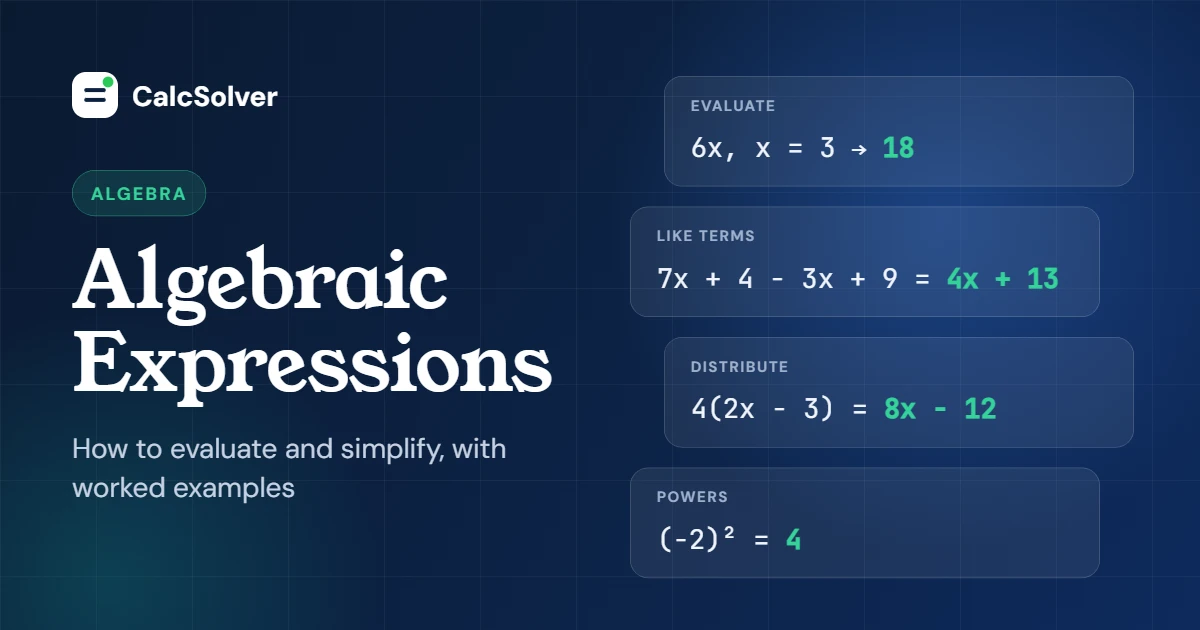
Example: Evaluate 6x when x = 3 → 6(3) = 18.
Example: Evaluate 2x² + 3x − 5 when x = 4 → 2(4)² + 3(4) − 5 = 2(16) + 12 − 5 = 32 + 12 − 5 = 39.
Example: Evaluate the same expression when x = −2 → 2(−2)² + 3(−2) − 5 = 2(4) − 6 − 5 = 8 − 6 − 5 = −3.
Example: Evaluate 3a − 2b when a = 5 and b = 4 → 3(5) − 2(4) = 15 − 8 = 7.
The brackets matter most with negative numbers. (−2)² = 4, because the whole −2 is squared. But −2² = −4, because only the 2 is squared and the minus sign is applied after.
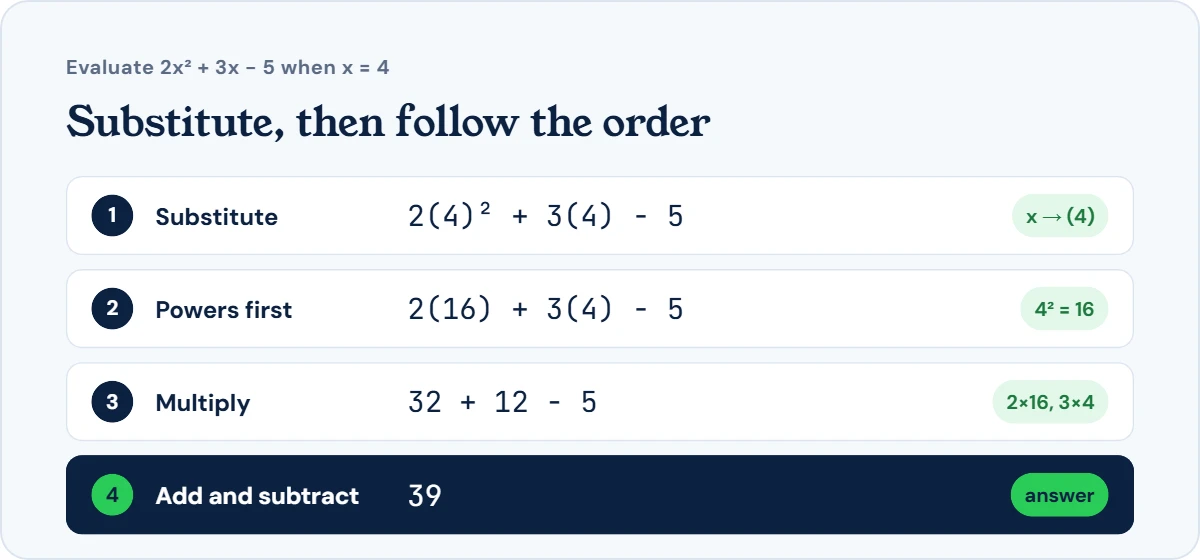
In short: Put each value in brackets, do the powers first, then multiplication, then addition and subtraction.
How to Simplify an Algebraic Expression
To simplify means to write the expression with as few terms as possible, without changing its value. Use these steps in order.
- Multiply out any brackets using the distributive property: a(b + c) = ab + ac.
- Group like terms together, keeping each sign with its term.
- Combine like terms by adding or subtracting their coefficients.
- Write the answer in standard form, with the highest power first.
Like terms have exactly the same variable raised to exactly the same power. Only like terms can be combined.
| Terms | Like terms? | Why |
|---|---|---|
| 3x and −5x | Yes | Same variable, same power |
| 4x² and 4x | No | Different powers of x |
| 2xy and −7yx | Yes | xy and yx are the same, because order does not matter in multiplication |
| 6a and 6b | No | Different variables |
Example: 7x + 4 − 3x + 9 → (7x − 3x) + (4 + 9) = 4x + 13.
Example: 4(2x − 3) + 5x → 8x − 12 + 5x = 13x − 12.
Example: 5 − 2(x − 4) → 5 − 2x + 8 = −2x + 13. The −2 multiplies both terms, so −2 × −4 = +8.
Example: 3x² + 2x − x² + 6x − 4 → (3x² − x²) + (2x + 6x) − 4 = 2x² + 8x − 4.
Example: x/2 + x/3 → use a common denominator of 6: 3x/6 + 2x/6 = 5x/6.
In short: Open brackets, then add or subtract only like terms: same letter and same power. Everything else stays as it is.
How to Multiply Terms
Adding and multiplying follow different rules. You can only add like terms, but you can multiply any terms: multiply the numbers, then multiply the letters.
| Multiply | Answer | Rule |
|---|---|---|
| x · x | x² | Same letter: add the powers (1 + 1 = 2) |
| 2x · 3x | 6x² | 2 × 3 = 6, and x · x = x² |
| 4a · 5b | 20ab | Different letters are written side by side |
| 3x² · 2x³ | 6x⁵ | Add the powers: 2 + 3 = 5 |
Compare: x + x = 2x, but x · x = x².
Simplify First, Then Evaluate
When an expression is long, simplify it before you substitute. There is less to calculate, and you can use the long form to check the short one.
Example: Evaluate 3(x + 2) + 2(x − 1) when x = 5. Simplify first: 3x + 6 + 2x − 2 = 5x + 4. Then substitute: 5(5) + 4 = 29.
Check with the original form: 3(5 + 2) + 2(5 − 1) = 21 + 8 = 29. On the CalcSolver calculator, type 3×(5+2)+2×(5−1) and you get 29, the same answer. If the two values match, your simplification is correct.
How to Write an Expression From Words
| Words | Expression |
|---|---|
| 5 more than a number | x + 5 |
| 3 less than a number | x − 3 |
| Twice a number | 2x |
| The product of 4 and a number | 4x |
| A number divided by 6 | x/6 |
| Five less than twice a number | 2x − 5 |
| The square of a number, plus 1 | x² + 1 |
Watch the order with “less than”. “3 less than a number” means start with the number and take 3 away, so it is x − 3, not 3 − x.
Common Mistakes
- Combining unlike terms. 3x + 2 is already simplified. It is not 5x.
- Adding powers when adding terms. x² + x² = 2x², not x⁴. Powers are added only when you multiply.
- Distributing a minus sign to one term only. −(x − 4) = −x + 4, because the minus applies to both terms.
- Squaring a negative without brackets. When x = −3, x² is (−3)² = 9, not −9.
- Mixing up 2x² and (2x)². When x = 3, 2x² = 18, but (2x)² = 36.
Practice Problems (With Answers)
1. Evaluate 4x + 7 when x = 5
27. 4(5) + 7 = 20 + 7.
2. Evaluate x² − 3x when x = −4
28. (−4)² − 3(−4) = 16 + 12.
3. Simplify 9a − 4 + 2a + 10
11a + 6. 9a + 2a = 11a and −4 + 10 = 6.
4. Simplify 3(2x + 5) − 4x
2x + 15. 6x + 15 − 4x.
5. Simplify 6 − 3(x − 2)
−3x + 12. 6 − 3x + 6.
6. Simplify 4x² − 5x + 2x² + x
6x² − 4x. 4x² + 2x² = 6x² and −5x + x = −4x.
Algebraic Expressions: Frequently Asked Questions
What is an algebraic expression?
It is a combination of numbers, variables and operations, such as 3x + 5, with no equals sign. Because there is no equals sign, you evaluate or simplify an expression rather than solve it.
How do you evaluate an expression?
Replace each variable with its given value in brackets, then follow the order of operations. For 6x when x = 3, the value is 6(3) = 18.
How do you simplify an algebraic expression?
Multiply out brackets with the distributive property, then combine like terms, which are terms with the same variable and the same power. For example, 4(2x − 3) + 5x simplifies to 13x − 12.
What are like terms?
Like terms have exactly the same variable part, such as 3x and −5x, or 2x² and 7x². They can be added or subtracted. Terms such as 4x and 4x² are not like terms.
What is the difference between an expression and an equation?
An expression, such as 2x + 1, has no equals sign and is simplified or evaluated. An equation, such as 2x + 1 = 9, has an equals sign and is solved to find x.
Sources and Further Reading
- OpenStax, Prealgebra 2e, Section 2.2: Evaluate, Simplify, and Translate Expressions, Rice University.
- Math is Fun, Like Terms.
Every value in this guide was checked on the CalcSolver calculator. Next, learn to solve for x step by step, go back to the algebra basics, or see how expressions become functions.
Check your working in seconds
Type any problem from this guide into the free CalcSolver calculator and see the answer, with fractions, instantly.