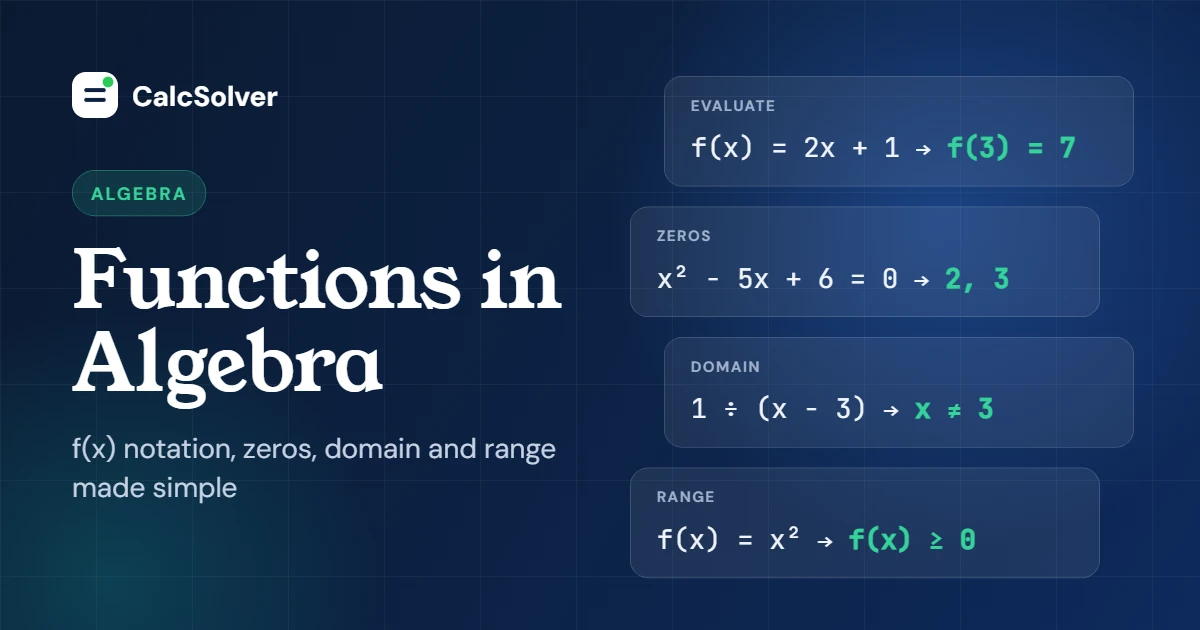
A function is a rule that turns each input into exactly one output. You see it written as f(x) = 2x + 1: put in x = 3 and you get 7. This guide explains function notation in plain words, then shows how to evaluate a function, make a function table, test whether a relation is a function, find its zeros and work out its domain and range.
In short: A function gives exactly one output for each input. To evaluate f(x), replace x with the input. To find the zeros, set f(x) = 0 and solve.
In this guide
What Is a Function?
Think of a function as a machine. You drop a number in, the machine follows its rule, and one number comes out. The number you put in is the input (usually x). The number that comes out is the output (usually y or f(x)).
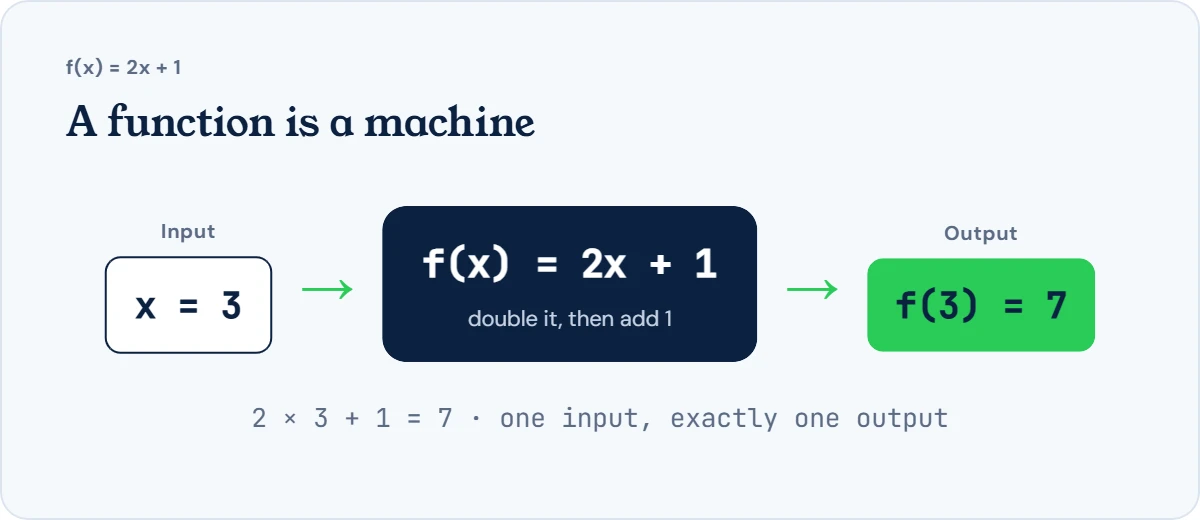
The key rule is that each input has exactly one output. Two different inputs may give the same output, but one input can never give two different outputs.
In short: A function is a rule that matches every input with exactly one output.
How to Read f(x) Notation
f(x) is read “f of x”. It names the function (f) and its input (x). It does not mean f times x. So f(x) = 2x + 1 says “the function f doubles the input and adds 1”, and f(3) means “the output when the input is 3”.
Other letters work too. g(t), h(n) and P(x) are all functions; the letter outside the brackets is the name, and the letter inside is the input.
How to Evaluate a Function
Evaluating a function is also what people mean by “solving a function” for a given value. Replace every x with the input, in brackets, then work it out with the order of operations.
Example: f(x) = 2x + 1. Find f(3) → 2(3) + 1 = 7.
Example: f(x) = x² − 4x + 3. Find f(5) → (5)² − 4(5) + 3 = 25 − 20 + 3 = 8.
Example: Same function, find f(−1) → (−1)² − 4(−1) + 3 = 1 + 4 + 3 = 8. Two inputs, one output each, and they happen to match. That is allowed.
Example: f(x) = 2x + 1. Find f(a + 1) → 2(a + 1) + 1 = 2a + 2 + 1 = 2a + 3. The input can be an expression, not just a number.
Check a value on the CalcSolver calculator: for f(5) above, type 5²−4×5+3 and press =. The answer is 8.
In short: To evaluate f(a), put a in brackets wherever x appears, then calculate.
How to Make a Function Table
A function table lists inputs and their outputs. Pick a few x values, evaluate each one, and write the results in a row. Here is f(x) = 2x + 1:
| x | −2 | −1 | 0 | 1 | 2 |
|---|---|---|---|---|---|
| f(x) = 2x + 1 | −3 | −1 | 1 | 3 | 5 |
Each output is 2 more than the one before, because the function adds 2 every time x goes up by 1. That steady change is the slope, and it shows the function is linear.
How to Tell If a Relation Is a Function
A relation is any set of input-output pairs. It is a function only if no input appears with two different outputs.
| Relation | Function? | Why |
|---|---|---|
| (1, 4), (2, 5), (3, 4) | Yes | Each x appears once. Repeating the output 4 is fine. |
| (2, 3), (2, 7), (4, 1) | No | The input 2 has two outputs, 3 and 7. |
| y = x² | Yes | Each x gives one y. For example, x = 3 gives y = 9. |
| x = y² | No | x = 4 gives y = 2 and y = −2. |
On a graph, use the vertical line test. If any vertical line crosses the graph more than once, the graph is not a function. A parabola that opens upward, like y = x², passes. A circle fails.
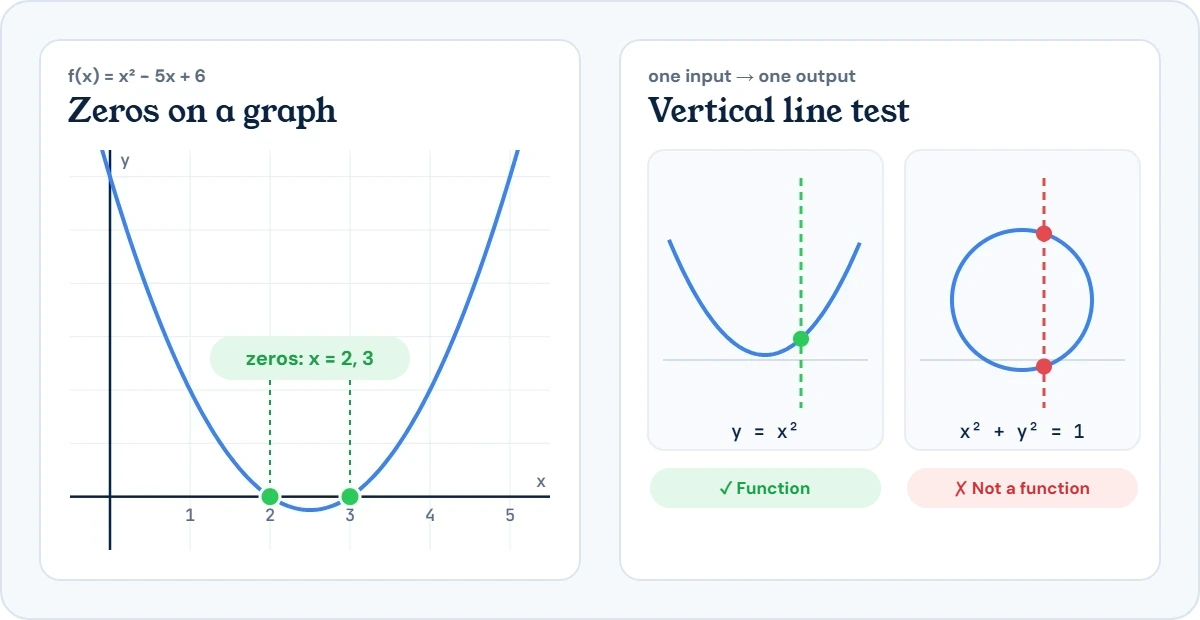
In short: If any input has two outputs, it is not a function. On a graph, a vertical line must cross the graph at most once.
How to Solve f(x) = a Value
Sometimes you know the output and need the input. Set the function equal to that value and solve for x.
Example: f(x) = 2x + 1. When is f(x) = 11? → 2x + 1 = 11 → 2x = 10 → x = 5. Check: f(5) = 2(5) + 1 = 11.
How to Find the Zeros of a Function
The zeros of a function are the inputs that make the output 0. On a graph, they are the points where the line or curve crosses the x-axis, so they are also called x-intercepts or roots, as the graph above shows. To find them, set f(x) = 0 and solve.
Example: f(x) = 3x − 12 → 3x − 12 = 0 → 3x = 12 → x = 4.
Example: f(x) = x² − 5x + 6 → factor: (x − 2)(x − 3) = 0 → x = 2 or x = 3. Check: f(2) = 4 − 10 + 6 = 0, and f(3) = 9 − 15 + 6 = 0.
If a quadratic does not factor easily, use the quadratic formula, x = (−b ± √(b² − 4ac)) ÷ 2a. It is in the basic algebra formulas table.
In short: Set f(x) equal to 0 and solve. Each answer is a point where the graph crosses the x-axis.
What Are Domain and Range?
The domain is every input the function accepts. The range is every output it can produce. For most functions, the domain is all real numbers. Look for two things that shrink it:
- Division by zero. A denominator can never be 0.
- Square roots of negative numbers. With real numbers, the value under √ must be 0 or more.
| Function | Domain | Range |
|---|---|---|
| f(x) = 2x + 1 | All real numbers | All real numbers |
| f(x) = x² | All real numbers | f(x) ≥ 0 |
| f(x) = 1 ÷ (x − 3) | x ≠ 3 | f(x) ≠ 0 |
| f(x) = √(x − 2) | x ≥ 2 | f(x) ≥ 0 |
Example: For f(x) = 1 ÷ (x − 3), x = 3 makes the denominator 0, so 3 is left out of the domain. The output can be very large or very small, but never exactly 0, because 1 divided by a number is never 0.
In short: Domain means allowed inputs and range means possible outputs. Rule out any x that divides by zero or takes the square root of a negative.
Linear Functions and Slope
A linear function has the form f(x) = mx + b. Its graph is a straight line. The number m is the slope, which is how much f(x) changes when x goes up by 1, and b is the y-intercept, which is the output when x = 0.
Example: f(x) = 3x − 2 has slope 3 and y-intercept −2. It crosses the y-axis at (0, −2) and rises 3 units for every 1 unit to the right.
Common Mistakes With Functions
- Reading f(x) as multiplication. f(3) means “input 3”, not f × 3.
- Forgetting brackets around negative inputs. For f(x) = x², f(−4) = (−4)² = 16, not −16.
- Replacing only some of the x’s. In x² − 4x + 3, both x terms get the new value.
- Thinking a repeated output breaks the rule. Two inputs may share an output. Only one input with two outputs breaks it.
Practice Problems (With Answers)
1. f(x) = 5x − 2. Find f(4).
18. 5(4) − 2 = 20 − 2.
2. g(x) = x² + 3x. Find g(−2).
−2. (−2)² + 3(−2) = 4 − 6.
3. f(x) = 4x + 3. For which x is f(x) = 23?
x = 5. 4x + 3 = 23, so 4x = 20.
4. Find the zero of f(x) = 2x + 10.
x = −5. 2x + 10 = 0, so 2x = −10.
5. Find the zeros of f(x) = x² − 9.
x = 3 or x = −3. x² = 9, and both 3² and (−3)² are 9.
6. What is the domain of f(x) = √(x + 5)?
x ≥ −5. The value under the root, x + 5, must be 0 or more.
Functions: Frequently Asked Questions
What is a function in algebra?
A function is a rule that gives exactly one output for each input. For example, f(x) = 2x + 1 turns the input 3 into the output 7.
What does f(x) mean?
f(x) is read “f of x”. It is the output of the function f when the input is x. It does not mean f multiplied by x.
How do you solve a function?
To evaluate it, replace x with the given input and calculate. To find which input gives a certain output, set f(x) equal to that output and solve for x. For f(x) = 2x + 1 and f(x) = 11, x = 5.
How do you find the zeros of a function?
Set f(x) = 0 and solve for x. For f(x) = x² − 5x + 6, factoring gives (x − 2)(x − 3) = 0, so the zeros are x = 2 and x = 3.
What is the difference between domain and range?
The domain is the set of all allowed inputs, and the range is the set of all possible outputs. For f(x) = x², the domain is all real numbers and the range is f(x) ≥ 0.
Sources and Further Reading
- OpenStax, College Algebra 2e, Section 3.1: Functions and Function Notation, Rice University.
- OpenStax, College Algebra 2e, Section 3.2: Domain and Range, Rice University.
Every value in this guide was checked on the CalcSolver calculator. Before functions, make sure you can evaluate and simplify expressions and solve for x. New to it all? Start with algebra basics.
Check your working in seconds
Type any problem from this guide into the free CalcSolver calculator and see the answer, with fractions, instantly.