Runs in your browser. Nothing you type is sent or stored.
This free percentage calculator works out any percentage problem in one step and shows the working. Find X% of a number, what percent one number is of another, the percentage increase or decrease between two values, the whole from a part, or a fraction as a decimal and percent. It runs in your browser with no sign-up, and every answer comes with numbered steps so you can see how to calculate the percentage yourself.
In short: Pick the type of question, type two numbers, and read the answer and steps. The answer updates as you type.
In this guide
How to Use the Percentage Calculator
- Choose a question type from the five tabs.
- Type two numbers. You can use decimals, negative numbers and commas, such as 1,250.
- Read the answer in the dark box. The steps below it show exactly how it was calculated.
- Copy the answer with one tap, or press Reset to start again.
| Tab | Question it answers | Example |
|---|---|---|
| X% of Y | What is 20% of 150? | 30 |
| X is what % of Y | 18 is what percent of 72? | 25% |
| % increase or decrease | What is the change from 80 to 100? | 25% increase |
| X is Y% of what | 12 is 15% of what number? | 80 |
| Fraction to % | What is 5/8 as a decimal and percent? | 0.625 and 62.5% |
The Percentage Formulas Behind the Calculator
Every tab uses one of these formulas. Knowing them lets you check any answer by hand, and our full guide on how to calculate a percentage explains each one in detail.
| Calculation | Formula |
|---|---|
| Percent of a number | part = percent ÷ 100 × whole |
| Percentage of a total | percent = part ÷ whole × 100 |
| Percentage change | change = (new − old) ÷ old × 100 |
| Whole from a part | whole = part ÷ (percent ÷ 100) |
| Fraction to percent | percent = numerator ÷ denominator × 100 |
For percentage change, the calculator always divides by the starting value. A positive answer is an increase and a negative answer is a decrease.
In short: Percent means per hundred, so every formula either divides by 100 or multiplies by 100. The calculator does that step for you and shows it.
Worked Examples
Example: Discount: a $120 pair of shoes is 35% off. 35% of 120 = 0.35 × 120 = $42 off, so you pay $78.
Example: Test score: 46 correct out of 50. 46 ÷ 50 × 100 = 92%.
Example: Salary rise: pay goes from $3,200 to $3,440 a month. (3,440 − 3,200) ÷ 3,200 × 100 = 7.5% increase.
Example: Original price: you saved $18, which was 15% off. 18 ÷ 0.15 = $120 was the original price.
Example: Fraction: 3/8 of a pizza is 3 ÷ 8 = 0.375, which is 37.5%.
For conversions of common fractions with full working, see our guides to 1/4, 1/3, 5/8 and the rest of the percentages and decimals section.
How to Calculate a Percentage on a Basic Calculator
Any basic calculator online, on your phone or on your desk can do percentages if you type the steps in the right order:
- What percent is 18 of 72? Type 18 ÷ 72 × 100 =. The answer is 25.
- What is 20% of 150? Type 150 × 20 ÷ 100 =, or 150 × 0.2 =. The answer is 30.
- Percentage change from 80 to 100? Type (100 − 80) ÷ 80 × 100 =. The answer is 25.
The % key works differently on different calculators, so typing ÷ 100 or × 100 yourself is the safest way. A search-engine calculator gives a single number, while this page also shows the steps. For trig, logs, powers and fractions, use the free CalcSolver scientific calculator.
In short: On any calculator: part ÷ whole × 100 gives a percentage, and number × percent ÷ 100 gives a percent of a number.
Common Percentage Mistakes the Calculator Helps You Avoid
- Dividing by the new value for percentage change. Always divide by the old value.
- Swapping part and whole. “18 of 72” is 18 ÷ 72, not 72 ÷ 18.
- Adding up percentage changes. A 10% rise then a 10% fall leaves you 1% lower, not back where you started.
- Rounding too early. 1/3 is 33.33…%, so round only at the end.
Percentage Calculator: Frequently Asked Questions
How do I calculate a percentage?
Divide the part by the whole and multiply by 100. For example, 18 out of 72 is 18 ÷ 72 × 100 = 25%. The calculator above does this in the “X is what % of Y” tab.
Is this percentage calculator free?
Yes. It is completely free, with no sign-up and no limit. It runs in your browser, so the numbers you type are never sent or stored.
How do I calculate percentage increase or decrease?
Subtract the old value from the new value, divide by the old value and multiply by 100. From 80 to 100 is (100 − 80) ÷ 80 × 100 = a 25% increase.
How do I find the original number from a percentage?
Divide the part by the percent written as a decimal. If 12 is 15% of a number, the number is 12 ÷ 0.15 = 80.
Can it convert fractions to percentages?
Yes. Use the “Fraction to %” tab. It divides the numerator by the denominator, shows the decimal, marks repeating digits and gives the percent. For example, 5/8 = 0.625 = 62.5%.
Does it work with negative numbers and decimals?
Yes. You can type decimals such as 7.5 and negative numbers such as −20. For percentage change, a negative result means a decrease.
Sources and Further Reading
- OpenStax, Prealgebra 2e, Section 6.1: Understand Percent, Rice University.
- Math is Fun, Introduction to Percents.
More percentage and decimal guides
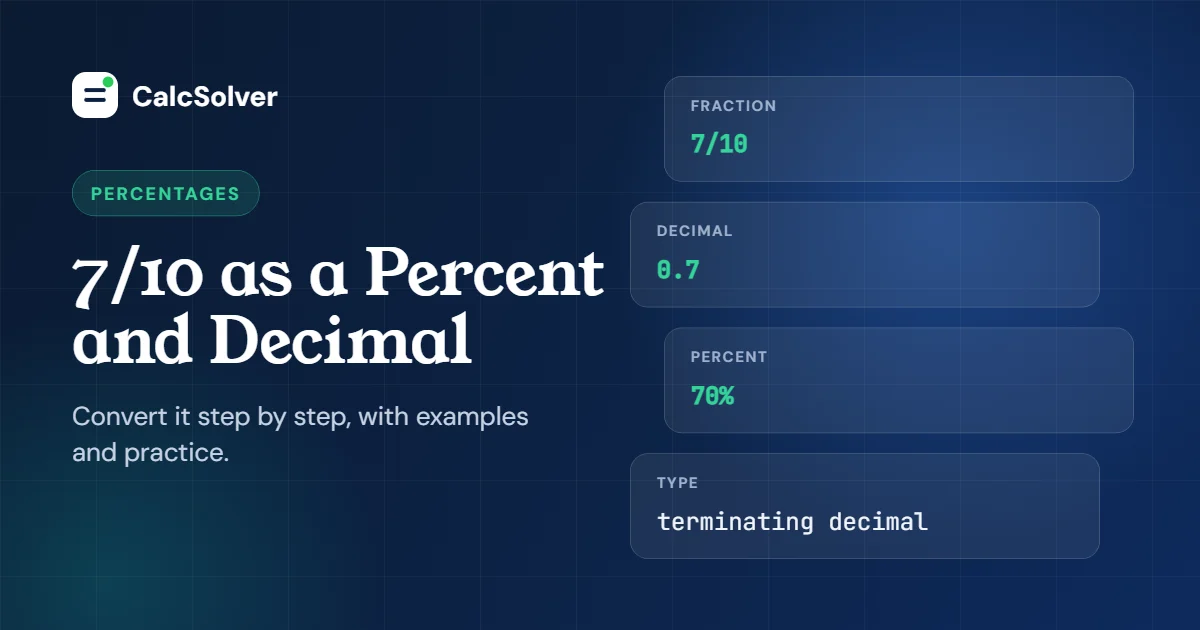
7/10 as a Percent and Decimal
7/10 as a decimal is 0.7 and as a percent is 70%. See how to convert it step by step, with a diagram, worked examples, practice…
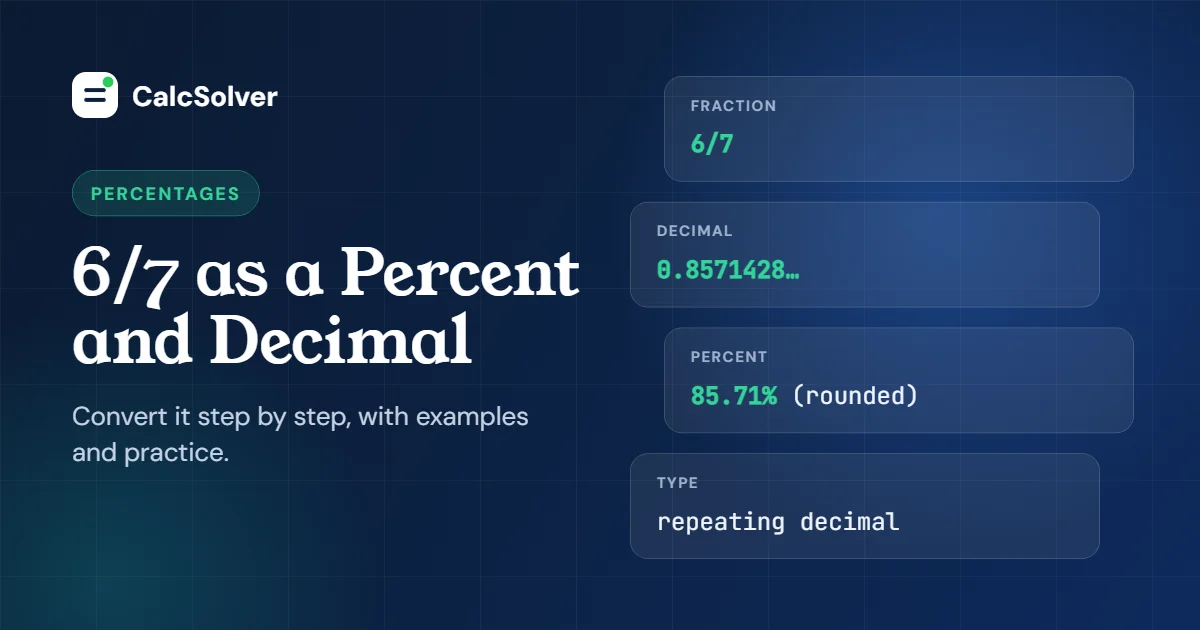
6/7 as a Percent and Decimal
6/7 as a decimal is 0.8571428… and as a percent is 85 5/7% (about 85.71%). See how to convert it step by step, with a diagram,…
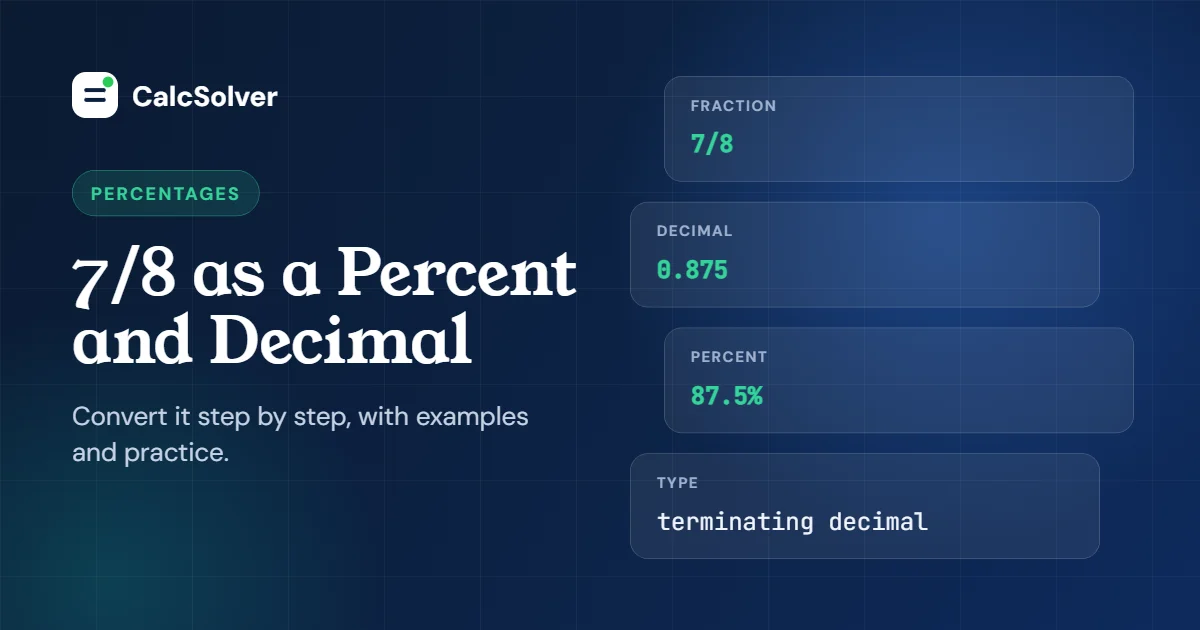
7/8 as a Percent and Decimal
7/8 as a decimal is 0.875 and as a percent is 87.5%. See how to convert it step by step, with a diagram, worked examples, practice…