To calculate a percentage, divide the part by the whole and multiply by 100: percentage = (part ÷ whole) × 100. For example, 15 out of 60 is 15 ÷ 60 = 0.25, and 0.25 × 100 = 25%. This guide shows how to calculate percentages in every common situation: a percentage of a number, one number as a percentage of another, a missing whole, and percentage increase and decrease. Each method has worked examples, mental-math shortcuts, practice problems with answers, and a free percentage calculator to check your work.
In this guide
What Is a Percentage?
A percentage is a number written as a fraction of 100. The word percent means “per hundred”, and the symbol is %. So 25% means 25 out of every 100, which is the fraction 25/100 and the decimal 0.25.
| Percent | Fraction | Decimal | Meaning |
|---|---|---|---|
| 1% | 1/100 | 0.01 | 1 out of every 100 |
| 10% | 1/10 | 0.1 | 1 out of every 10 |
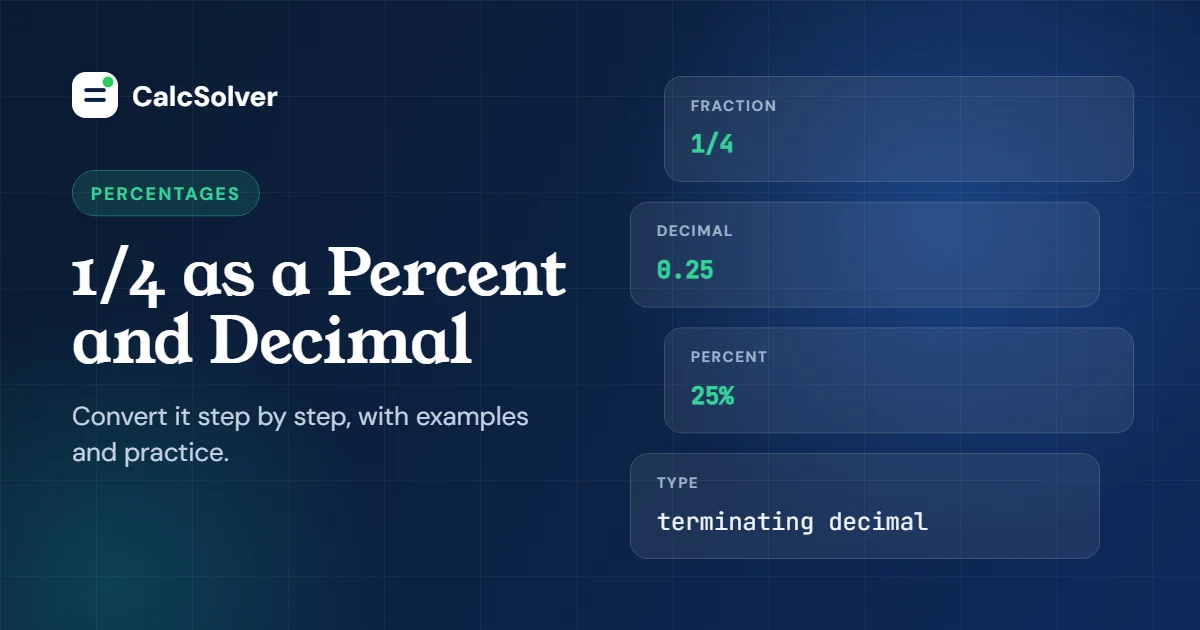
| 25% | 1/4 | 0.25 | 1 out of every 4 |
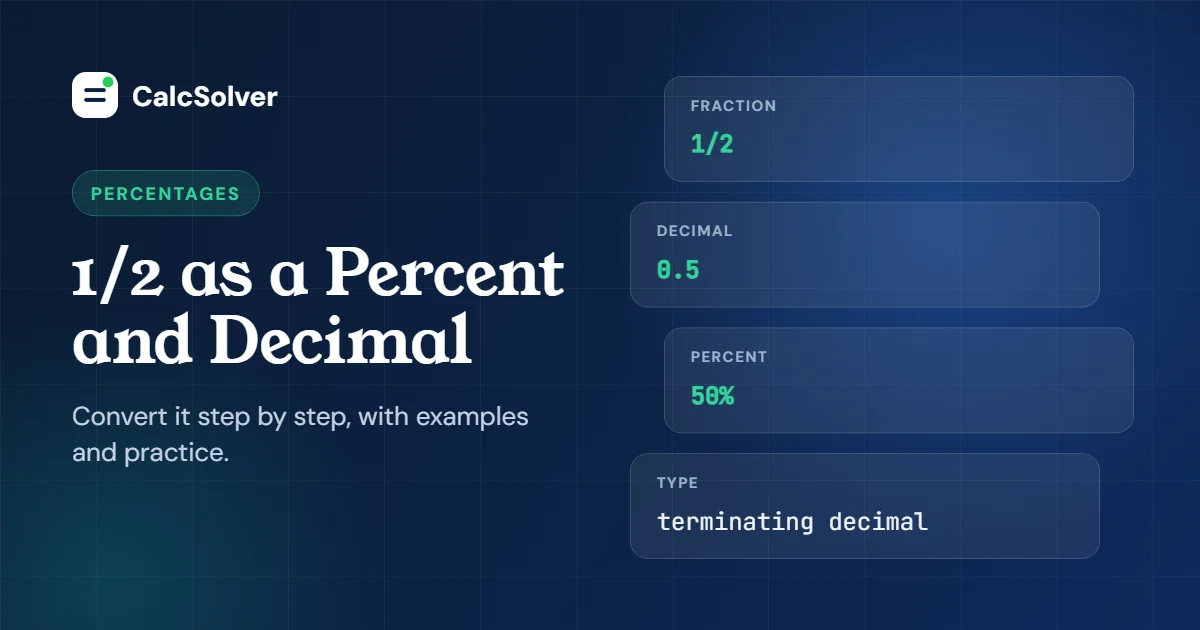
| 50% | 1/2 | 0.5 | half |
| 100% | 1 | 1 | the whole amount |
| 150% | 3/2 | 1.5 | one and a half times |
A percentage can be above 100%. A price that rises from 40 to 100 has grown to 250% of its old value.
In short: A percentage is a number out of 100. Divide a percent by 100 to get a decimal, and multiply a decimal by 100 to get a percent.
The Percentage Formula
Every percentage problem has three parts: the part, the whole and the percent. If you know two of them, you can find the third.
| You want | Formula | Example |
|---|---|---|
| The percent | percent = part ÷ whole × 100 | 15 of 60: 15 ÷ 60 × 100 = 25% |
| The part | part = percent ÷ 100 × whole | 20% of 150: 0.20 × 150 = 30 |
| The whole | whole = part ÷ percent × 100 | 12 is 15% of: 12 ÷ 15 × 100 = 80 |
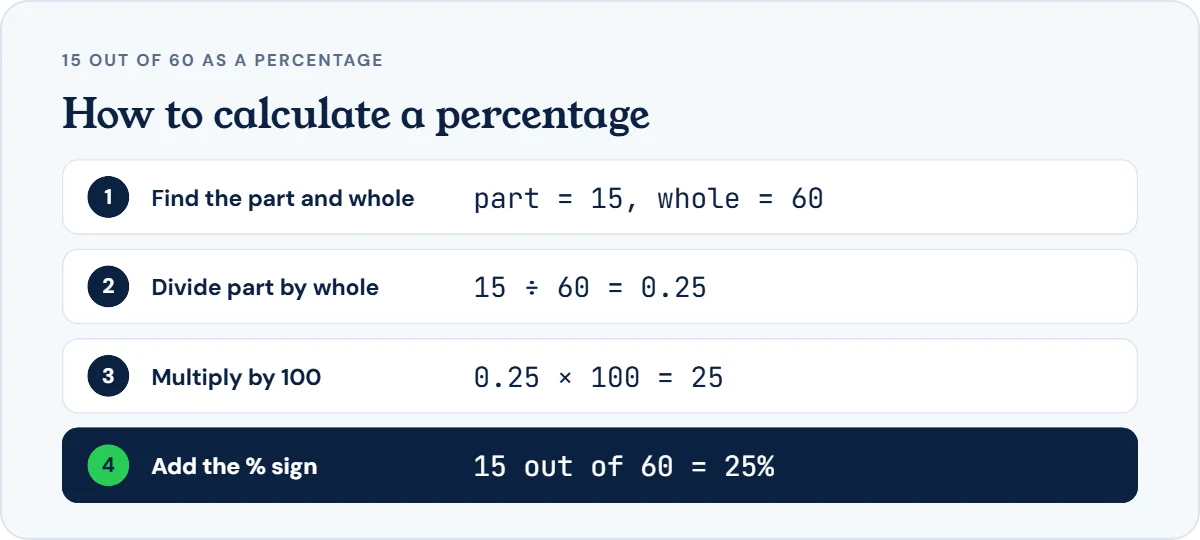
- Identify the part (the piece you are looking at) and the whole (the total).
- Divide the part by the whole to get a decimal.
- Multiply the decimal by 100.
- Write the % sign.
In short: Percent = part ÷ whole × 100. Rearrange it to find the part or the whole.
How to Calculate a Percentage of a Number
To find a percentage of a number, change the percent to a decimal and multiply. Move the decimal point two places left to change a percent into a decimal.
Example: Find 20% of 150. 20% = 0.20, and 0.20 × 150 = 30.
Example: Find 15% of 80. 0.15 × 80 = 12.
Example: Find 7.5% of 240. 0.075 × 240 = 18.
The word “of” in a percentage problem means multiply. You can also write the percent as a fraction over 100 and multiply, then divide by 100: 15 × 80 ÷ 100 = 12.
In short: Percent of a number: convert the percent to a decimal, then multiply by the number.
How to Find What Percent One Number Is of Another
To find what percent a number is of another number, divide the part by the whole and multiply by 100.
Example: What percent of 72 is 18? 18 ÷ 72 = 0.25, so it is 25%.
Example: A student scores 45 out of 60. 45 ÷ 60 = 0.75, so the score is 75%.
Example: What percent of 8 is 3? 3 ÷ 8 = 0.375, so it is 37.5%.
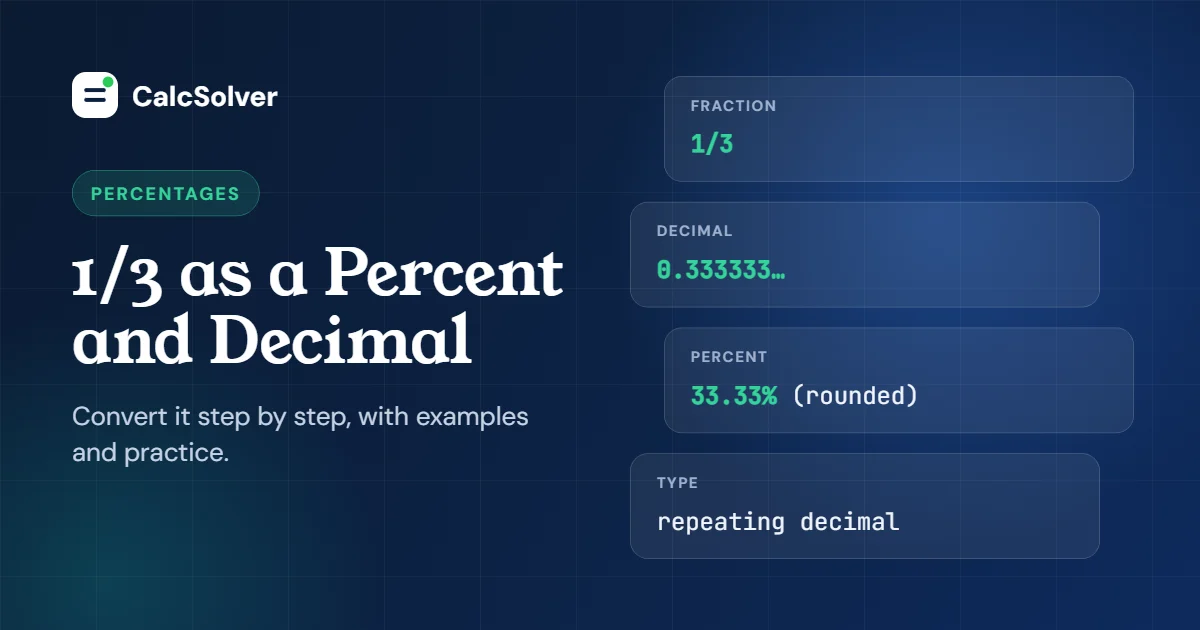
If the answer is a repeating decimal, round it. For example, 1 ÷ 3 = 0.3333… and 33.3% is the rounded percentage. Our guide to fractions as percents and decimals shows the exact values for common fractions.
How to Find the Whole When You Know the Percent
Sometimes you know the part and the percent, and you need the whole. Divide the part by the percent written as a decimal.
Example: 12 is 15% of what number? 12 ÷ 0.15 = 80. Check: 15% of 80 = 12.
Example: 45 is 30% of what number? 45 ÷ 0.30 = 150.
This is the method for finding an original price from a sale price, or a full total from a known share.
In short: Percent known, part known: whole = part ÷ (percent ÷ 100). Always check by finding the percent of your answer.
How to Calculate Percentage Increase and Decrease
Percentage change tells you how much a value has grown or shrunk compared with where it started.
Percentage change = (new value − old value) ÷ old value × 100
A positive result is an increase. A negative result is a decrease.
Example: A price rises from 80 to 100. (100 − 80) ÷ 80 = 0.25, so the increase is 25%.
Example: A price falls from 200 to 150. (150 − 200) ÷ 200 = −0.25, so the decrease is 25%.
Discounts and sales tax
Example: A $60 jacket is 20% off. The discount is 0.20 × 60 = $12, so you pay 60 − 12 = $48. A shortcut is to multiply by 0.80: 60 × 0.80 = 48.
Example: A $50 item has 8% sales tax. The tax is 0.08 × 50 = $4, so the total is $54. A shortcut is to multiply by 1.08.
A 25% increase and a 25% decrease do not cancel out. Start with 100, add 25% to get 125, then take 25% off 125 and you get 93.75, not 100. The second percentage is taken from a larger number.
In short: Percentage change = (new − old) ÷ old × 100. Always divide by the old value, the starting point.
Mental Math Shortcuts for Percentages
You can calculate many percentages in your head by starting from 10% and 1%.
| To find | Do this | Example on 80 |
|---|---|---|
| 10% | Divide by 10 | 8 |
| 5% | Half of 10% | 4 |
| 1% | Divide by 100 | 0.8 |
| 20% | Double 10% | 16 |
| 25% | Divide by 4 | 20 |
| 50% | Divide by 2 | 40 |
| 15% | 10% + 5% | 8 + 4 = 12 |
The swap trick: a percent of a number equals that number as a percent of the first, so 8% of 50 is the same as 50% of 8. Both are 4. Pick whichever is easier.
Example: Tip of 15% on a $40 bill: 10% is $4 and 5% is $2, so the tip is $6.
For more speed tricks, see our guide to mental math tricks.
Where You Use Percentages Every Day
- Shopping: sale prices and discounts.
- Tipping and tax: restaurant bills and sales tax.
- School: test scores and grade weights.
- Money: interest rates, savings and loans.
- Health and fitness: body-fat percentage and nutrition labels.
- Data: survey results, growth rates and statistics.
Percent, Decimal and Fraction Conversion Table
These common values come up constantly. Learn them once and many percentage problems become quick.
| Fraction | Decimal | Percent |
|---|---|---|
| 1/2 | 0.5 | 50% |
| 1/3 | 0.333… | 33.3% |
| 1/4 | 0.25 | 25% |
| 1/5 | 0.2 | 20% |
| 1/8 | 0.125 | 12.5% |
| 3/4 | 0.75 | 75% |
| 3/5 | 0.6 | 60% |
| 5/6 | 0.833… | 83.3% |
| 7/8 | 0.875 | 87.5% |
To convert any fraction, divide the top by the bottom, then multiply by 100. Browse our guides to fractions as percents and decimals for step-by-step versions of each one.
Common Mistakes When Calculating Percentages
- Forgetting to divide by 100. 20% of 150 is 0.20 × 150 = 30, not 20 × 150.
- Dividing by the wrong number. For percent change, divide by the old value, not the new one.
- Mixing up part and whole. “18 is what percent of 72” divides 18 by 72, not 72 by 18.
- Adding percentages that apply to different bases. A 10% discount followed by another 10% discount is 19% off, not 20%.
- Confusing percent and percentage points. A rate that rises from 10% to 12% went up 2 percentage points, which is a 20% increase.
Free Percentage Calculator Online
To check any answer quickly, use our free percentage calculator. It solves five problem types: what is X% of Y, X is what percent of Y, the percentage increase or decrease between two numbers, the whole from a part, and a fraction as a decimal and percent. It shows the working so you can learn the method as well as get the answer. On a basic calculator, type 15 ÷ 60 × 100 for 15 out of 60, or use the % key. The main CalcSolver scientific calculator handles the same arithmetic.
Percentage Practice Problems (With Answers)
1. What is 30% of 90?
27. 0.30 × 90 = 27.
2. 12 out of 48 is what percent?
25%. 12 ÷ 48 = 0.25.
3. 36 is 45% of what number?
80. 36 ÷ 0.45 = 80.
4. A price rises from $50 to $65. What is the percentage increase?
30%. (65 − 50) ÷ 50 = 0.30.
5. An $85 coat is 40% off. What do you pay?
$51. The discount is 0.40 × 85 = $34, and 85 − 34 = 51.
6. A test score is 42 out of 60. What is the percentage?
70%. 42 ÷ 60 = 0.70.
7. What is 2.5% of 400?
10. 0.025 × 400 = 10.
8. A town shrinks from 8,000 to 7,200 people. What is the percentage decrease?
10%. The change is −800, and 800 ÷ 8,000 = 0.10.
9. What is a 15% tip on a $64 meal?
$9.60. 10% is 6.40 and 5% is 3.20, and 6.40 + 3.20 = 9.60.
10. Write 0.375 as a percentage.
37.5%. Multiply by 100.
How to Calculate a Percentage: Frequently Asked Questions
What is the formula to calculate a percentage?
Percentage = (part ÷ whole) × 100. For example, 15 out of 60 is 15 ÷ 60 × 100 = 25%.
How do you calculate a percentage of a number?
Convert the percent to a decimal by dividing by 100, then multiply it by the number. For example, 20% of 150 is 0.20 × 150 = 30.
How do you calculate percentage increase?
Subtract the old value from the new value, divide by the old value, and multiply by 100. A rise from 80 to 100 is (100 − 80) ÷ 80 × 100 = 25%.
How do you calculate a percentage without a calculator?
Start from 10% by dividing by 10, then build up. 5% is half of 10%, 20% is double 10%, and 1% is dividing by 100. For 15%, add 10% and 5%.
How do you turn a percent into a decimal?
Divide by 100, which means moving the decimal point two places to the left. 45% becomes 0.45, and 6% becomes 0.06.
What is the difference between a percent and a percentage point?
A percentage point is the plain difference between two percentages. A rate that goes from 10% to 12% rises by 2 percentage points, which is a 20% increase relative to 10%.
How do you calculate a percentage on a basic calculator?
Divide the part by the whole, then multiply by 100. For 15 out of 60, enter 15 ÷ 60 × 100 to get 25. Many calculators also have a % key that does the last step for you.
Sources and Further Reading
- OpenStax, Prealgebra 2e, Section 6.1: Understand Percent, Rice University.
- Math is Fun, Introduction to Percents.
Every answer on this page was checked by working it a second way. Try the percentage calculator, or browse all percentage and decimal guides.
Related: browse all percentages and decimals guides, or use the equivalent fractions calculator for fractions.
Check your working in seconds
Type any problem from this guide into the free CalcSolver calculator and see the answer, with fractions, instantly.