To subtract fractions, make the denominators the same, subtract the numerators and keep the denominator. For example, 3/4 − 1/2 = 3/4 − 2/4 = 1/4. With mixed numbers, you may need to borrow 1 from the whole number when the fraction you are taking away is bigger.
In short: Same denominators: subtract the tops. Different denominators: use the least common denominator first. Mixed numbers: borrow 1 whole when the second fraction is bigger, or change both to improper fractions. Simplify the answer.
In this guide
Subtracting Fractions With the Same Denominator
Example: 2/3 − 1/3 = (2 − 1)/3 = 1/3. Keep the denominator and subtract the numerators.
Subtracting Fractions With Different Denominators
- Find the least common denominator (LCD). For 4 and 2 it is 4.
- Rewrite the fractions. 1/2 = 2/4.
- Subtract the numerators. 3/4 − 2/4 = 1/4.
- Simplify. 1/4 is already in simplest form.
Example: 2/3 − 1/2. The LCD of 3 and 2 is 6: 4/6 − 3/6 = 1/6.
Example: 5/6 − 1/10. The LCD of 6 and 10 is 30: 25/30 − 3/30 = 22/30 = 11/15.
Subtracting Mixed Numbers (With Borrowing)
Subtract the whole numbers and the fractions separately. If the first fraction is smaller than the second, borrow 1 from the whole number and add it to the fraction as a full set of pieces, such as 4/4 or 3/3.
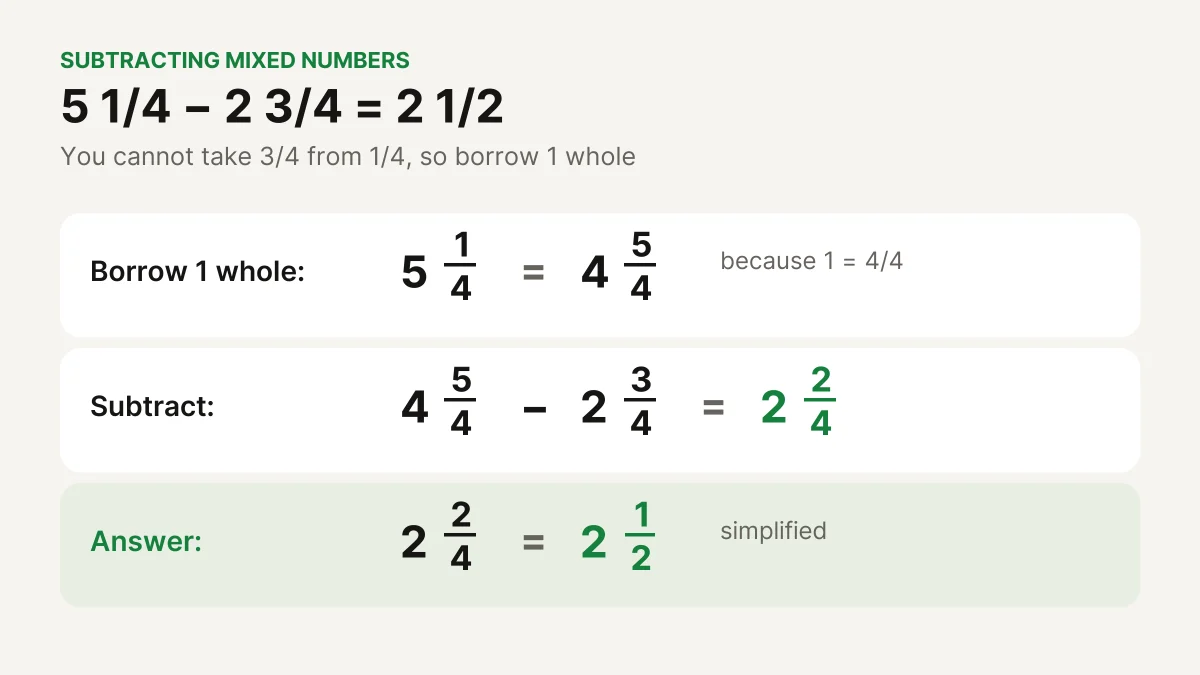
Example: 5 1/4 − 2 3/4. You cannot take 3/4 from 1/4, so borrow: 5 1/4 = 4 + 4/4 + 1/4 = 4 5/4. Then 4 5/4 − 2 3/4 = 2 2/4 = 2 1/2.
Example: 3 1/2 − 1 1/3. Fractions first: 1/2 − 1/3 = 3/6 − 2/6 = 1/6. Wholes: 3 − 1 = 2. Answer: 2 1/6.
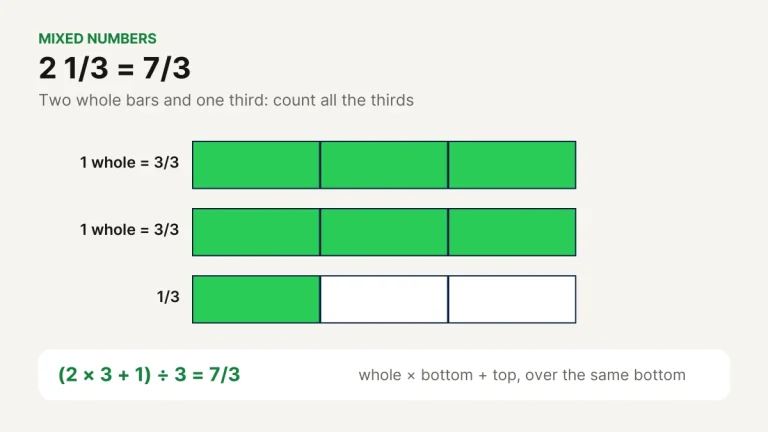
The improper fraction way avoids borrowing. Change both numbers to improper fractions and subtract: 2 1/3 − 2/3 = 7/3 − 2/3 = 5/3 = 1 2/3.
Subtracting a Fraction From a Whole Number
Example: 3 − 1 2/5. Write 3 as 2 5/5. Then 2 5/5 − 1 2/5 = 1 3/5.
Common Examples
| Problem | Working | Answer |
|---|---|---|
| 2 1/3 − 2/3 | 7/3 − 2/3 = 5/3 | 1 2/3 |
| 3 1/2 − 2/3 | 21/6 − 4/6 = 17/6 | 2 5/6 |
| 3 1/2 − 1 1/3 | 2 + (3/6 − 2/6) | 2 1/6 |
| 3/4 − 1/2 | 3/4 − 2/4 | 1/4 |
| 2/3 − 1/3 | same denominator | 1/3 |
| 2/3 − 1/2 | 4/6 − 3/6 | 1/6 |
Try it
Subtract fractions or mixed numbers and see the borrowing step done for you.
FAQ
How do you subtract fractions with different denominators?
Rewrite both fractions with the least common denominator, then subtract the numerators. For example, 3/4 − 1/2 = 3/4 − 2/4 = 1/4.
What is 2 1/3 − 2/3 as a fraction?
2 1/3 = 7/3, so 7/3 − 2/3 = 5/3, which is 1 2/3 as a mixed number.
How do you borrow when subtracting mixed numbers?
Take 1 from the whole number and add it to the fraction as a full set of pieces. For 5 1/4, borrowing gives 4 5/4, because 1 = 4/4.
What is 3 1/2 − 2/3?
3 1/2 = 21/6 and 2/3 = 4/6, so 21/6 − 4/6 = 17/6 = 2 5/6.
What if the answer is negative?
If you take a bigger fraction from a smaller one, the answer is negative. For example, 1/4 − 3/4 = −2/4 = −1/2.
Sources and Further Reading
- OpenStax, Prealgebra, Section 4.6: Add and Subtract Mixed Numbers, Rice University.
- Common Core Grade 5: Number and Operations, Fractions.
More fraction guides: How to add fractions, Mixed numbers and improper fractions, How to simplify fractions, Fraction, decimal and percent chart. Or check any answer with the fraction calculator.
Check your working in seconds
Type any problem from this guide into the free CalcSolver calculator and see the answer, with fractions, instantly.