To multiply fractions, multiply the numerators together and the denominators together, then simplify. You do not need a common denominator. For example, 2/3 × 3/4 = 6/12 = 1/2. To multiply by a whole number, write it over 1 first: 2/3 × 2 = 2/3 × 2/1 = 4/3.
In short: Top × top, bottom × bottom, then simplify. Whole numbers go over 1. Mixed numbers become improper fractions first. “Of” means multiply: 1/3 of 1/2 = 1/6.
In this guide
How to Multiply Fractions in Three Steps
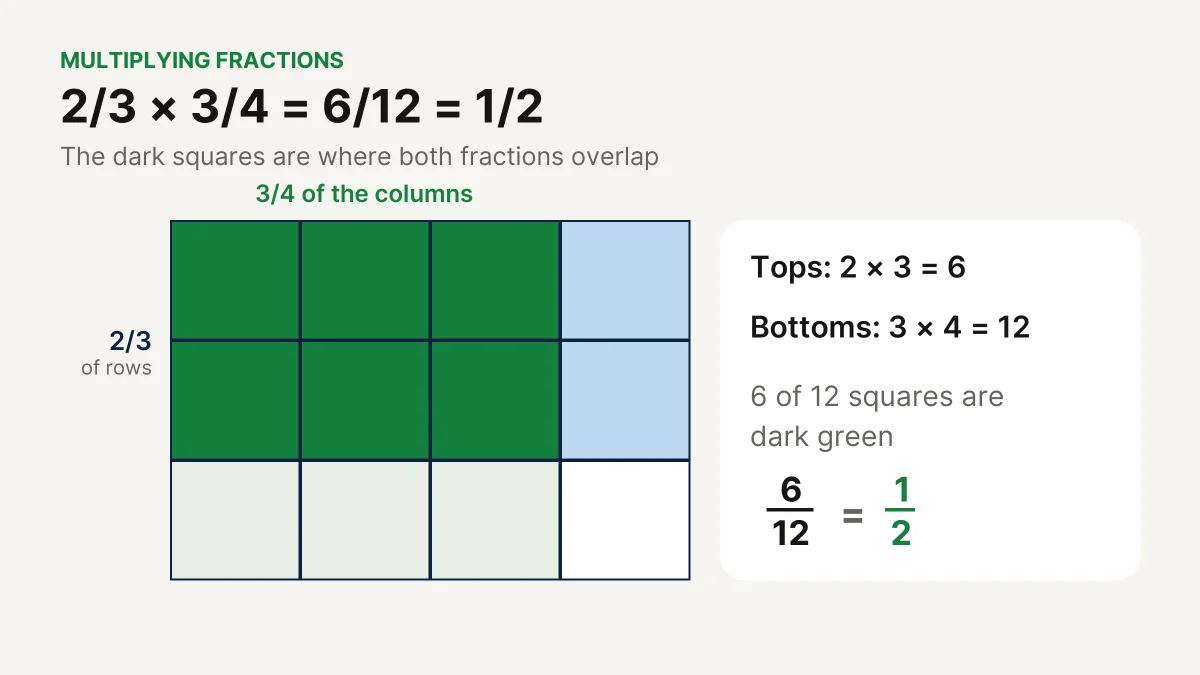
- Multiply the numerators: 2 × 3 = 6.
- Multiply the denominators: 3 × 4 = 12.
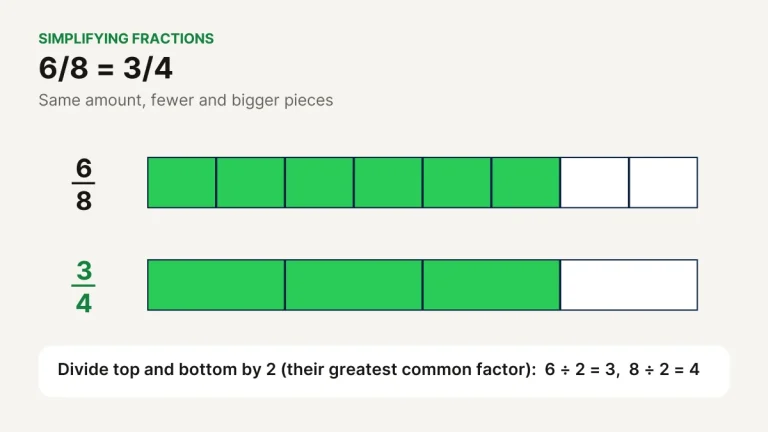
- Simplify: 6/12 = 1/2.
The picture shows why it works: shade 3/4 of the columns and 2/3 of the rows. The overlap is 6 of the 12 squares.
Multiplying a Fraction by a Whole Number
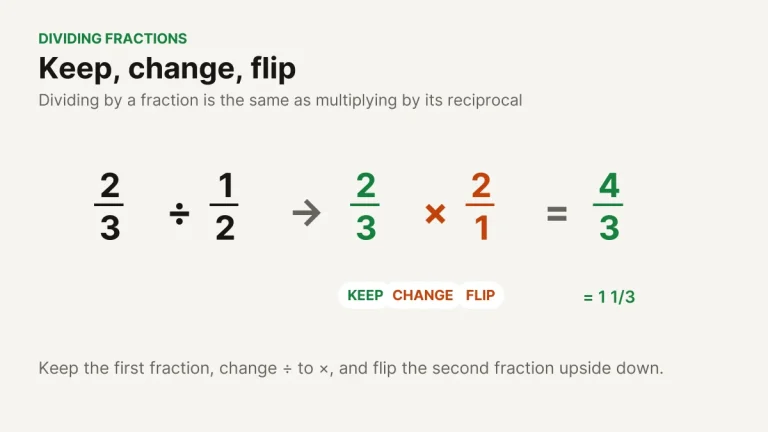
Example: What is 2/3 times 2 as a fraction? 2/3 × 2/1 = 4/3, which is 1 1/3 as a mixed number.
Example: 1/3 × 2 = 2/3. Only the numerator is multiplied, because 2 = 2/1.
Multiplying Mixed Numbers
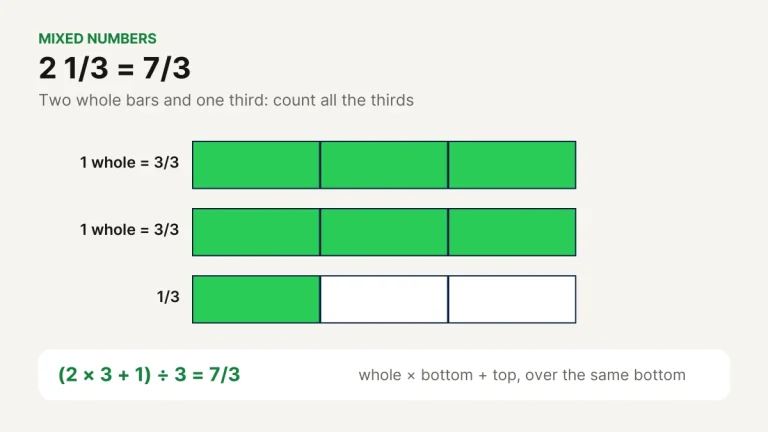
Change each mixed number to an improper fraction first. Do not multiply the whole numbers and fractions separately; that gives the wrong answer.
Example: 1 1/2 × 2 = 3/2 × 2/1 = 6/2 = 3.
Example: 3 1/2 × 3 = 7/2 × 3/1 = 21/2 = 10 1/2.
Finding a Fraction “of” a Number
In math, “of” means multiply.
Example: What is 1/3 of 1/2? 1/3 × 1/2 = 1/6.
Example: What is 2/3 of 4? 2/3 × 4/1 = 8/3 = 2 2/3.
Example: 1/2 of 3/4 = 3/8.
Cancel First to Keep Numbers Small
Before you multiply, you can divide any numerator and any denominator by a common factor. In 2/3 × 3/4, the 3s cancel and the 2 and 4 share a factor of 2: (1 × 1)/(1 × 2) = 1/2. The answer is the same, with less simplifying at the end.
Common Examples
| Problem | Working | Answer |
|---|---|---|
| 2/3 × 2 | 2/3 × 2/1 = 4/3 | 1 1/3 |
| 1/2 × 1/2 × 1/2 | (1 × 1 × 1)/(2 × 2 × 2) | 1/8 |
| 2/5 × 3/5 | 6/25 | 6/25 |
| 1 1/2 × 2 | 3/2 × 2/1 = 6/2 | 3 |
| 3 1/2 × 3 | 7/2 × 3/1 | 21/2 = 10 1/2 |
| 1/3 of 1/2 | 1/3 × 1/2 | 1/6 |
| 2/3 of 4 | 2/3 × 4/1 | 8/3 = 2 2/3 |
Three fractions work the same way: multiply all the tops and all the bottoms. That is why 1/2 × 1/2 × 1/2 = 1/8.
Try it
Multiply two, three or four fractions, whole numbers or mixed numbers and see each step.
FAQ
What is 2/3 times 2 as a fraction?
2/3 × 2 = 2/3 × 2/1 = 4/3. As a mixed number that is 1 1/3.
Do you need a common denominator to multiply fractions?
No. Common denominators are only needed to add or subtract. To multiply, multiply the tops together and the bottoms together.
What is 1/2 times 1/2 times 1/2?
1/2 × 1/2 × 1/2 = 1/8, because 1 × 1 × 1 = 1 and 2 × 2 × 2 = 8.
What is 1/3 of 1/2 as a fraction?
“Of” means multiply, so 1/3 × 1/2 = 1/6.
How do you multiply mixed numbers?
Change each mixed number to an improper fraction, multiply, then simplify. For example, 3 1/2 × 3 = 7/2 × 3/1 = 21/2 = 10 1/2.
Why does multiplying by a fraction make a number smaller?
Multiplying by a fraction less than 1 means taking part of the number. Half of 6 is 3, so 6 × 1/2 = 3.
Sources and Further Reading
- OpenStax, Prealgebra 2e, Section 4.2: Multiply and Divide Fractions, Rice University.
- OpenStax, Prealgebra 2e, Section 4.3: Multiply and Divide Mixed Numbers and Complex Fractions.
- Common Core Grade 5: Number and Operations, Fractions (5.NF.B.4: multiplying fractions).
More fraction guides: How to divide fractions, Mixed numbers and improper fractions, How to simplify fractions, How to add fractions. Or check any answer with the fraction calculator.
Check your working in seconds
Type any problem from this guide into the free CalcSolver calculator and see the answer, with fractions, instantly.