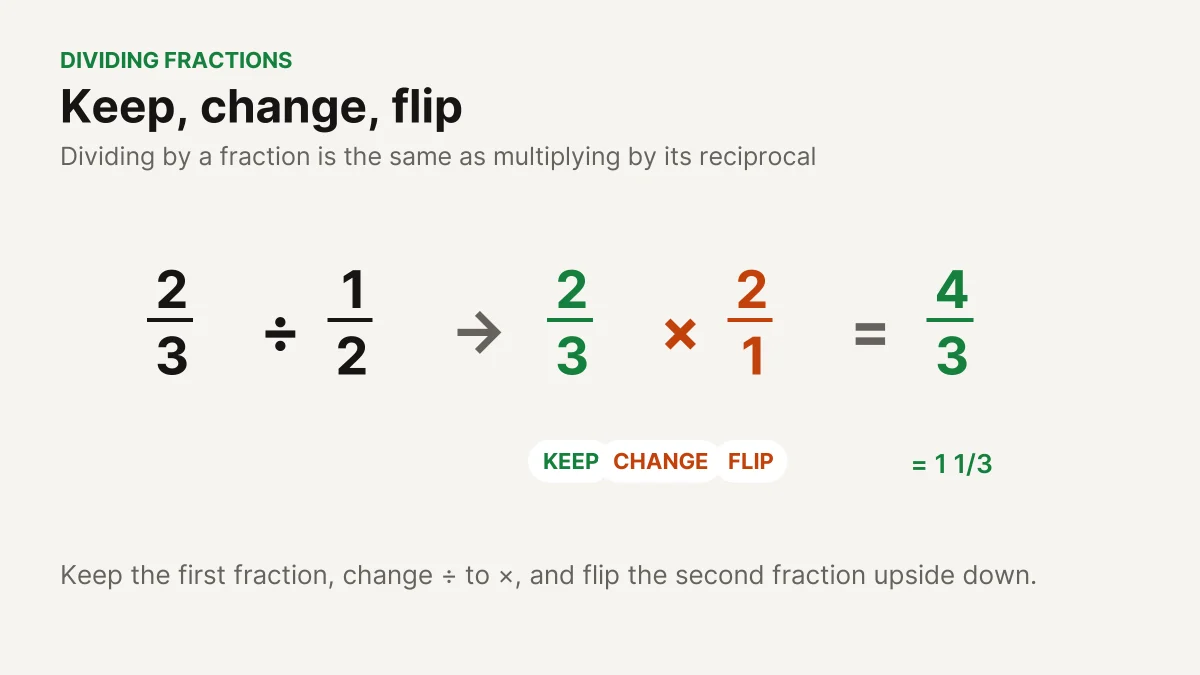
To divide fractions, keep the first fraction, change ÷ to ×, and flip the second fraction (use its reciprocal). Then multiply. For example, 2/3 ÷ 1/2 = 2/3 × 2/1 = 4/3. This rule is often called keep, change, flip.
In short: Keep the first fraction, change ÷ to ×, flip the second. Whole numbers go over 1, and mixed numbers become improper fractions before you flip. Simplify the answer.
In this guide
Keep, Change, Flip
- Keep the first fraction: 2/3.
- Change ÷ to ×.
- Flip the second fraction: 1/2 becomes 2/1.
- Multiply and simplify: 2/3 × 2/1 = 4/3 = 1 1/3.
Why Keep, Change, Flip Works
Dividing asks “how many of these fit into that?” Dividing by 1/2 asks how many halves fit, and there are 2 halves in every whole, so dividing by 1/2 is the same as multiplying by 2. The flipped fraction is called the reciprocal: a fraction times its reciprocal is 1, such as 1/2 × 2/1 = 1.
Dividing With Whole Numbers
Write the whole number over 1, then flip it if it is the second number.
Example: 2/3 ÷ 3 = 2/3 × 1/3 = 2/9.
Example: 5 divided by 3 as a fraction is simply 5/3 (or 1 2/3). Any division can be written as a fraction: top ÷ bottom.
Dividing Mixed Numbers
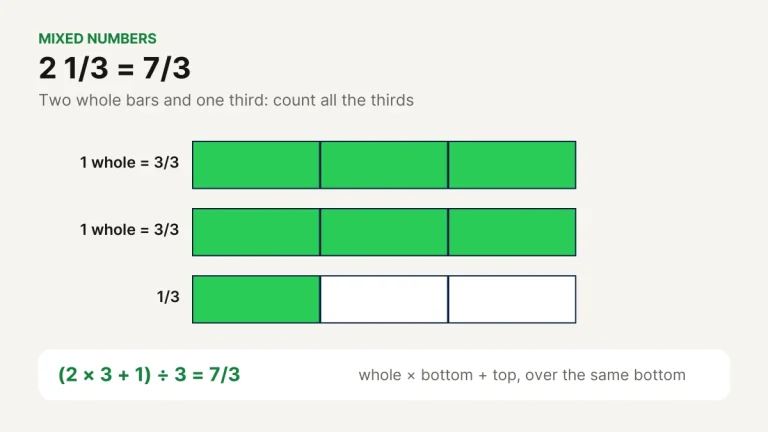
Change each mixed number to an improper fraction first, then keep, change, flip.
Example: 3 1/3 ÷ 2 = 10/3 × 1/2 = 10/6 = 5/3 = 1 2/3.
Example: 2 1/2 ÷ 3/4 = 5/2 × 4/3 = 20/6 = 10/3 = 3 1/3.
Example: 1 1/3 ÷ 1 3/4 = 4/3 ÷ 7/4 = 4/3 × 4/7 = 16/21.
Common Examples
| Problem | Working | Answer |
|---|---|---|
| 3 1/3 ÷ 2 | 10/3 × 1/2 = 10/6 | 5/3 = 1 2/3 |
| 2/3 ÷ 1/2 | 2/3 × 2/1 | 4/3 = 1 1/3 |
| 3 1/2 ÷ 1/3 | 7/2 × 3/1 | 21/2 = 10 1/2 |
| 2 1/3 ÷ 2 | 7/3 × 1/2 | 7/6 = 1 1/6 |
| 2 1/2 ÷ 3/4 | 5/2 × 4/3 = 20/6 | 10/3 = 3 1/3 |
| 2 1/2 ÷ 2/3 | 5/2 × 3/2 | 15/4 = 3 3/4 |
| 3/10 ÷ 4/5 | 3/10 × 5/4 = 15/40 | 3/8 |
| 5 1/8 ÷ 2 | 41/8 × 1/2 | 41/16 = 2 9/16 |
Try it
Divide fractions, whole numbers and mixed numbers and see the flip step shown for you.
FAQ
How do you divide fractions?
Keep the first fraction, change ÷ to ×, flip the second fraction, then multiply. For example, 2/3 ÷ 1/2 = 2/3 × 2/1 = 4/3.
What is 3 1/3 divided by 2?
3 1/3 = 10/3, so 10/3 ÷ 2 = 10/3 × 1/2 = 10/6 = 5/3, or 1 2/3.
What is 2/3 divided by 1/2 as a fraction?
2/3 × 2/1 = 4/3, which is 1 1/3 as a mixed number.
What is 5 divided by 3 as a fraction?
5 ÷ 3 = 5/3, which is 1 2/3 as a mixed number.
What is a reciprocal?
The reciprocal of a fraction is the fraction flipped upside down. The reciprocal of 3/4 is 4/3, and the reciprocal of 5 is 1/5. A number times its reciprocal is 1.
Do you flip the first or the second fraction?
Always flip the second fraction, the one you are dividing by. The first fraction stays the same.
Sources and Further Reading
- OpenStax, Prealgebra 2e, Section 4.2: Multiply and Divide Fractions, Rice University.
- OpenStax, Prealgebra 2e, Section 4.3: Multiply and Divide Mixed Numbers and Complex Fractions.
- Common Core Grade 5: Number and Operations, Fractions (5.NF.B.7: dividing with unit fractions).
More fraction guides: How to multiply fractions, Mixed numbers and improper fractions, How to simplify fractions, How to do fractions on a calculator. Or check any answer with the fraction calculator.
Check your working in seconds
Type any problem from this guide into the free CalcSolver calculator and see the answer, with fractions, instantly.