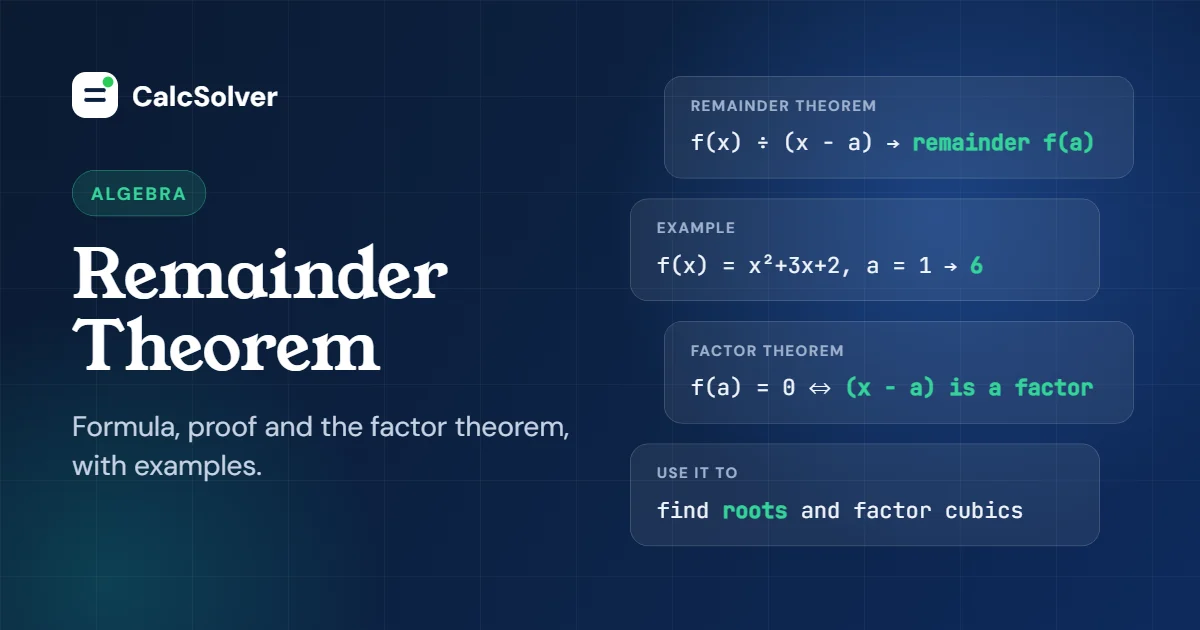
The Remainder Theorem says that when a polynomial f(x) is divided by x − a, the remainder is f(a). You find it by substituting a into the polynomial, with no long division needed. Its partner, the Factor Theorem, says that x − a is a factor exactly when f(a) = 0. This guide gives the formula, a short proof, and worked examples for finding remainders, testing factors, finding unknown coefficients and factoring polynomials.
In this guide
What Is the Remainder Theorem?
The Remainder Theorem says: if a polynomial f(x) is divided by x − a, the remainder is f(a). Instead of dividing, you substitute the number a for x and calculate.
| Part | Meaning | Example: f(x) = x² + 3x + 2 ÷ (x − 1) |
|---|---|---|
| Divisor | x − a | x − 1, so a = 1 |
| Formula | Remainder = f(a) | f(1) |
| Calculation | Substitute a into f(x) | 1 + 3 + 2 |
| Remainder | The result | 6 |
Check it with division: (x² + 3x + 2) ÷ (x − 1) gives x + 4 with remainder 6, because (x − 1)(x + 4) + 6 = x² + 3x − 4 + 6 = x² + 3x + 2. ✓ The method of dividing polynomials is covered in its own guide.
In short: Divide f(x) by x − a and the remainder is f(a). To find a, set the divisor equal to 0: for x − 1 use 1, for x + 2 use −2.
Why the Remainder Theorem Works (Proof)
Division always gives f(x) = (x − a) × q(x) + r, where q(x) is the quotient and r is the remainder. Because the divisor has degree 1, the remainder r is just a number.
Now substitute x = a. The bracket becomes (a − a) = 0, so the whole product disappears:
f(a) = 0 × q(a) + r = r
So the remainder r is exactly f(a). For numbers it is the same idea: 17 = 5 × 3 + 2, so 17 minus the multiple of 5 leaves the remainder 2.
How to Find the Remainder Using the Theorem
- Set the divisor equal to 0 and solve to find a. For x + 2, a = −2. For 2x − 1, a = 1/2.
- Substitute a into f(x). Use brackets, especially for negative values.
- Calculate. The answer is the remainder.
In short: Set the divisor to 0 to find a, substitute a into the polynomial, and calculate. The result is the remainder.
Remainder Theorem Examples
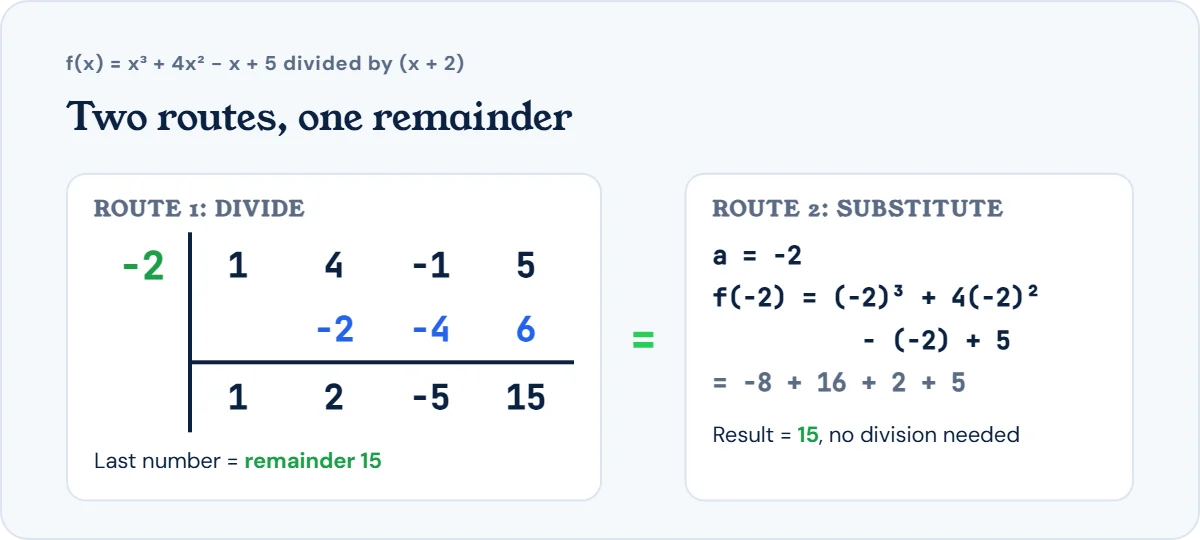
Example 1: divisor with a negative a. Find the remainder when f(x) = x³ + 4x² − x + 5 is divided by x + 2.
Set x + 2 = 0, so a = −2. Then f(−2) = (−2)³ + 4(−2)² − (−2) + 5 = −8 + 16 + 2 + 5 = 15. Synthetic division with a = −2 on the coefficients 1, 4, −1, 5 gives the bottom row 1, 2, −5, 15, which confirms it.
Example 2: divisor with a leading coefficient. Find the remainder when f(x) = 4x³ − 3x + 5 is divided by 2x − 1.
Set 2x − 1 = 0, so a = 1/2. Then f(1/2) = 4(1/8) − 3(1/2) + 5 = 0.5 − 1.5 + 5 = 4.
Example 3: find an unknown coefficient. The polynomial f(x) = x³ + kx² − 2x + 4 leaves remainder 6 when divided by x − 2. Find k.
By the theorem f(2) = 6. So 8 + 4k − 4 + 4 = 6, which gives 8 + 4k = 6 and k = −1/2. Check: f(2) = 8 − 2 − 4 + 4 = 6. ✓
Example 4: a remainder of zero. Find the remainder when f(x) = x³ − 2x² − 5x + 6 is divided by x − 3. Here f(3) = 27 − 18 − 15 + 6 = 0. A zero remainder means something special, as the next section shows.
In short: Always find a first. For a divisor like 2x − 1, a is a fraction (1/2). To find an unknown coefficient, set f(a) equal to the given remainder and solve.
The Factor Theorem
The Factor Theorem is the special case where the remainder is 0: x − a is a factor of f(x) if and only if f(a) = 0. In other words, a is a root (zero) of the polynomial.
Example 5. Is x − 3 a factor of x³ − 2x² − 5x + 6? Since f(3) = 0 (Example 4), yes.
Example 6. Is x + 1 a factor of x³ + 2x² + x + 3? Here a = −1 and f(−1) = −1 + 2 − 1 + 3 = 3, which is not 0, so no. The remainder is 3.
In short: If f(a) = 0, then x − a is a factor. If f(a) is not 0, it is the remainder and x − a is not a factor.
Factoring Polynomials With the Factor Theorem
This is the most useful application. For a cubic or higher polynomial, test small values until f(a) = 0. Then divide by x − a to get a smaller polynomial, and factor that.
Example 7: factor f(x) = x³ − 6x² + 11x − 6.
- Try a = 1: f(1) = 1 − 6 + 11 − 6 = 0, so x − 1 is a factor.
- Divide by x − 1 with synthetic division: the coefficients 1, −6, 11, −6 give the bottom row 1, −5, 6, 0.
- The quotient is x² − 5x + 6 = (x − 2)(x − 3).
- So f(x) = (x − 1)(x − 2)(x − 3), and the roots are 1, 2 and 3.
Example 8: solve x³ − 7x + 6 = 0. f(1) = 1 − 7 + 6 = 0, so x − 1 is a factor. Dividing with the coefficients 1, 0, −7, 6 gives 1, 1, −6, 0, so the quotient is x² + x − 6 = (x + 3)(x − 2). The solutions are x = 1, x = 2 and x = −3. You can confirm them with the solve for x calculator.
In short: Test values until f(a) = 0, divide by x − a, then factor what is left. Each root found removes one degree.
Which Values of a Should You Test?
You do not have to guess. For a polynomial with whole-number coefficients, any rational root has the form p/q, where p divides the constant term and q divides the leading coefficient. This is the Rational Zero Theorem.
Example 9: f(x) = 2x³ − 3x² − 3x + 2. The constant term 2 has factors ±1, ±2, and the leading coefficient 2 has factors ±1, ±2. The candidates are ±1, ±2 and ±1/2.
| Test value a | f(a) | Factor? |
|---|---|---|
| 1 | 2 − 3 − 3 + 2 = −2 | No |
| 2 | 16 − 12 − 6 + 2 = 0 | Yes, x − 2 |
| −1 | −2 − 3 + 3 + 2 = 0 | Yes, x + 1 |
| 1/2 | 0.25 − 0.75 − 1.5 + 2 = 0 | Yes, 2x − 1 |
So f(x) = (x − 2)(x + 1)(2x − 1). The roots are 2, −1 and 1/2.
Remainder Theorem vs Factor Theorem
| Remainder Theorem | Factor Theorem | |
|---|---|---|
| Statement | Dividing f(x) by x − a leaves remainder f(a) | x − a is a factor if and only if f(a) = 0 |
| Use it to | Find a remainder without dividing | Test factors and find roots |
| Result | Any number | Always 0 |
| Relationship | The general rule | The special case where the remainder is 0 |
Common Mistakes With the Remainder Theorem
- Using the wrong sign for a. For x + 2, a is −2, not 2.
- Forgetting the leading coefficient. For 2x − 1, a = 1/2, not 1.
- Sign errors with negative values. (−2)³ = −8, but (−2)² = 4. Use brackets.
- Thinking the remainder is a polynomial. When you divide by a linear factor, the remainder is a single number.
- Mixing up the two theorems. A non-zero f(a) is a remainder, not a root.
- Using the shortcut for the wrong divisor. The Remainder Theorem in this form needs a linear divisor, such as x − a or px − q.
Remainder Theorem Practice Problems (With Answers)
1. Find the remainder when x² − 5x + 7 is divided by x − 2.
1. f(2) = 4 − 10 + 7 = 1.
2. Find the remainder when x³ − 2x² + x − 3 is divided by x − 3.
9. f(3) = 27 − 18 + 3 − 3 = 9.
3. Find the remainder when 2x³ + x² − 4 is divided by x + 1.
−5. f(−1) = −2 + 1 − 4 = −5.
4. Is x + 3 a factor of x³ + 3x² − 4x − 12?
Yes. f(−3) = −27 + 27 + 12 − 12 = 0.
5. Is x − 2 a factor of x³ − 4x² + x + 6?
Yes. f(2) = 8 − 16 + 2 + 6 = 0.
6. Find k so that x − 1 is a factor of x³ + kx² − x + 2.
k = −2. f(1) = 1 + k − 1 + 2 = k + 2 = 0.
7. Find the remainder when x⁴ − 3x² + 2 is divided by x + 2.
6. f(−2) = 16 − 12 + 2 = 6.
8. Factor x³ − x² − 4x + 4.
(x − 1)(x − 2)(x + 2). f(1) = 0, then dividing by x − 1 leaves x² − 4.
Remainder Theorem: Frequently Asked Questions
What is the remainder theorem?
The remainder theorem states that when a polynomial f(x) is divided by x − a, the remainder is f(a). You can find the remainder by substituting a into the polynomial instead of doing long division.
What is the remainder theorem formula?
Remainder = f(a), where the divisor is x − a. To find a, set the divisor equal to 0. For x + 2, a = −2, and for 2x − 1, a = 1/2.
What is the difference between the remainder theorem and the factor theorem?
The remainder theorem gives the remainder when you divide by x − a, which is f(a). The factor theorem is the special case: x − a is a factor of f(x) if and only if the remainder f(a) is 0.
How do you use the remainder theorem to factor a polynomial?
Test values of a until f(a) = 0. Then x − a is a factor. Divide by x − a, usually with synthetic division, and factor the quotient. Repeat until the polynomial is fully factored.
Does the remainder theorem work for any divisor?
The form f(a) works for linear divisors x − a, or px − q using a = q/p. For divisors of higher degree, such as x² + 1, you need to use long division.
Why is the remainder a constant?
A remainder always has a lower degree than the divisor. When the divisor is linear (degree 1), the remainder must have degree 0, which means it is a single number.
Sources and Further Reading
- OpenStax, College Algebra 2e, Section 5.5: Zeros of Polynomial Functions, Rice University.
- Math is Fun, Remainder Theorem and Factor Theorem.
Every value in this guide was checked on the CalcSolver calculator. Learn how to divide first in our guide to dividing polynomials, or browse all algebra guides.
Check your working in seconds
Type any problem from this guide into the free CalcSolver calculator and see the answer, with fractions, instantly.