To reach about $50,000 in a 529 plan by age 18, assuming a 6% yearly return, you would save roughly $129 a month from birth, $212 from age 5, or $407 from age 10. The earlier you start, the less you deposit, because growth does more of the work. These are estimates, not promises, and this is general information, not financial or tax advice.
In this guide
How Much Does College Cost Right Now?
| School type | Tuition and fees | Full budget* |
|---|---|---|
| Public four-year, in-state | $11,950 | about $30,990 |
| Private nonprofit four-year | $45,000 | about $65,470 |
*Includes housing, food, books and other expenses. Four years at the in-state public average is about $124,000 in today’s dollars. Many students pay far less after grants, and prices keep rising, so treat your target as a range. Saving a share of the total is a common and realistic goal.
How Much Should You Save Each Month?
| Child’s age today | Years left | Goal $25,000 | Goal $50,000 | Goal $100,000 |
|---|---|---|---|---|
| Newborn | 18 | $65 | $129 | $258 |
| 5 | 13 | $106 | $212 | $425 |
| 10 | 8 | $204 | $407 | $814 |
| 15 | 3 | $636 | $1,271 | $2,542 |
How Does the Math Work?
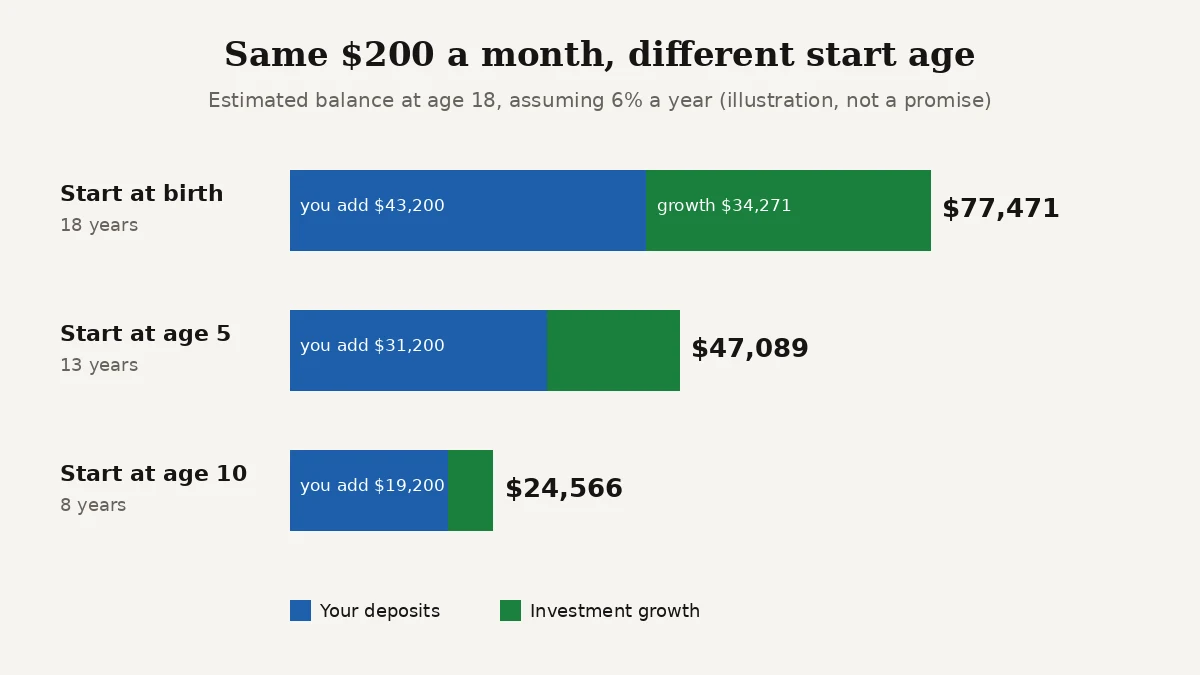
A 529 balance grows by compound interest. With monthly deposits, the formula is Future value = PMT × [((1 + r)ⁿ − 1) ÷ r], where PMT is the monthly deposit, r is the annual return ÷ 12, and n is the number of months. For $200 a month for 18 years at 6%: r = 0.005, n = 216, so 200 × 387.4 ≈ $77,471. You deposited $43,200, and about $34,271 came from growth. To check your own numbers, use the calculator below, the CalcSolver calculator, and convert yearly rates with the percentage calculator. Remember that 6% is an assumption. A cautious plan also tests 4%.
529 Savings Calculator
Enter your own numbers to see a projected balance, or add a goal to see the monthly deposit needed. It uses the same formula as the table above.
Project your balance
Estimate only. Real returns vary, fees apply, and costs rise over time. Not financial advice.
What Changed for 529 Plans in 2026?
- K-12 limit doubled. Starting in 2026 you can withdraw up to $20,000 a year per student for K-12 costs, up from $10,000, and the list now includes more than tuition.
- Credentials count. Qualified postsecondary credentialing programs, such as approved certifications and licences, are now eligible expenses.
- Roth IRA rollover. Under SECURE 2.0, up to $35,000 per beneficiary can move to their Roth IRA tax- and penalty-free. The 529 must be open 15+ years, yearly rollovers are capped by the Roth limit ($7,500 in 2026), and contributions from the last five years do not qualify.
State rules can differ from federal rules, so check your state plan before using these new options.
Does a 529 Affect Financial Aid?
Slightly. A parent-owned 529 is reported as a parent asset and counts at up to 5.64% of its value, so $10,000 could reduce aid by about $564. A 529 owned by a grandparent or another relative is generally not reported on the FAFSA, and since the 2024–25 aid year its withdrawals are no longer counted as student income. Some colleges that use the CSS Profile may still count it.
What If There Is Money Left Over?
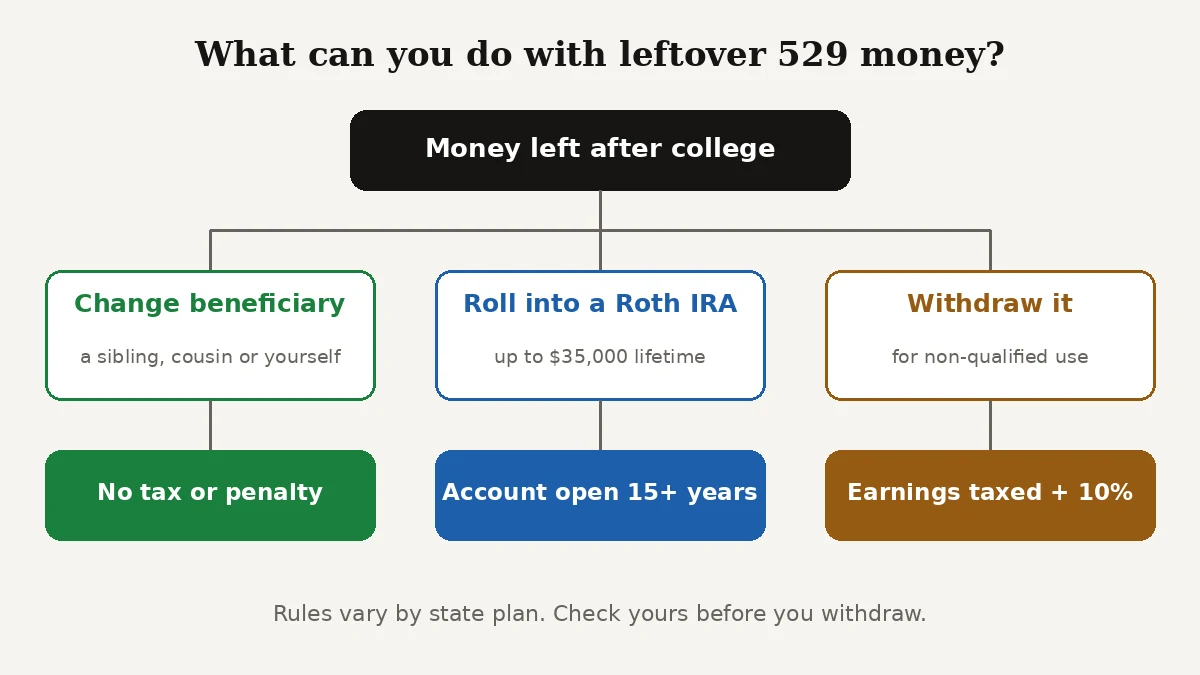
If a scholarship covers costs, you can withdraw the same amount without the 10% penalty, but the earnings are still taxed as income. On non-qualified withdrawals, the earnings are taxed and a 10% penalty applies.
Can Family Chip In, and Is There a Limit?
Yes. Anyone can contribute. Gifts up to the $19,000 yearly gift-tax exclusion need no gift tax return, and a 529 allows five years of gifts at once, so up to $95,000 per donor ($190,000 per couple) in one go. Each state also sets a lifetime balance cap per beneficiary, so check yours.
FAQ
How much should I put in a 529 each month?
It depends on your goal and start date. At an assumed 6% return, about $129 a month from birth, $212 from age 5 or $407 from age 10 builds roughly $50,000 by age 18.
Does a 529 plan hurt financial aid?
A little. A parent-owned 529 is counted as a parent asset at up to 5.64% of its value on the FAFSA. Grandparent-owned 529 plans are generally not reported.
What happens if my child does not go to college?
You can change the beneficiary to another family member, roll up to $35,000 into the beneficiary’s Roth IRA if the account is 15+ years old, or withdraw it and pay tax on earnings plus a 10% penalty.
Are 529 contributions tax deductible?
Not on your federal return. Many states offer a deduction or credit, and growth and qualified withdrawals are federally tax-free.
Ready to test your own plan? Enter your deposit, years and return in the CalcSolver calculator and compare a few scenarios.
Sources
- College Board: Trends in College Pricing, 2025–26
- Vanguard: 529 plans and financial aid
- Saving for College: 529 plans and financial aid
- Surgent: 529 plan rules for 2026 after OBBBA
- Ascensus: 2026 IRA limit of $7,500 (IRS Notice 2025-67)
- IRS Publication 970: Tax Benefits for Education
General information for the United States, not financial, tax or legal advice. Rules and limits change, so check your state plan and a qualified adviser.
Check your working in seconds
Type any problem from this guide into the free CalcSolver calculator and see the answer, with fractions, instantly.