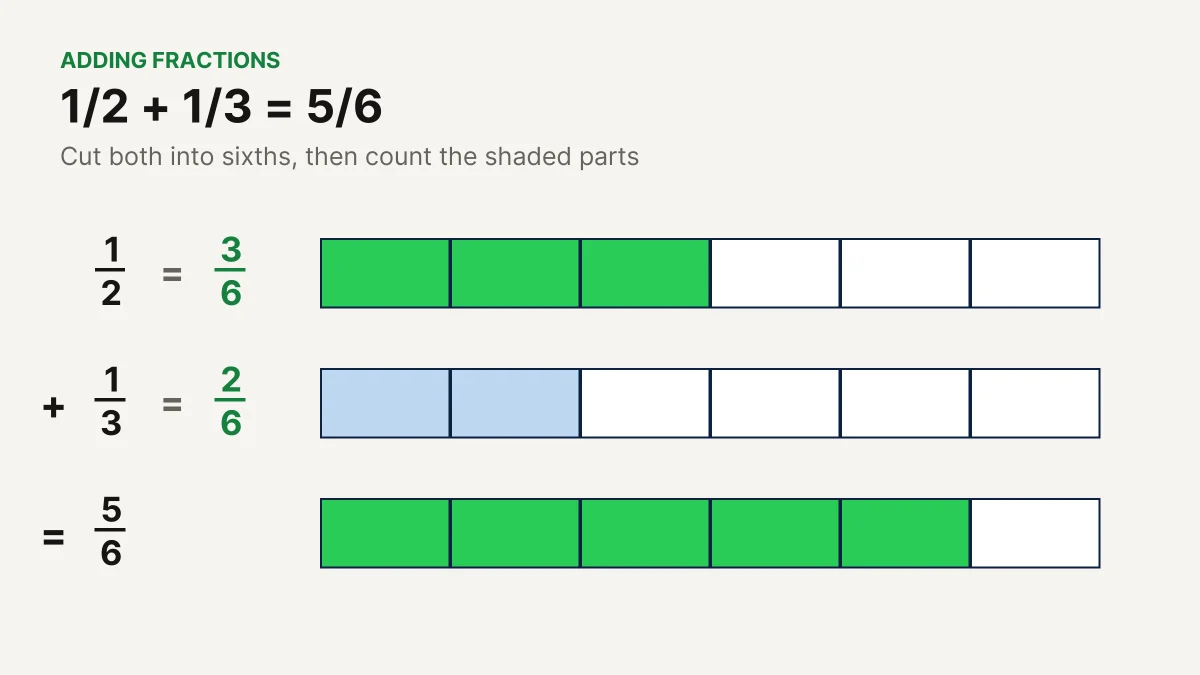
To add fractions, make the denominators (bottom numbers) the same, then add the numerators (top numbers) and keep the denominator. If the denominators already match, just add the tops: 2/5 + 1/5 = 3/5. If they are different, rewrite both fractions with a common denominator first: 1/2 + 1/3 = 3/6 + 2/6 = 5/6.
In short: Same denominators: add the numerators. Different denominators: find the least common denominator, rewrite each fraction, then add. Mixed numbers: add the wholes and the fractions, or change to improper fractions first. Always simplify at the end.
In this guide
Adding Fractions With the Same Denominator
When the bottom numbers match, the pieces are the same size, so you only count them. Add the numerators and keep the denominator.
Example: 2/5 + 1/5 = (2 + 1)/5 = 3/5. Two fifths and one fifth make three fifths.
Do not add the denominators. 2/5 + 1/5 is not 3/10, because the pieces are still fifths.
Adding Fractions With Different Denominators
You can only add pieces of the same size, so first rewrite both fractions with a common denominator. The smallest one, the least common denominator (LCD), keeps the numbers small.
- Find the LCD. List multiples of the larger denominator until one is also a multiple of the smaller one. For 2 and 3: 3, 6. The LCD is 6.
- Rewrite each fraction. Multiply the top and bottom by the same number: 1/2 = 3/6 (× 3) and 1/3 = 2/6 (× 2).
- Add the numerators. 3/6 + 2/6 = 5/6.
- Simplify if you can. 5/6 is already in simplest form.
Example: 4/6 + 1/4. The LCD of 6 and 4 is 12. 4/6 = 8/12 and 1/4 = 3/12, so the sum is 8/12 + 3/12 = 11/12.
Rewriting a fraction like this gives an equivalent fraction: the value does not change, only the size of the pieces.
How to Add Mixed Numbers
There are two ways. Both give the same answer.
- Add the parts separately. Add the whole numbers, add the fractions, then combine. If the fraction part comes out as more than 1, carry the extra whole.
- Change to improper fractions. Turn each mixed number into an improper fraction, add, then change back.
Example: 3 1/2 + 1 1/3. Wholes: 3 + 1 = 4. Fractions: 1/2 + 1/3 = 3/6 + 2/6 = 5/6. Answer: 4 5/6 (or 29/6).
Example: 2 3/4 + 1 2/3. Wholes: 2 + 1 = 3. Fractions: 3/4 + 2/3 = 9/12 + 8/12 = 17/12 = 1 5/12. Carry the 1: 3 + 1 5/12 = 4 5/12.
Adding a Whole Number and a Fraction
Write the whole number in front of the fraction to make a mixed number: 2 + 3/4 = 2 3/4. As an improper fraction, 2 = 8/4, so 8/4 + 3/4 = 11/4.
Common Examples
| Problem | Working | Answer |
|---|---|---|
| 1/2 + 2/5 | 5/10 + 4/10 | 9/10 |
| 1/2 + 1/3 | 3/6 + 2/6 | 5/6 |
| 1/6 + 1/2 | 1/6 + 3/6 = 4/6 | 2/3 |
| 3/4 + 1/8 | 6/8 + 1/8 | 7/8 |
| 1/4 + 1/6 | 3/12 + 2/12 | 5/12 |
| 3 1/2 + 1 1/3 | 4 + 5/6 | 4 5/6 |
Try it
Add any fractions, mixed numbers or whole numbers and see the common denominator worked out for you.
Mistakes to Avoid
- Adding the denominators. 1/2 + 1/3 is not 2/5. Make the pieces the same size first.
- Changing only the bottom. When you rewrite 1/2 as sixths, multiply the top too: 1/2 = 3/6, not 1/6.
- Forgetting to simplify. 1/6 + 3/6 = 4/6, which simplifies to 2/3.
- Leaving an improper fraction part. In a mixed number answer, 3 17/12 should be 4 5/12.
FAQ
How do you add fractions with different denominators?
Find the least common denominator, rewrite each fraction with it, then add the numerators. For example, 1/2 + 2/5 = 5/10 + 4/10 = 9/10.
Do you add the denominators when adding fractions?
No. The denominator tells you the size of the pieces, and it stays the same. Only the numerators are added: 2/5 + 1/5 = 3/5.
What is 1/2 + 1/3 as a fraction?
1/2 + 1/3 = 3/6 + 2/6 = 5/6.
How do you add mixed numbers?
Add the whole numbers and the fractions separately, then combine them. If the fraction part is more than 1, carry the extra whole. 3 1/2 + 1 1/3 = 4 5/6.
Do you need the least common denominator?
Any common denominator works, but the least one keeps the numbers small, so there is less to simplify at the end.
Sources and Further Reading
- OpenStax, Prealgebra, Section 4.6: Add and Subtract Mixed Numbers, Rice University.
- Common Core Grade 5: Number and Operations, Fractions (5.NF.A.1: adding fractions with unlike denominators).
More fraction guides: How to subtract fractions, Mixed numbers and improper fractions, How to simplify fractions, How to do fractions on a calculator. Or check any answer with the fraction calculator.
Check your working in seconds
Type any problem from this guide into the free CalcSolver calculator and see the answer, with fractions, instantly.