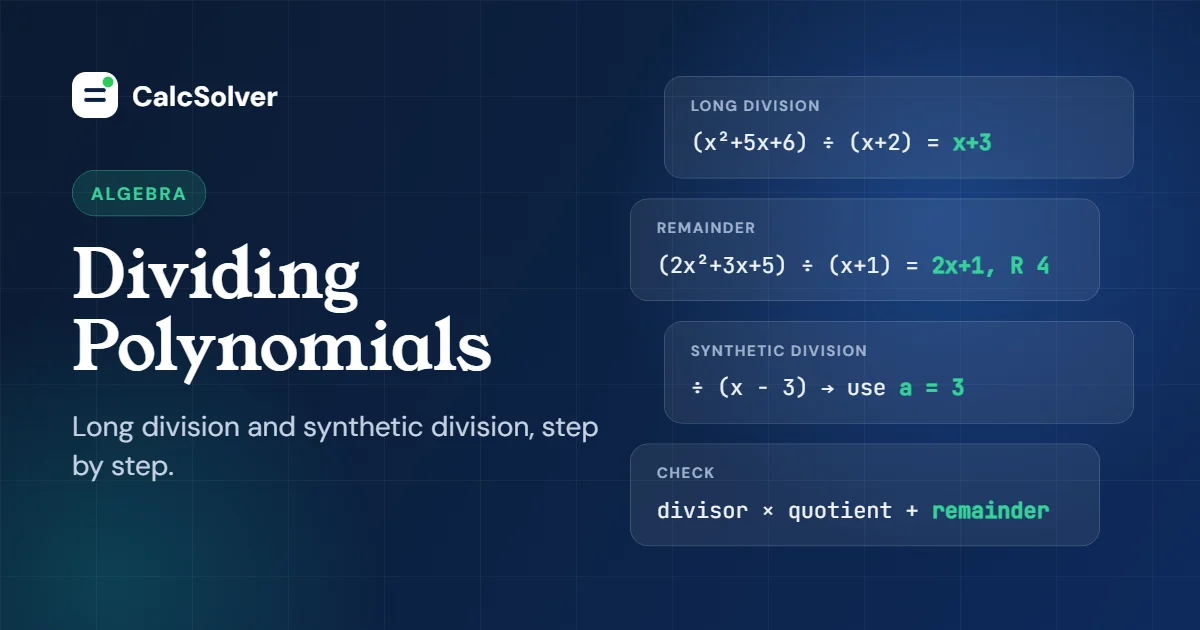
To divide polynomials, use polynomial long division for any divisor, or synthetic division as a shortcut when the divisor is x − a. This guide explains both methods step by step with worked examples: no remainder, with a remainder, missing terms, a leading coefficient other than 1, and a divisor like x + 2. You will also learn how to write the answer and how to check it by multiplying.
In this guide
What Does Dividing Polynomials Mean?
Dividing polynomials works like dividing whole numbers. Just as 17 ÷ 5 = 3 remainder 2 means 17 = 5 × 3 + 2, dividing a polynomial gives a quotient and sometimes a remainder. This is the division algorithm:
Dividend = Divisor × Quotient + Remainder
| Term | Meaning | In (2x² + 3x + 5) ÷ (x + 1) |
|---|---|---|
| Dividend | The polynomial being divided | 2x² + 3x + 5 |
| Divisor | The polynomial you divide by | x + 1 |
| Quotient | The result of the division | 2x + 1 |
| Remainder | What is left over. Its degree is lower than the divisor’s | 4 |
If the remainder is 0, the divisor divides evenly. That means the divisor is a factor of the dividend. The polynomials here are explained in our guide to polynomials.
In short: Dividend = divisor × quotient + remainder. A remainder of 0 means the divisor is a factor of the dividend.
Which Method Should You Use?
| Divisor | Best method | Example |
|---|---|---|
| A single term (monomial) | Split into separate fractions | (6x³ + 9x²) ÷ 3x |
| Any polynomial | Long division | (6x² + x − 2) ÷ (2x − 1) |
| x − a (leading coefficient 1) | Synthetic division (faster) | (x³ − 2x² − 5x + 6) ÷ (x − 3) |
In short: Long division always works. Synthetic division is a quicker shortcut that only works when the divisor looks like x − a.
Dividing a Polynomial by a Monomial
Divide each term of the polynomial by the monomial, then simplify using the exponent rule xᵐ ÷ xⁿ = xᵐ⁻ⁿ (see the laws of exponents).
Example: (6x³ + 9x² − 3x) ÷ 3x = 6x³/3x + 9x²/3x − 3x/3x = 2x² + 3x − 1.
How to Do Polynomial Long Division
Long division repeats four steps, often remembered as divide, multiply, subtract, bring down. First write both polynomials in descending order of powers.
- Divide the first term of the dividend by the first term of the divisor. This is the next term of the quotient.
- Multiply the whole divisor by that term.
- Subtract the result from the dividend. Take care with signs.
- Bring down the next term and repeat until the degree of what is left is lower than the divisor.
Example 1: (x² + 5x + 6) ÷ (x + 2)
| Step | Divide | Multiply and subtract | What is left |
|---|---|---|---|
| 1 | x² ÷ x = x | x(x + 2) = x² + 2x. Subtract: (x² + 5x) − (x² + 2x) = 3x | 3x + 6 |
| 2 | 3x ÷ x = 3 | 3(x + 2) = 3x + 6. Subtract: (3x + 6) − (3x + 6) = 0 | 0 |
The quotient is x + 3 with remainder 0. Check: (x + 2)(x + 3) = x² + 5x + 6. ✓
Example 2: (x³ − 2x² − 5x + 6) ÷ (x − 3)
| Step | Divide | Multiply and subtract | What is left |
|---|---|---|---|
| 1 | x³ ÷ x = x² | x²(x − 3) = x³ − 3x². Subtract: gives x² − 5x | x² − 5x + 6 |
| 2 | x² ÷ x = x | x(x − 3) = x² − 3x. Subtract: gives −2x | −2x + 6 |
| 3 | −2x ÷ x = −2 | −2(x − 3) = −2x + 6. Subtract: gives 0 | 0 |
The quotient is x² + x − 2 with remainder 0. That quotient factors further as (x + 2)(x − 1), so x³ − 2x² − 5x + 6 = (x − 3)(x + 2)(x − 1).
In short: Divide the leading terms, multiply the divisor, subtract (watch the signs) and bring down the next term. Stop when what is left has a lower degree than the divisor.
Division With a Remainder
When the leftover has a lower degree than the divisor but is not 0, it is the remainder. Write the answer as quotient + remainder ÷ divisor.
Example 3: (2x² + 3x + 5) ÷ (x + 1)
| Step | Divide | Multiply and subtract | What is left |
|---|---|---|---|
| 1 | 2x² ÷ x = 2x | 2x(x + 1) = 2x² + 2x. Subtract: gives x | x + 5 |
| 2 | x ÷ x = 1 | 1(x + 1) = x + 1. Subtract: gives 4 | 4 |
The quotient is 2x + 1 and the remainder is 4, so the answer is 2x + 1 + 4/(x + 1). Check: (x + 1)(2x + 1) + 4 = 2x² + 3x + 1 + 4 = 2x² + 3x + 5. ✓
In short: Write a non-zero remainder as a fraction over the divisor: quotient + remainder/divisor.
Missing Terms: Use a Zero Placeholder
If a power is missing, write it with a coefficient of 0 so the columns stay lined up. A missing term is one of the most common reasons for a wrong answer.
Example 4: (x³ − 8) ÷ (x − 2). Rewrite the dividend as x³ + 0x² + 0x − 8.
| Step | Divide | Multiply and subtract | What is left |
|---|---|---|---|
| 1 | x³ ÷ x = x² | x²(x − 2) = x³ − 2x². Subtract: gives 2x² | 2x² + 0x − 8 |
| 2 | 2x² ÷ x = 2x | 2x(x − 2) = 2x² − 4x. Subtract: gives 4x | 4x − 8 |
| 3 | 4x ÷ x = 4 | 4(x − 2) = 4x − 8. Subtract: gives 0 | 0 |
The quotient is x² + 2x + 4. This matches the difference of cubes formula x³ − 8 = (x − 2)(x² + 2x + 4).
When the Divisor Has a Leading Coefficient Other Than 1
Nothing changes in the steps. Divide the first term by the first term, even when the divisor starts with 2x or 3x.
Example 5: (6x² + x − 2) ÷ (2x − 1)
| Step | Divide | Multiply and subtract | What is left |
|---|---|---|---|
| 1 | 6x² ÷ 2x = 3x | 3x(2x − 1) = 6x² − 3x. Subtract: gives 4x | 4x − 2 |
| 2 | 4x ÷ 2x = 2 | 2(2x − 1) = 4x − 2. Subtract: gives 0 | 0 |
The quotient is 3x + 2. Check: (2x − 1)(3x + 2) = 6x² + 4x − 3x − 2 = 6x² + x − 2. ✓
Synthetic Division: The Shortcut for x − a
Synthetic division uses only the coefficients, so there are no variables to copy. It works when the divisor is x − a. Use the number a (the root of the divisor), which means you change the sign: for x − 3 use 3, and for x + 2 use −2.
- Write the coefficients of the dividend in descending order, with 0 for any missing power.
- Write a to the left. Bring down the first coefficient.
- Multiply the number you brought down by a, write it under the next coefficient, and add.
- Repeat until the end. The last number is the remainder, and the other numbers are the coefficients of the quotient, one degree lower.
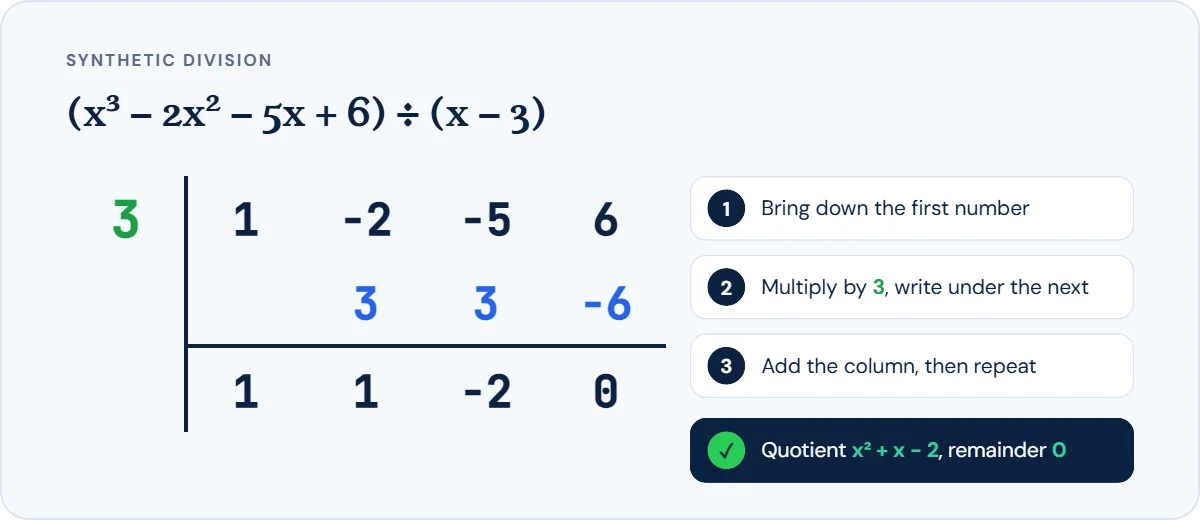
Example 6: (x³ − 2x² − 5x + 6) ÷ (x − 3). Use a = 3 and the coefficients 1, −2, −5, 6. Bring down 1. Then 3 × 1 = 3 and −2 + 3 = 1. Then 3 × 1 = 3 and −5 + 3 = −2. Then 3 × (−2) = −6 and 6 − 6 = 0. The quotient is x² + x − 2 with remainder 0, the same answer as long division in Example 2.
Example 7: divisor x + 2. Divide x³ + 4x² + x − 6 by x + 2 using a = −2 and the coefficients 1, 4, 1, −6. Bring down 1. Then −2 × 1 = −2 and 4 − 2 = 2. Then −2 × 2 = −4 and 1 − 4 = −3. Then −2 × (−3) = 6 and −6 + 6 = 0. The quotient is x² + 2x − 3, remainder 0.
Example 8: with a remainder. Divide 2x³ − 3x² + 4x − 5 by x − 1 using a = 1 and the coefficients 2, −3, 4, −5. The bottom row is 2, −1, 3, −2. The quotient is 2x² − x + 3 and the remainder is −2. This remainder equals the value of the polynomial at x = 1, which is the idea behind the Remainder Theorem.
In short: For x − a, write the coefficients, bring down the first, then multiply by a and add across. The last number is the remainder. For x + 2, use a = −2.
How to Check Your Answer
Multiply the quotient by the divisor and add the remainder. You should get the original polynomial.
Example: Check Example 8: (x − 1)(2x² − x + 3) + (−2) = 2x³ − x² + 3x − 2x² + x − 3 − 2 = 2x³ − 3x² + 4x − 5. ✓
For a quick second check, substitute x = 1 into the dividend: 2 − 3 + 4 − 5 = −2, which matches the remainder.
Why Dividing Polynomials Matters
- Factoring higher-degree polynomials. If the remainder is 0, the divisor is a factor, and the quotient is what is left to factor. See factoring higher-degree polynomials.
- Finding all roots. Find one root, divide it out, then solve the smaller equation. You can confirm the roots with the solve for x calculator.
- Simplifying algebraic fractions. A fraction with a polynomial on top and bottom can often be simplified by division.
Common Mistakes When Dividing Polynomials
- Skipping a missing term. x³ − 8 needs x³ + 0x² + 0x − 8.
- Not writing in descending order. Put the highest power first in both polynomials.
- Sign errors when subtracting. Subtract every term of the product. For example, (x² − 5x) − (x² − 3x) = −2x, not −8x.
- Using the wrong number in synthetic division. For x + 2, use −2, not 2.
- Forgetting the remainder. Write it as remainder/divisor, as in 2x + 1 + 4/(x + 1).
- Using synthetic division for the wrong divisor. It only works for x − a. Use long division for divisors such as x² + 1 or 2x − 1.
Dividing Polynomials Practice Problems (With Answers)
1. (x² + 7x + 10) ÷ (x + 5)
x + 2, remainder 0.
2. (x² − x − 12) ÷ (x − 4)
x + 3, remainder 0.
3. (3x² + 10x + 8) ÷ (x + 2)
3x + 4, remainder 0.
4. (x³ + x² − 4x − 4) ÷ (x + 1)
x² − 4, remainder 0. Use synthetic division with a = −1.
5. (x³ − 27) ÷ (x − 3)
x² + 3x + 9, remainder 0. Remember the zero placeholders.
6. (x² + 3x + 5) ÷ (x + 1)
x + 2 + 3/(x + 1). The quotient is x + 2 and the remainder is 3.
7. (4x² − 9) ÷ (2x + 3)
2x − 3, remainder 0. A difference of squares.
8. (2x³ + 3x² − 8x + 3) ÷ (x − 1)
2x² + 5x − 3, remainder 0.
Dividing Polynomials: Frequently Asked Questions
How do you divide polynomials?
Use polynomial long division: divide the leading terms, multiply the divisor by that result, subtract, bring down the next term and repeat. When the divisor is x − a, synthetic division does the same job faster using only the coefficients.
What is synthetic division?
Synthetic division is a shortcut for dividing a polynomial by x − a. You write only the coefficients, bring down the first one, then multiply by a and add across. The last number is the remainder and the others are the coefficients of the quotient.
Can you use synthetic division when the divisor is x + 2?
Yes. Write x + 2 as x − (−2) and use a = −2. Change the sign of the number in the divisor and use that value.
What do you do with the remainder?
Write it as a fraction over the divisor and add it to the quotient. For (2x² + 3x + 5) ÷ (x + 1), the answer is 2x + 1 + 4/(x + 1).
Why do you add zero terms when dividing polynomials?
Zero placeholders keep each power in its own column. Without them, terms of different degrees get mixed up. For x³ − 8, write x³ + 0x² + 0x − 8.
How do you check a polynomial division?
Multiply the quotient by the divisor and add the remainder. The result must equal the original polynomial. You can also substitute the root of the divisor into the dividend to confirm the remainder.
Sources and Further Reading
- OpenStax, College Algebra 2e, Section 5.4: Dividing Polynomials, Rice University.
- OpenStax, Elementary Algebra 2e, Section 6.6: Divide Polynomials, Rice University.
- Math is Fun, Polynomials: Long Division.
Every answer on this page was checked by multiplying back on the CalcSolver calculator. New to the topic? Start with what a polynomial is, or browse all algebra guides.
Check your working in seconds
Type any problem from this guide into the free CalcSolver calculator and see the answer, with fractions, instantly.