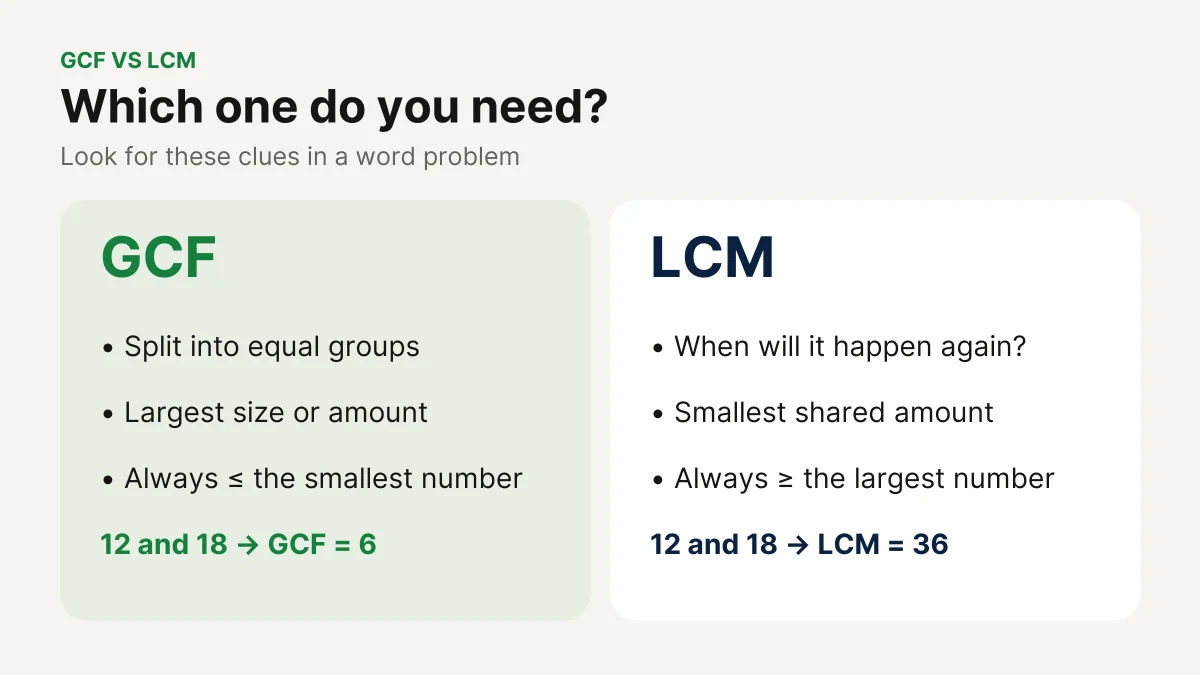
Use the GCF when you split things into the largest possible equal groups, and the LCM when you want to know when two repeating things will line up again. The GCF is always less than or equal to the smallest number; the LCM is always greater than or equal to the largest. For 12 and 18, the GCF is 6 and the LCM is 36.
In short: GCF: splitting, sharing, cutting into equal pieces, “largest” or “greatest”. LCM: repeating events, schedules, buying packs to match, “least”, “smallest” or “next time together”.
In this guide
GCF vs LCM at a Glance
| GCF | LCM | |
|---|---|---|
| Stands for | Greatest common factor | Least common multiple |
| It is… | The largest number that divides into all the numbers | The smallest number all the numbers divide into |
| Size | At most the smallest number | At least the largest number |
| Primes to use | Shared primes, smallest power | All primes, largest power |
| 12 and 18 | 6 | 36 |
| Used for | Simplifying fractions, equal groups, factoring | Common denominators, schedules, matching packs |
How to Tell Which One a Word Problem Needs
- Are you splitting a set of things into smaller, equal groups? Use the GCF. The answer is smaller than the numbers you start with.
- Are things repeating until they meet, or are you buying packs to get equal amounts? Use the LCM. The answer is bigger than the numbers you start with.
- Check the size of your answer. If a “groups” answer is bigger than your numbers, or a “when again” answer is smaller, you used the wrong one.
GCF Word Problems
Example: Fruit bags. You have 24 apples and 36 oranges and want identical bags with nothing left over. What is the greatest number of bags? GCF(24, 36) = 12 bags, each with 2 apples and 3 oranges.
Example: Ribbon. Two ribbons are 48 cm and 72 cm long. You cut both into equal pieces, as long as possible. GCF(48, 72) = 24 cm, which gives 2 + 3 = 5 pieces.
Example: Rows. 30 boys and 45 girls stand in rows with the same number in each row, and each row has only boys or only girls. The most students per row is GCF(30, 45) = 15, giving 2 rows of boys and 3 rows of girls.
LCM Word Problems
Example: Buses. One bus leaves every 12 minutes and another every 18 minutes. Both leave at 8:00. When do they next leave together? LCM(12, 18) = 36 minutes, so at 8:36.
Example: Hot dogs and buns. Hot dogs come in packs of 10 and buns in packs of 8. What is the smallest number of each so none are left over? LCM(10, 8) = 40: buy 4 packs of hot dogs and 5 packs of buns.
Example: Adding fractions. To add 1/4 + 5/6 you need the least common denominator, which is LCM(4, 6) = 12: 3/12 + 10/12 = 13/12. See how to add fractions.
Try it
Check any word problem by finding the GCF and LCM of its numbers in one go.
How the GCF and LCM Are Linked
For any two numbers, GCF × LCM = the two numbers multiplied. For 12 and 18: 6 × 36 = 216, and 12 × 18 = 216. So if you know one, you can find the other: LCM = (a × b) ÷ GCF. This only works for two numbers at a time.
Learn each one in detail: how to find the GCF and how to find the LCM.
FAQ
What is the difference between GCF and LCM?
The GCF is the largest number that divides into all the numbers, and the LCM is the smallest number that all of them divide into. For 12 and 18, the GCF is 6 and the LCM is 36.
How do I know whether to use GCF or LCM in a word problem?
Use the GCF when you split things into equal groups or cut them into equal pieces. Use the LCM when things repeat and you need to know when they line up, or when you buy packs to get equal amounts.
Is the GCF always smaller than the LCM?
The GCF is never bigger than the LCM. They are equal only when all the numbers are the same, such as 6 and 6.
What is the GCF and LCM of 12 and 18?
The GCF of 12 and 18 is 6 and the LCM is 36. Check: 6 × 36 = 216 = 12 × 18.
Does GCF × LCM = a × b work for three numbers?
No. The rule only works for two numbers. For 8, 12 and 16, the GCF is 4 and the LCM is 48, but 4 × 48 = 192 is not 8 × 12 × 16 = 1,536.
Sources and Further Reading
- OpenStax, Prealgebra, Section 2.5: Prime Factorization and the Least Common Multiple, Rice University.
- OpenStax, Prealgebra 2e, Section 10.6: Introduction to Factoring Polynomials.
- Common Core Grade 6: The Number System (6.NS.B.4).
Solve any of these with the GCF and LCM calculator, and use the fraction calculator for fraction problems.
Check your working in seconds
Type any problem from this guide into the free CalcSolver calculator and see the answer, with fractions, instantly.