Roman numerals use seven letters (I, V, X, L, C, D, M) and were used in ancient engineering to label, count and order things, such as the numbered gates of the Colosseum. Romans did not calculate with them. They added and divided on counting boards, then wrote the result in numerals.
In this guide
What Are the Seven Roman Numeral Symbols?
| Symbol | I | V | X | L | C | D | M |
|---|---|---|---|---|---|---|---|
| Value | 1 | 5 | 10 | 50 | 100 | 500 | 1,000 |
The Three Rules That Decide Everything
- Add when symbols go from large to small: VIII = 5 + 3 = 8.
- Subtract when a small symbol sits before a larger one, but only in six pairs.
- Repeat I, X, C or M up to three times. V, L and D never repeat.
| Pair | IV | IX | XL | XC | CD | CM |
|---|---|---|---|---|---|---|
| Value | 4 | 9 | 40 | 90 | 400 | 900 |
How Do You Convert Roman Numerals Step by Step?
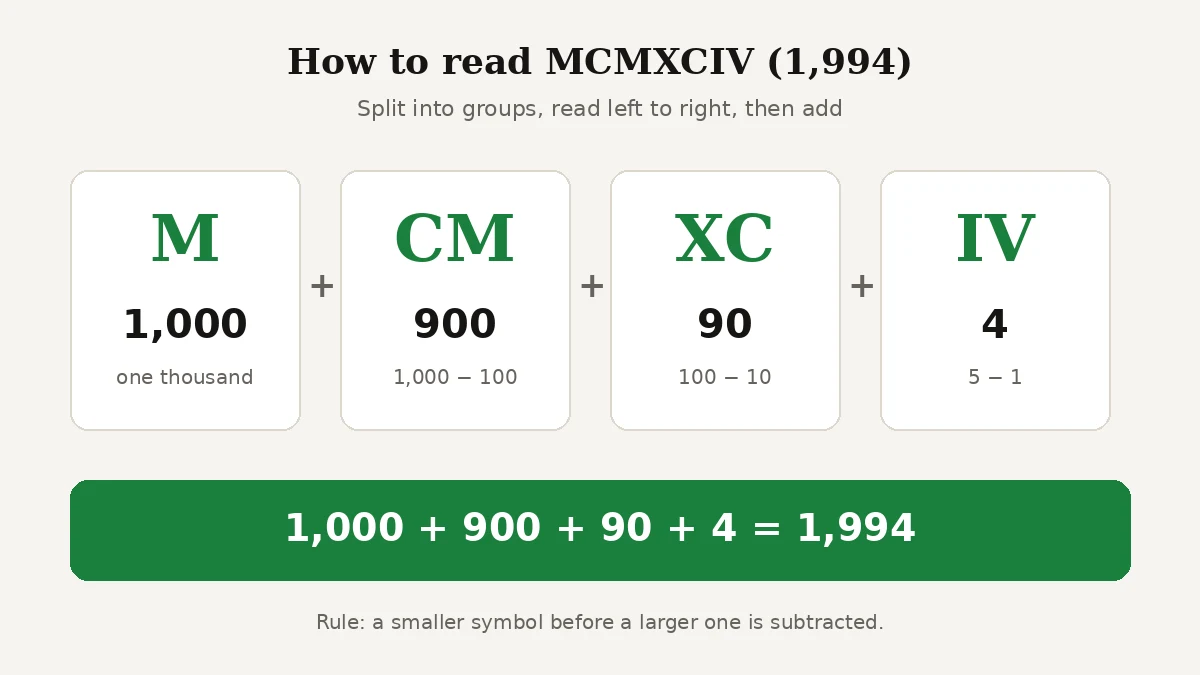
Roman to number: split the numeral into groups, value each group, then add. For MCMXCIV, the groups are M, CM, XC and IV.
Number to Roman: work from the biggest place value down. For 2,026, write 2,000 (MM), 0 hundreds, 20 (XX) and 6 (VI): MMXXVI. Check any answer with the CalcSolver calculator.
Common mistakes
- 49 is XLIX, not IL. Only I, X and C can be subtracted, and only from the next two larger symbols.
- 99 is XCIX, not IC.
- Four identical symbols in a row (except old clock-style IIII) are wrong.
How Did Romans Use Numerals in Engineering?
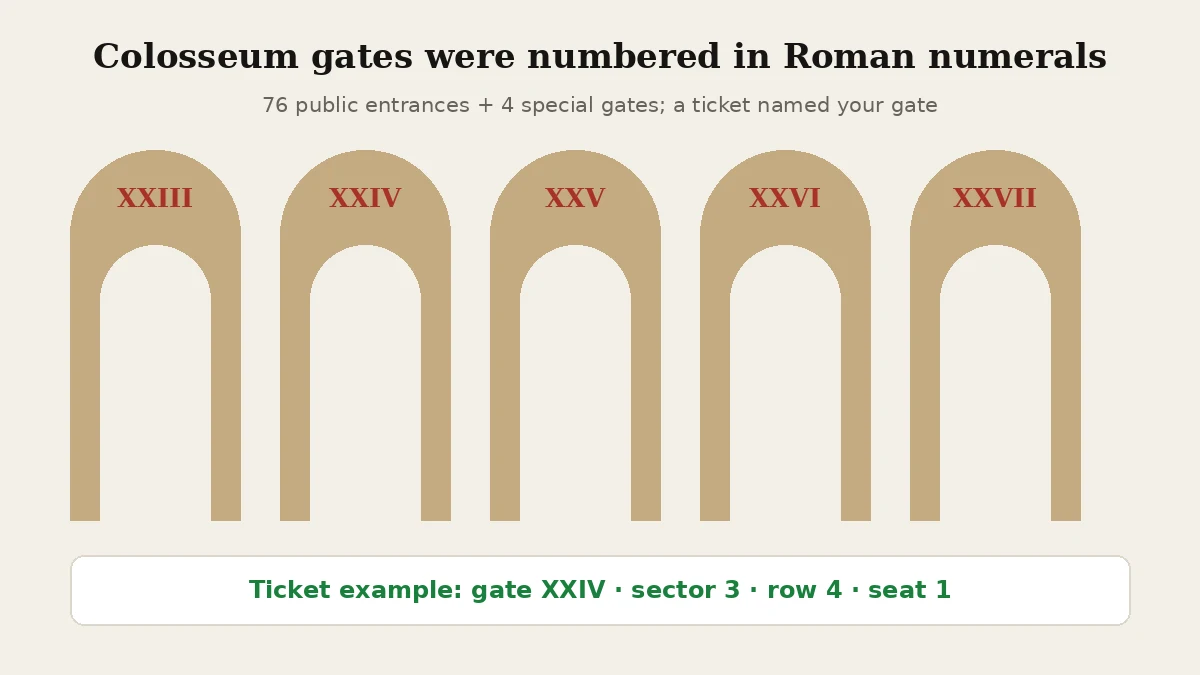
The best-documented example is the Colosseum. It had 80 ground-level arches, and 76 of them were public entrances numbered in Roman numerals. A ticket (tessera) named your gate, section, row and seat, which helped about 50,000 spectators find their places. The numerals were carved into the stone and painted red, and gates XXIII to LIV still survive.
Numerals also marked other counts and distances. A Roman mile was 1,000 paces, roughly 1.48 km. For the actual maths, builders and accountants used counting boards with pebbles called calculi, the root of the word “calculate”.
Why Do Clocks Use IIII Instead of IV?
Nobody has proved one answer. Popular stories blame the god Jupiter (IVPPITER) or a king who preferred IIII, but historians doubt them, because subtractive IV became standard long after Rome fell and IIII was common on many early clocks. The explanation with the most support is balance: IIII looks as heavy as VIII on the opposite side of the dial.
How Do Large Numbers and Modern Uses Work?
A bar (vinculum) over a numeral multiplies it by 1,000, so V̄ = 5,000. Today Roman numerals still appear in copyright years (MMXXVI = 2026), Super Bowl names (Super Bowl LX = 60) and outline lists. Europe moved to Hindu-Arabic digits from the 13th century because they have a zero and place value, which makes written arithmetic much easier.
FAQ
What are the seven Roman numeral symbols?
I = 1, V = 5, X = 10, L = 50, C = 100, D = 500 and M = 1,000.
Why is there no zero in Roman numerals?
The Roman system labelled and counted things, so it had no symbol for zero. Calculations were done on counting boards instead.
Why do clocks show IIII instead of IV?
No single reason is proven. The best-supported explanation is visual balance with VIII on the opposite side of the dial.
What was the Roman numeral system used for in ancient engineering?
Mostly for labels and counts, such as numbered Colosseum gates, distances and quantities, not for calculation.
Sources
Check your working in seconds
Type any problem from this guide into the free CalcSolver calculator and see the answer, with fractions, instantly.