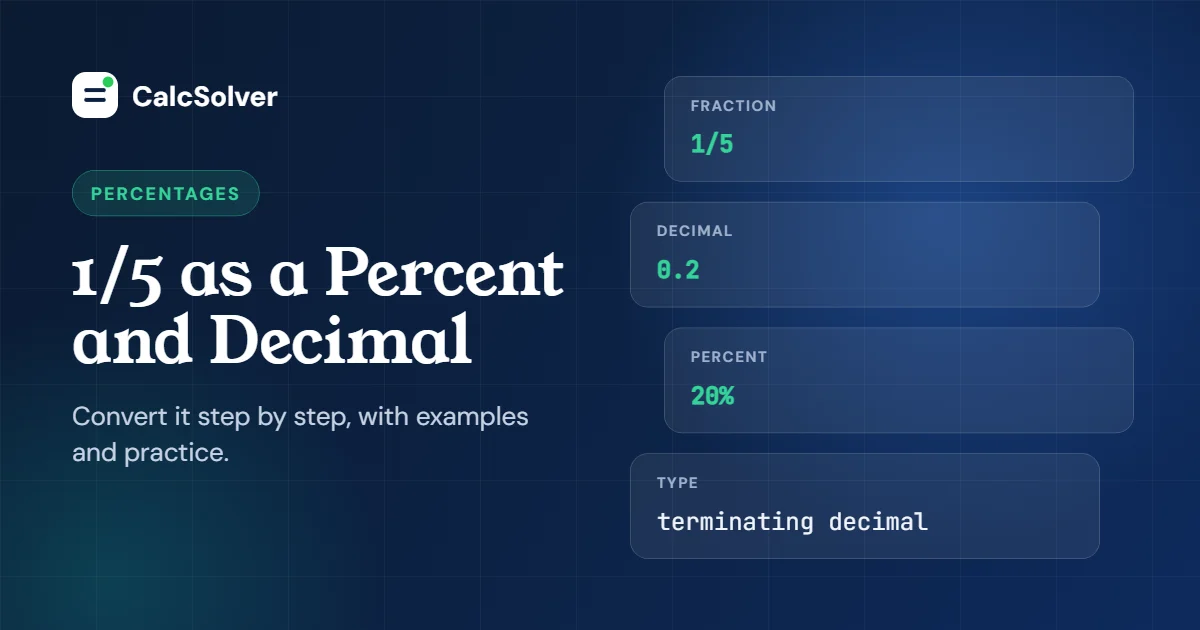
1/5 as a decimal is 0.2 and 1/5 as a percent is 20%. To convert, divide 1 by 5 to get the decimal, then multiply by 100 to get the percent. This page shows both conversions step by step, a diagram of 1/5, the full table of fifths, real-life examples and practice problems with answers.
In this guide
1/5 as a Decimal and Percent: Quick Answer
| Form | Value |
|---|---|
| Fraction | 1/5 (one fifth) |
| Decimal | 0.2 |
| Percent | 20% |
| Decimal type | Terminating |
| Simplest form | Yes, 1/5 is already in simplest form |
What Does 1/5 Mean?
The fraction 1/5, read as “one fifth”, means one of five equal parts. One fifth is the same as two tenths, which is why it equals 0.2.
The top number, 1, is the numerator: how many parts you have. The bottom number, 5, is the denominator: how many equal parts make one whole. A fraction bar also means “divided by”, so 1/5 is the same as 1 ÷ 5. That is the key to converting it.
How to Convert 1/5 to a Decimal
Method 1: Divide the numerator by the denominator
Divide 1 by 5. Because 1 is smaller than 5, the answer starts with 0 and a decimal point, and you bring down zeros:
- 10 ÷ 5 = 2, remainder 0
The remainder is 0, so the division stops: 1/5 = 0.2.
Method 2: Make the denominator a power of 10
Multiply the top and bottom by the same number so the denominator becomes 10, 100 or 1000. Here 5 × 2 = 10, so 1/5 = (1 × 2)/(5 × 2) = 2/10 = 0.2. The number of zeros in 10 tells you the number of decimal places.
In short: Divide 1 by 5. 1/5 = 0.2, a terminating decimal.
How to Convert 1/5 to a Percent
Method 1: Convert to a decimal, then multiply by 100
Take the decimal and multiply by 100, which moves the decimal point two places to the right: 0.2 × 100 = 20%.
Method 2: Multiply by 100 first, then divide
Multiply the numerator by 100 and divide by the denominator: 1 × 100 = 100, and 100 ÷ 5 = 20%. Because 5 × 20 = 100, you can also write 1/5 = 20/100 directly.
Method 3: Use the value of one part
Each 1/5 is worth 20%. You have 1 of those parts, so 1/5 = 1 × 20% = 20%. This is the fastest way to work out any fraction with a denominator of 5 in your head.

In short: Multiply 1/5 by 100: 1/5 = 20%.
All Fifths as Decimals and Percents
These are the fractions with a denominator of 5. Learning the whole row makes 1/5 easier to remember, because each one is 20% more than the one before.
| Fraction | Decimal | Percent |
|---|---|---|
| 1/5 | 0.2 | 20% |
| 2/5 | 0.4 | 40% |
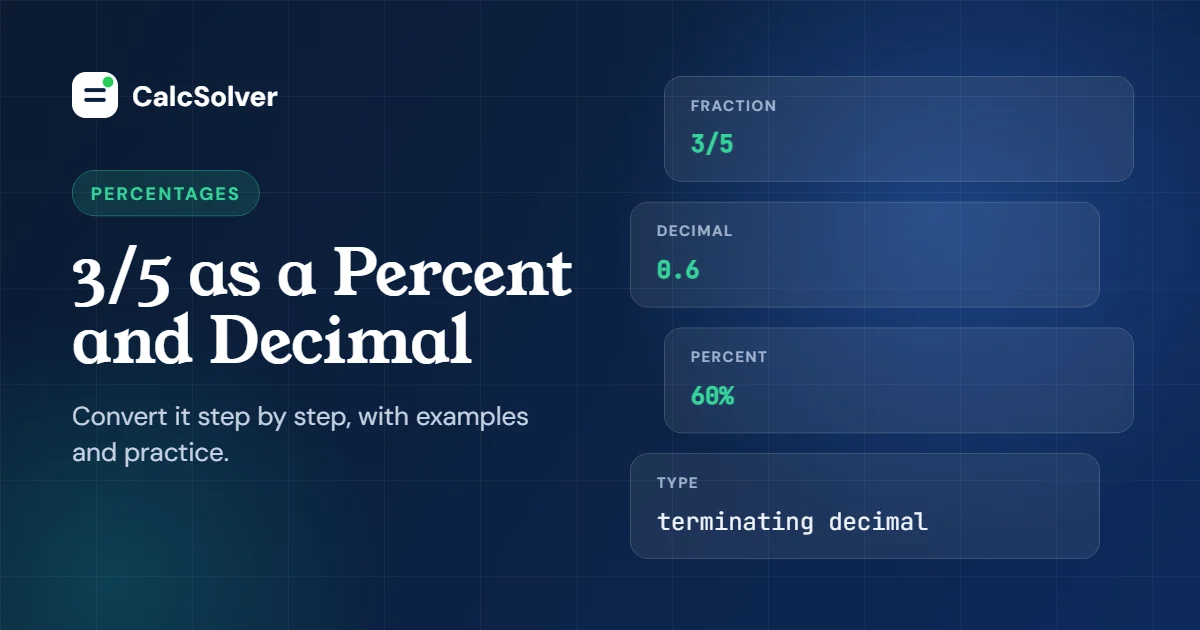
| 3/5 | 0.6 | 60% |
| 4/5 | 0.8 | 80% |
| 5/5 = 1 | 1 | 100% |
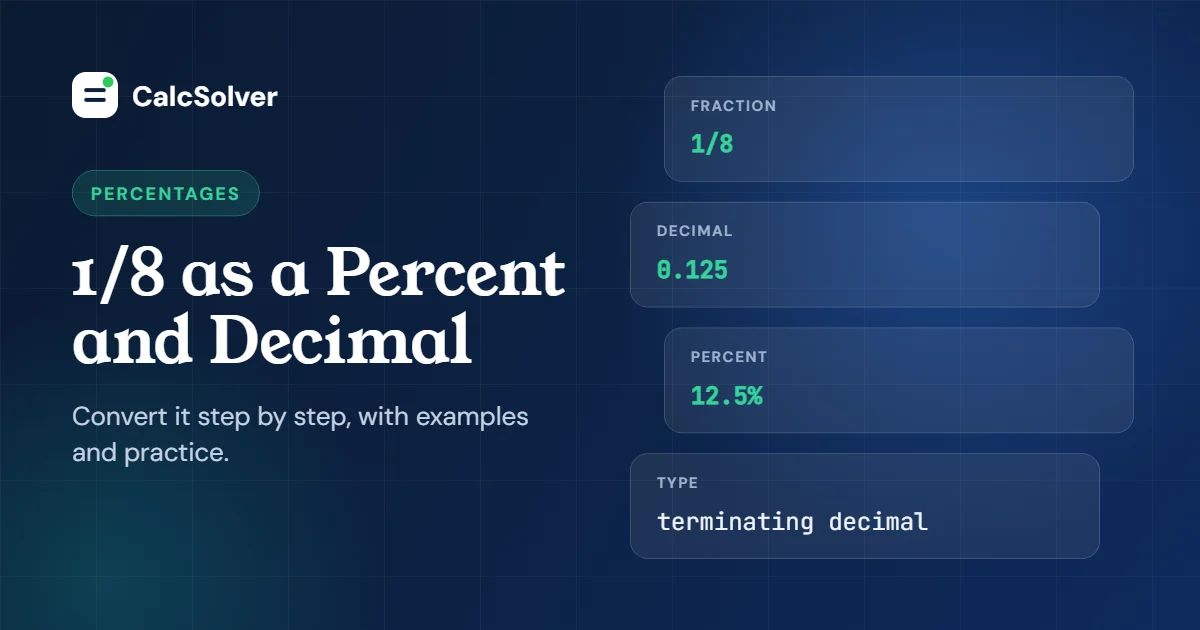
Related conversions: 1/8 as a percent and decimal, 1/4 as a percent and decimal, 3/5 as a percent and decimal.
How to Use 1/5 in Real Life
Example: Find 1/5 of 30. Divide by 5, then multiply by 1: 30 ÷ 5 = 6, and 6 × 1 = 6.
Example: Find 20% of 150. It is the same as 1/5 of 150: 150 ÷ 5 × 1 = 30.
- Tips: a 20% tip on a $45 bill is $9, which is 1/5 of the bill.
- Time: 12 minutes is 1/5 of an hour.
- Money: 20 cents is 1/5 of a dollar.
To find any fraction of a number, divide by the bottom number and multiply by the top. For other percentage problems, see how to calculate a percentage.
Is 1/5 More Than Half?
No. 1/5 = 20%, which is less than 50%. The part that is left over is 4/5, which is 80%, because 20% + 80% = 100%.
How to Convert the Decimal or Percent Back to 1/5
Write the decimal over a power of 10, then simplify. 0.2 has 1 decimal place, so 0.2 = 2/10. Divide the top and bottom by their greatest common factor, 2: 2 ÷ 2 = 1 and 10 ÷ 2 = 5. So 0.2 = 1/5.
From the percent: 20% = 20/100. Simplify the fraction.
Equivalent fractions of 1/5: 2/10, 3/15, 4/20 and 5/25. They all equal 0.2 and 20%.
Common Mistakes When Converting 1/5
- Writing 1/5 as 0.5. 1 ÷ 5 = 0.2; the decimal 0.5 is 1/2.
- Dividing the wrong way round. 1/5 means 1 ÷ 5, not 5 ÷ 1. 5 ÷ 1 = 5, which is more than 1.
- Forgetting to multiply by 100. 0.2 is the decimal. The percent is 100 times bigger: 20%.
- Moving the decimal point the wrong way. To go from decimal to percent, move it two places to the right.
1/5 Practice Problems (With Answers)
1. Write 4/5 as a decimal and a percent.
0.8 and 80%. Divide 4 by 5, then multiply by 100.
2. What is 1/5 of 60?
12. 60 ÷ 5 × 1 = 12.
3. What percent is 7 out of 35?
20%. 7/35 simplifies to 1/5.
4. A tank holds 50 litres and is 1/5 full. How many litres are in it, and what percent full is it?
10 litres, 20% full.
5. Write 80% as a fraction in simplest form.
4/5.
1/5 as a Percent and Decimal: FAQ
What is 1/5 as a decimal?
1/5 as a decimal is 0.2. Divide 1 by 5 to get it.
What is 1/5 as a percent?
1/5 as a percent is 20%. Multiply the decimal by 100 to get it.
How do you convert 1/5 to a percentage?
Divide 1 by 5 to get 0.2, then multiply by 100 and add the % sign. Or multiply 1 by 100 first: 100 ÷ 5 = 20%.
Is 1/5 a terminating or repeating decimal?
1/5 is a terminating decimal. It stops after 1 decimal place, because its denominator, 5, has no prime factors other than 2 and 5.
What fractions are equal to 1/5?
2/10, 3/15 and 4/20 are all equal to 1/5, because each is 1/5 with the top and bottom multiplied by the same number.
Sources and Further Reading
- OpenStax, Prealgebra 2e, Section 6.1: Understand Percent, Rice University.
- Math is Fun, Convert Fractions to Decimals.
- Math is Fun, Convert Fractions to Percents.
Every value on this page was checked by exact division. Convert any number with the percentage calculator or the CalcSolver calculator, and browse all percentage and decimal guides.
Related: browse all percentages and decimals guides, or use the equivalent fractions calculator for fractions.
Check your working in seconds
Type any problem from this guide into the free CalcSolver calculator and see the answer, with fractions, instantly.