An algebraic fraction is a fraction whose numerator, denominator or both contain variables, such as (x + 1)/(x − 3). You work with it the same way as a number fraction: factor first, cancel common factors, find a common denominator to add or subtract, multiply across, and flip to divide. This guide shows each operation step by step with worked examples, the excluded values you must state, and the mistakes that cost the most marks.
In this guide
What Are Algebraic Fractions?
An algebraic fraction, also called a rational expression, is one polynomial divided by another: P(x)/Q(x), with Q(x) not equal to 0. The top and bottom are polynomials, so everything you know about polynomials still applies.
| Algebraic fraction | Numerator | Denominator |
|---|---|---|
| 3/x | 3 | x |
| (x + 1)/(x − 3) | x + 1 | x − 3 |
| (x² − 4)/(x² + 5x + 6) | x² − 4 | x² + 5x + 6 |
| (2x + y)/(x − y) | 2x + y | x − y |
Not every fraction with a variable counts. √x/2 is not an algebraic fraction because the variable sits under a root, and 2ˣ/3 is not one because the variable is in an exponent.
Excluded Values: Where the Fraction Is Undefined
Division by zero is not allowed, so any value of x that makes the denominator 0 must be excluded. To find it, set the denominator equal to 0 and solve.
Example: (x + 1)/(x − 3) is undefined when x − 3 = 0, so x ≠ 3.
Example: 5/(x² − 4) is undefined when x² − 4 = 0. Since x² − 4 = (x − 2)(x + 2), the excluded values are x ≠ 2 and x ≠ −2.
Always find the excluded values from the original denominator, before you cancel anything.
In short: Set every denominator equal to 0 and solve. Those values of x are not allowed, even if a factor cancels later.
How to Simplify Algebraic Fractions
- Factor the numerator and the denominator completely. Use the factoring methods if needed.
- Cancel factors that appear on both the top and the bottom.
- State the excluded values from the original denominator.
Example: (6x²)/(9x) = (3x · 2x)/(3x · 3) = 2x/3, with x ≠ 0.
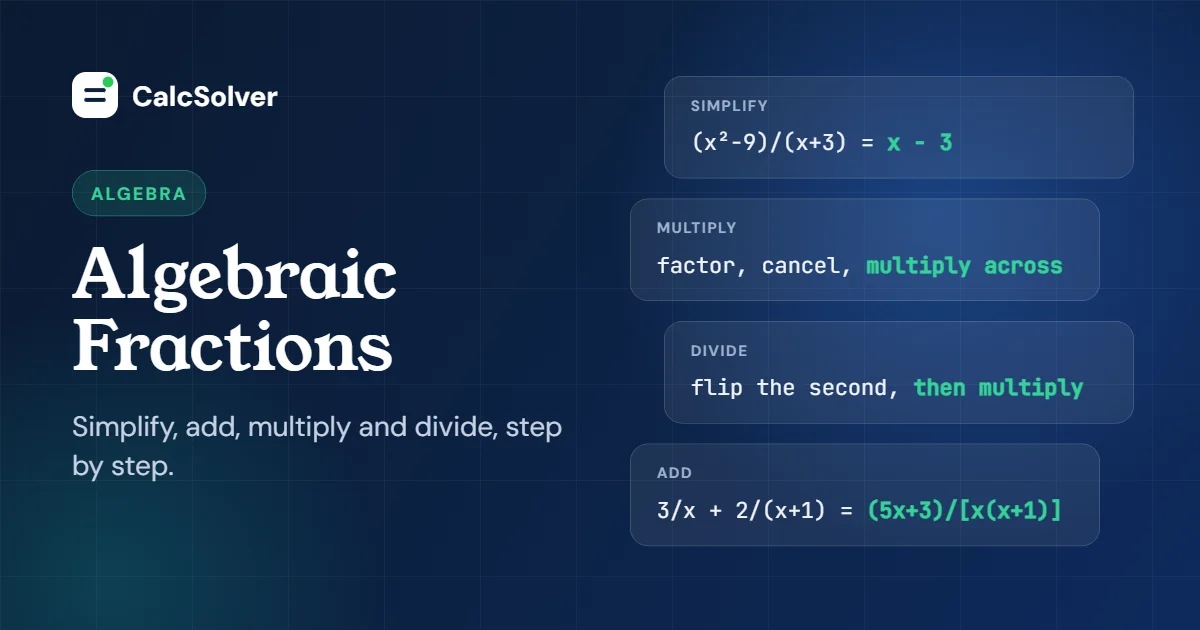
Example: (x² − 9)/(x + 3) = (x + 3)(x − 3)/(x + 3) = x − 3, with x ≠ −3.
Example: (x² + 5x + 6)/(x² − 4) = (x + 2)(x + 3)/((x + 2)(x − 2)) = (x + 3)/(x − 2), with x ≠ 2 and x ≠ −2.
Example: (2x² − 8)/(4x + 8) = 2(x − 2)(x + 2)/(4(x + 2)) = (x − 2)/2, with x ≠ −2.
Cancel factors, never terms. A factor is multiplied; a term is added. In (x + 3)/3 you cannot cancel the 3s. Test it with x = 3: (3 + 3)/3 = 2, but the wrong answer x + 1 would give 4.
In short: Factor first, then cancel only whole factors that appear on both the top and the bottom. Never cancel terms joined by + or −.
How to Multiply Algebraic Fractions
Factor everything, cancel any factor that appears on a top and a bottom (across the fractions too), then multiply what is left.
Example: (x² − 1)/(x + 2) × (x + 2)/(x − 1) = (x + 1)(x − 1)/(x + 2) × (x + 2)/(x − 1) = x + 1, with x ≠ −2 and x ≠ 1.
Example: 3x/(x + 1) × (x² − 1)/(6x²) = 3x (x − 1)(x + 1) / ((x + 1) · 6x²) = (x − 1)/(2x), with x ≠ 0 and x ≠ −1.
How to Divide Algebraic Fractions
To divide, multiply by the reciprocal of the second fraction. Keep, change, flip: keep the first fraction, change ÷ to ×, flip the second. Then multiply as above.
Example: (x² − 4)/(x + 3) ÷ (x + 2)/(x² − 9) = (x − 2)(x + 2)/(x + 3) × (x − 3)(x + 3)/(x + 2) = (x − 2)(x − 3) = x² − 5x + 6, with x ≠ −3, −2 and 3.
The excluded values include any that make the second fraction equal to 0, because you cannot divide by 0. Here (x + 2)/(x² − 9) = 0 when x = −2.
In short: Multiply: factor, cancel, multiply. Divide: flip the second fraction and multiply. State every excluded value.
Adding and Subtracting With the Same Denominator
When the denominators match, keep the denominator and add or subtract the numerators. For subtraction, put the second numerator in brackets so the minus sign changes every term.
Example: (2x + 1)/(x − 3) + (x + 5)/(x − 3) = (3x + 6)/(x − 3) = 3(x + 2)/(x − 3).
Example: (5x + 2)/(x + 1) − (2x − 4)/(x + 1) = (5x + 2 − 2x + 4)/(x + 1) = (3x + 6)/(x + 1). Note that −(2x − 4) = −2x + 4.
Adding and Subtracting With Different Denominators
You must first make the denominators the same. Use the lowest common denominator (LCD), the smallest expression that every denominator divides into.
- Factor each denominator.
- Build the LCD from every different factor, using the highest power of each.
- Multiply the top and bottom of each fraction by the factor it is missing.
- Add or subtract the numerators, then simplify.
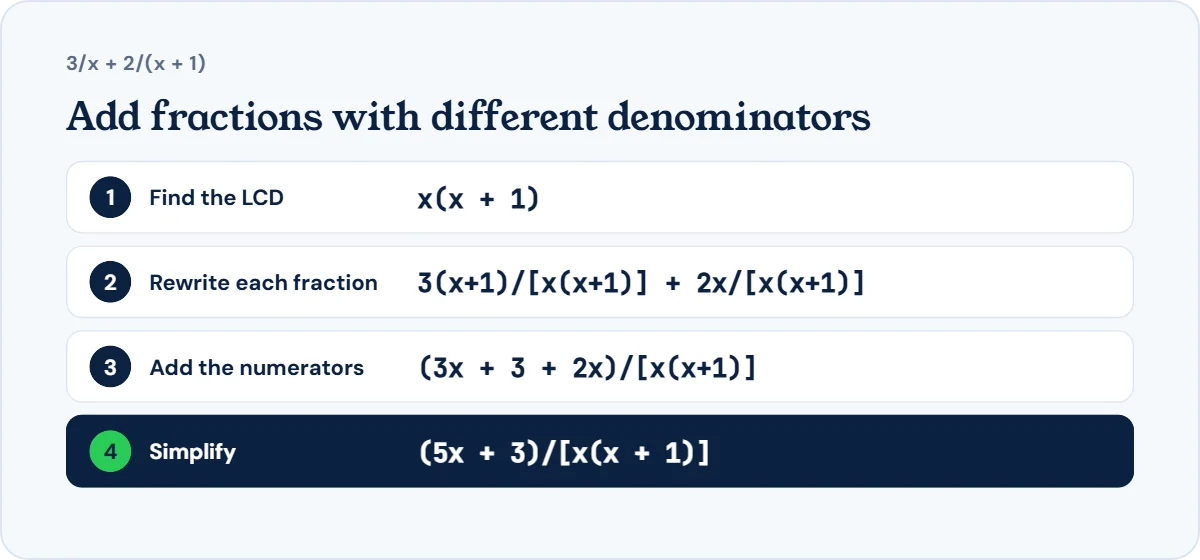
Example: 3/x + 2/(x + 1). The LCD is x(x + 1). Then 3(x + 1)/(x(x + 1)) + 2x/(x(x + 1)) = (3x + 3 + 2x)/(x(x + 1)) = (5x + 3)/(x(x + 1)).
Example: 1/(x − 2) + 1/(x + 2). The LCD is (x − 2)(x + 2). Then ((x + 2) + (x − 2))/((x − 2)(x + 2)) = 2x/(x² − 4).
Example: x/(x² − 1) − 1/(x + 1). Factor: x² − 1 = (x − 1)(x + 1), so the LCD is (x − 1)(x + 1). Then (x − (x − 1))/((x − 1)(x + 1)) = 1/(x² − 1).
In short: Factor the denominators, build the LCD, multiply each fraction by its missing factor, then add the numerators and simplify.
Complex Fractions
A complex fraction has fractions inside its numerator or denominator. Multiply the top and bottom by the LCD of all the small fractions to clear them.
Example: (1 + 1/x)/(1 − 1/x²). Multiply the top and bottom by x²: (x² + x)/(x² − 1) = x(x + 1)/((x − 1)(x + 1)) = x/(x − 1), with x ≠ 0, 1 and −1.
Solving Equations With Algebraic Fractions
To solve an equation with fractions, multiply both sides by the LCD to clear the denominators. Then solve the result and check every answer against the excluded values. A solution that makes a denominator 0 is called an extraneous solution and must be rejected.
Example: 3/(x − 1) = 6/(x + 1). Cross-multiply: 3(x + 1) = 6(x − 1), so 3x + 3 = 6x − 6 and x = 3. Check: 3/2 = 6/4. ✓
Example: x²/(x − 3) = 9/(x − 3). Multiply both sides by x − 3: x² = 9, so x = 3 or x = −3. But x = 3 makes the denominator 0, so it is extraneous. The only solution is x = −3.
Use the solve for x calculator to check: it rejects extraneous roots automatically and explains why. The basic method is in our guide to solving for x.
Common Mistakes With Algebraic Fractions
- Cancelling terms instead of factors. (x + 3)/3 does not simplify to x + 1.
- Forgetting the excluded values. (x² − 9)/(x + 3) = x − 3 only when x ≠ −3.
- Adding the denominators. 1/x + 1/y is not 2/(x + y). Find a common denominator first.
- Not distributing the minus sign. (a − (b − c)) is a − b + c, not a − b − c.
- Forgetting to multiply the numerator. When you change the denominator, change the numerator by the same factor.
- Flipping the wrong fraction. To divide, flip only the second fraction.
Algebraic Fractions Practice Problems (With Answers)
1. Simplify 4x³/(10x).
2x²/5, with x ≠ 0.
2. Simplify (x² − 16)/(x − 4).
x + 4, with x ≠ 4.
3. Simplify (x² + x − 6)/(x² − 9).
(x − 2)/(x − 3), with x ≠ 3 and x ≠ −3. The numerator factors as (x + 3)(x − 2).
4. Multiply x/(x − 1) × (x² − 1)/x².
(x + 1)/x.
5. Divide (x + 2)/(x − 5) ÷ (x² − 4)/(x − 5).
1/(x − 2).
6. Add 4/x + 1/(x − 1).
(5x − 4)/(x(x − 1)). 4(x − 1) + x = 5x − 4.
7. Subtract 3x/(x + 2) − (x − 4)/(x + 2).
2. The numerator is 3x − x + 4 = 2x + 4 = 2(x + 2), which cancels.
8. Solve 2/(x + 1) = 1/(x − 1).
x = 3. 2(x − 1) = x + 1, so x = 3. Check: 2/4 = 1/2. ✓
Algebraic Fractions: Frequently Asked Questions
What is an algebraic fraction?
An algebraic fraction is a fraction where the numerator, the denominator or both are algebraic expressions that contain variables, for example (x + 1)/(x − 3). It is also called a rational expression.
How do you simplify algebraic fractions?
Factor the numerator and denominator completely, cancel the factors they share, and state the values of the variable that are excluded because they make the original denominator 0.
How do you add algebraic fractions with different denominators?
Find the lowest common denominator, multiply each fraction by the factor it is missing, add the numerators, and simplify. For example, 3/x + 2/(x + 1) = (5x + 3)/(x(x + 1)).
Can you cancel terms in an algebraic fraction?
No. You can only cancel factors, which are multiplied, not terms that are added or subtracted. In (x + 3)/3 the 3 is a term in the numerator, so it cannot be cancelled with the 3 below.
How do you divide algebraic fractions?
Multiply by the reciprocal of the second fraction: keep the first, change the division sign to multiplication, and flip the second. Then factor, cancel and multiply.
What are excluded values?
Excluded values are the numbers that make a denominator equal to 0. The fraction is undefined there, so they are not allowed. Find them by setting each denominator equal to 0 and solving.
Sources and Further Reading
- OpenStax, College Algebra 2e, Section 1.6: Rational Expressions, Rice University.
- Math is Fun, Rational Expressions.
Every answer on this page was checked by substituting values on the CalcSolver calculator. Start with factoring polynomials if you need a refresher, or browse all algebra guides.
Check your working in seconds
Type any problem from this guide into the free CalcSolver calculator and see the answer, with fractions, instantly.