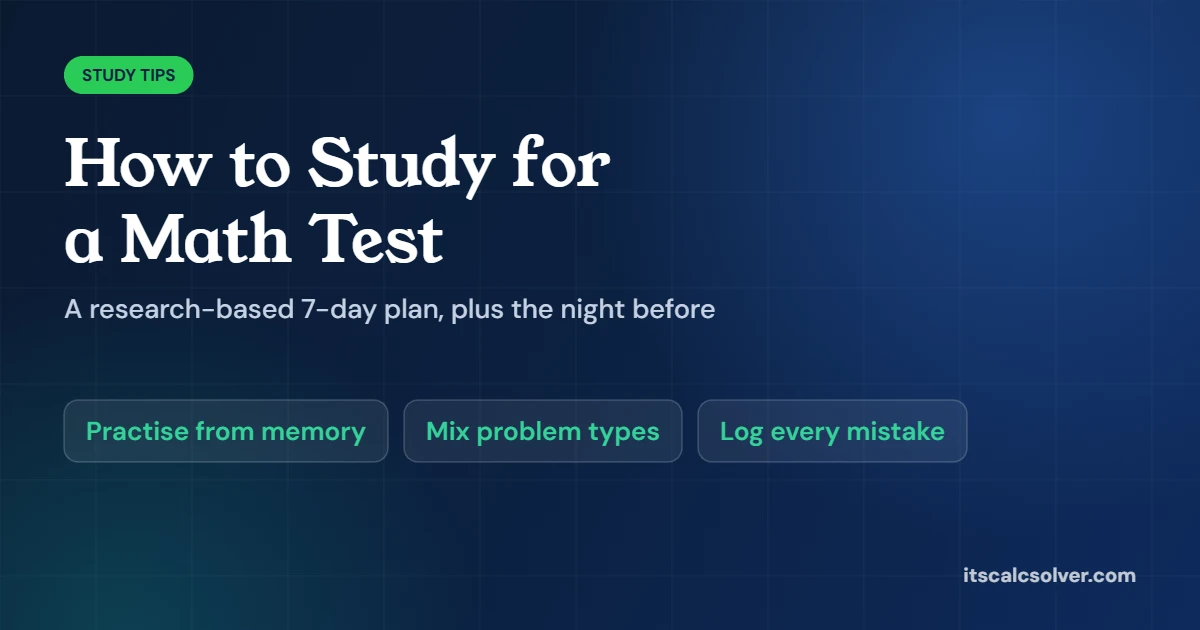
The best way to study for a math test is to solve problems from memory, not to reread your notes. Start about a week before, mix different types of problems in each session, keep a log of every mistake you make, and finish with a timed practice test. These methods come from learning research: in one classroom study, mixed practice almost doubled math test scores. This guide turns that research into a step-by-step plan, including what to do if your test is tomorrow.
In short: Make a topic list, practise problems with your notes closed, mix problem types, log and fix every mistake, spread study over 5–7 days, and take a timed practice test. On test day, do the easy questions first and check answers by substitution.
In this guide
How to Study for a Math Test: The 7-Step Plan
- List every topic the test covers and rate each one: can do, needs practice, or can’t do yet.
- Practise from memory. Close your notes, solve a problem, then check. This is retrieval practice.
- Mix problem types in each session instead of doing twenty of the same kind. This is interleaving.
- Keep a mistake log and write the fix next to every error.
- Spread your study over five to seven short sessions instead of one long one.
- Take a timed practice test two or three days before the real one.
- Sleep the night before and review only your mistake log on the morning of the test.
Why Rereading Notes Is the Wrong Way to Study for Math
Rereading feels productive because the page looks familiar. But recognising a solution is not the same as producing one, and a math test asks you to produce it. A large 2013 review of ten study techniques by John Dunlosky and colleagues rated practice testing and distributed (spaced) practice as the most useful, and rated rereading, highlighting and summarising as low utility.
The gap is big. In a 2006 study by Henry Roediger and Jeffrey Karpicke, students who tested themselves remembered 61% of a passage a week later, while students who simply studied it again remembered 40%.
In short: Reading a solution makes it feel easy. Solving it yourself is what builds the skill a test measures, and research rates self-testing far above rereading.
The 3 Study Methods Proven to Work for Math
| Method | What it means | How to do it for math | Evidence |
|---|---|---|---|
| Retrieval practice | Pulling answers out of memory | Solve problems with notes closed, then check | Tested students recalled 61% vs 40% after a week (Roediger & Karpicke, 2006) |
| Spaced practice | Short sessions spread over days | 30–45 minutes a day for a week, not 5 hours the night before | Rated high utility (Dunlosky et al., 2013) |
| Interleaving | Mixing different problem types | Shuffle questions from several topics into one set | 72% vs 38% on a surprise test (Rohrer et al., classroom study) |
All three feel harder than rereading. That is the point: researchers call this a “desirable difficulty”. If studying feels effortless, you are probably not practising the thing the test will ask you to do.
Step 1: Make a Topic List and Rate Yourself
Use your syllabus, the chapter headings in your textbook and any review sheet your teacher gives you. Write every topic on one page, then mark each with a colour:
| Rating | What it means | How much time to give it |
|---|---|---|
| Green: can do | You can solve a fresh problem without notes | A few mixed problems as a check |
| Amber: needs practice | You get there, but slowly or with hints | Most of your study time |
| Red: can’t do yet | You don’t know where to start | Relearn the idea first, then practise |
Rate yourself by doing one problem per topic, not by how confident you feel. Most students overrate topics they have only read about.
Step 2: Practise Problems From Memory
Take a worked example from your notes or textbook, cover the solution and solve it yourself. Only uncover the answer when you are finished or truly stuck. Then try a similar problem with different numbers.
- Use the end-of-chapter questions, old homework and past tests. Problems with answers in the back of the book are ideal.
- Write every step. Steps are where marks are lost and where you can find your mistakes.
- Check with a calculator after, not during. Work the problem by hand, then confirm the arithmetic on the CalcSolver calculator. For equations, the solve for x calculator shows each step so you can see exactly where your working went wrong.
Step 3: Mix Different Types of Problems
Textbooks usually give you twenty problems of the same kind in a row. That is called blocked practice, and it hides the hardest part of a test: working out which method a question needs. Interleaved practice mixes the types, so every problem makes you choose.
The effect is large. In a classroom experiment led by Doug Rohrer, 7th-grade students took a surprise test two weeks after a nine-week practice period. They scored 72% on the kinds of problems they had practised mixed, compared with 38% on the kinds they had practised in blocks.
Example: For an algebra test, don’t do ten “solve for x” problems and then ten “simplify” problems. Shuffle them: one equation, one expression to simplify, one word problem, one exponent question, then repeat.
In short: Mixing problem types trains you to spot which method to use, which is exactly what a test asks. In one study it nearly doubled scores.
Step 4: Keep a Mistake Log
Every wrong answer is free information about what to fix. Write each one in a notebook or a note on your phone with three columns: the problem, what went wrong and the fix. Most math mistakes fall into one of four types:
| Type of mistake | Example | Fix |
|---|---|---|
| Concept | Thinks x² + x² = x⁴ | Relearn the rule, then do five problems on it |
| Method | Uses the quadratic formula when factoring is faster | Practise choosing the method on mixed sets |
| Careless | Writes −(x − 4) = −x − 4 | Add a checking step to your routine |
| Reading | Answers in cm when the question asks for m | Underline what the question asks for |
Before the test, the mistake log is the most valuable thing to review, far more useful than your full notes. For the careless example above, the correct expansion is −(x − 4) = −x + 4, a sign error our guide to simplifying expressions covers in detail.
Step 5: Follow a 7-Day Math Test Study Schedule
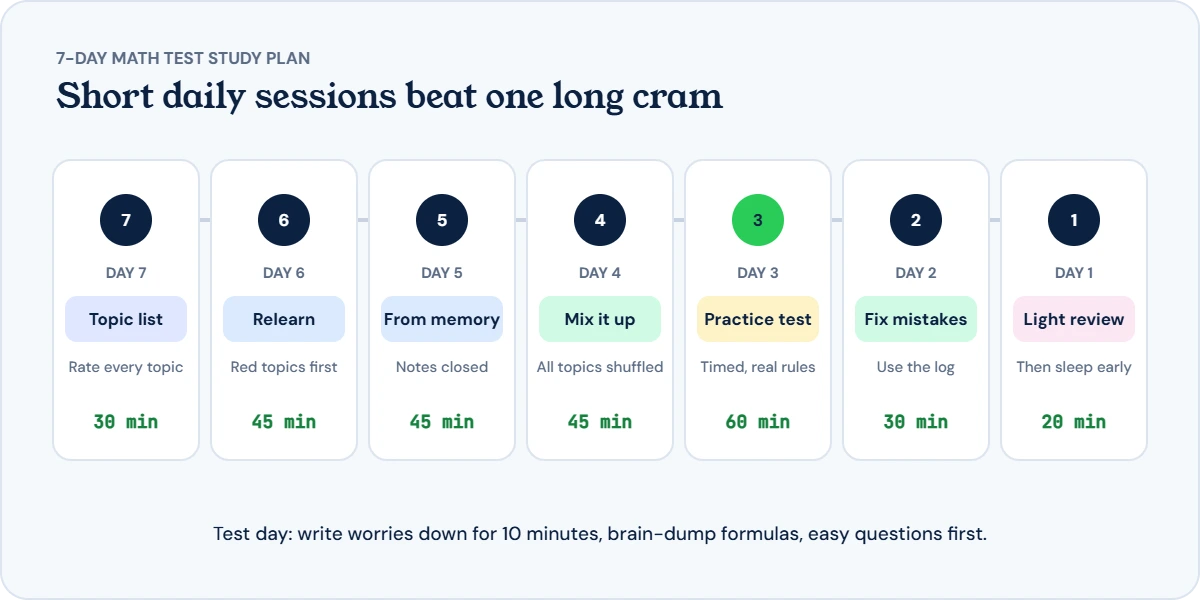
Short daily sessions beat one long cram, because spacing gives your memory time to consolidate. For a unit test, 30 to 45 minutes a day for a week is enough for most students.
| Day | Focus | Time |
|---|---|---|
| Day 7 | Make the topic list and rate every topic | 30 min |
| Day 6 | Relearn red topics, then try problems from memory | 45 min |
| Day 5 | Amber topics: closed-book practice, start the mistake log | 45 min |
| Day 4 | Mixed problem set from all topics | 45 min |
| Day 3 | Timed practice test in real test conditions | 45–60 min |
| Day 2 | Fix every mistake from the practice test | 30 min |
| Day 1 | Short mixed set, review the mistake log, sleep early | 20–30 min |
How to Study for a Math Test in One Day (or the Night Before)
If the test is tomorrow, you cannot learn everything, so spend your time where it earns the most marks.
- 20 minutes: skim the review sheet and pick the three to five topics most likely to appear.
- 60–90 minutes: for each topic, cover one worked example, solve it from memory, then do two or three more problems.
- 20 minutes: one short mixed set across those topics, so you practise choosing the method.
- 10 minutes: write the formulas and rules you keep forgetting on one card and read it once more in the morning.
- Then go to sleep. Staying up late to cram usually costs more on the test than the extra hour gains.
If you need a quick refresher on rules, our pages on the order of operations, exponent rules and solving for x each have a short answer at the top and practice problems at the end.
What to Do on the Day of the Math Test
- Write down your worries for 10 minutes. In a 2011 study in Science, Gerardo Ramirez and Sian Beilock found that highly anxious students who wrote about their worries just before an exam scored a B+ on average, compared with a B− for anxious students who did not.
- Do a “brain dump” when the test starts. Write the formulas you might forget in the margin before you begin.
- Skim the whole test first. Answer the questions you are sure about, mark the hard ones and come back.
- Budget your time by marks. A question worth 10% of the marks deserves about 10% of the time.
- Show your working. Many tests give method marks even when the final answer is wrong.
- Check answers in the last minutes, starting with the questions worth the most marks.
How to Avoid Careless Mistakes on a Math Test
Careless mistakes are the easiest marks to win back. Use these checks before you move on from each answer:
- Substitute it back. If you solved 3x + 5 = 20 and got x = 5, check that 3(5) + 5 really is 20.
- Estimate first. If 48 × 21 should be about 50 × 20 = 1,000, an answer of 10,080 is clearly wrong. Our mental math tricks make estimating fast.
- Watch the signs. Most algebra errors are a lost minus sign when expanding brackets.
- Check the calculator mode. Trig answers depend on DEG or RAD, and brackets change the answer: 1/2×4 is 2, but 1/(2×4) is 0.125.
- Reread the question. Make sure you answered what was asked, in the right units and rounding.
In short: Substitute answers back, estimate before calculating, watch minus signs and check units. These four checks catch most careless mistakes.
How to Study for a Math Test: FAQ
How many days before a math test should I start studying?
For a unit test, start about five to seven days before and study 30 to 45 minutes a day. For a final exam covering a whole term, start two to three weeks before. Spreading study out works better than the same hours in one night.
What is the best way to study for a math test?
Solve practice problems from memory with your notes closed, mix different problem types in each session, and fix every mistake. Research rates self-testing and spaced practice as the most effective study methods, and rereading as one of the least.
How can I study for a math test in one night?
Pick the three to five most likely topics, cover a worked example for each and solve it from memory, do a short mixed set, write your hardest formulas on one card, then sleep. Do not try to relearn the whole unit.
How many practice problems should I do?
Quality matters more than quantity. Aim for three to five problems per topic that you solve without notes, plus one mixed set. If you get a type wrong, do two or three more of that type the next day.
How do I stop panicking during a math test?
Start with a question you know you can do, take a few slow breaths, and come back to hard questions later. Writing down your worries for 10 minutes before the test helped anxious students score higher in a 2011 study.
Is it better to study math alone or in a group?
Do most practice alone, because the test is solo and you need to produce answers yourself. A study group is useful afterwards for explaining solutions to each other and comparing mistakes.
Sources
- Dunlosky, J., Rawson, K. A., Marsh, E. J., Nathan, M. J. and Willingham, D. T. (2013). Improving students’ learning with effective learning techniques. Psychological Science in the Public Interest. Summary: Which Study Strategies Make the Grade?
- Roediger, H. L. and Karpicke, J. D. (2006). Test-enhanced learning. Psychological Science. Summary: Washington University in St. Louis.
- The Learning Scientists, Interleaving: A Classroom Experiment (Rohrer and colleagues’ 7th-grade study).
- Ramirez, G. and Beilock, S. L. (2011). Writing about testing worries boosts exam performance in the classroom. Science. Summary: University of Chicago News.
Ready to practise? Warm up with a quick round of Math Sprint, then work through the algebra guides or the percentage guide, each with practice problems and answers.
Check your working in seconds
Type any problem from this guide into the free CalcSolver calculator and see the answer, with fractions, instantly.