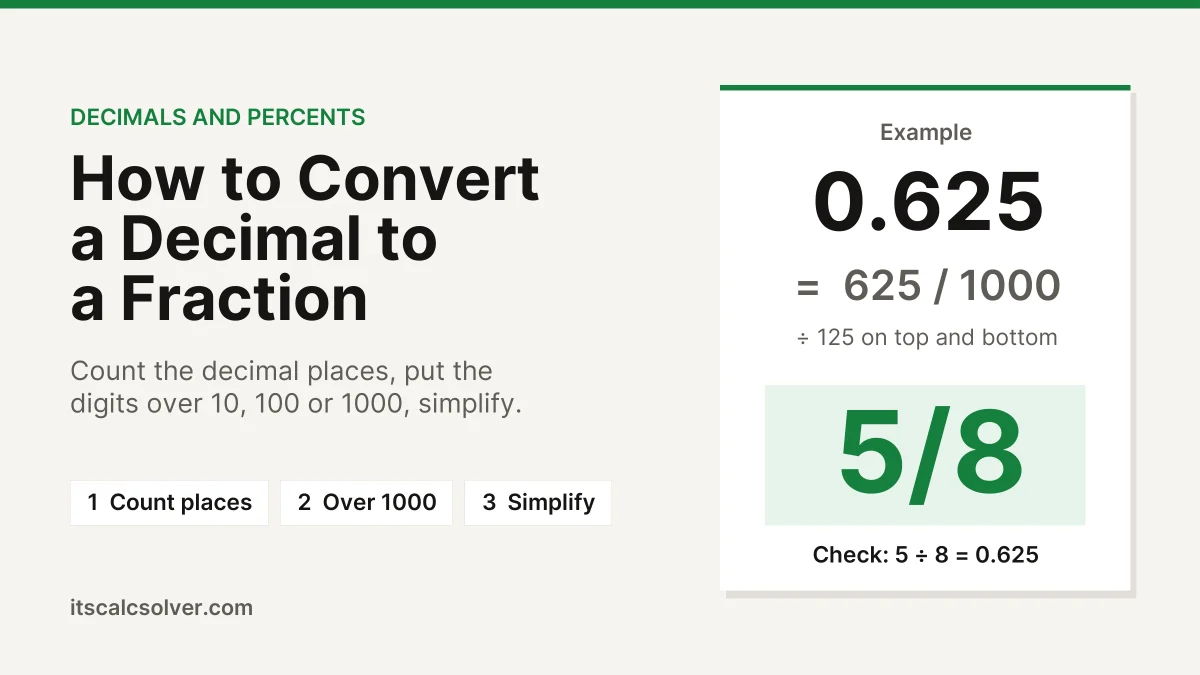
To convert a decimal to a fraction, write the digits after the decimal point over 10, 100 or 1000, then simplify. Use one zero for each decimal place. For example, 0.625 has three decimal places, so 0.625 = 625/1000 = 5/8. Repeating decimals need a small algebra trick, shown below.
In short: Count the decimal places, put the digits over the matching power of 10, and divide the top and bottom by their greatest common factor. For a repeating decimal, use 9s in the bottom.
In this guide
How to Convert a Decimal to a Fraction in 3 Steps
- Count the decimal places. 0.625 has 3 digits after the point.
- Write the digits over a power of 10. 1 place → 10, 2 places → 100, 3 places → 1000. So 0.625 = 625/1000.
- Simplify. Divide the top and bottom by their greatest common factor (GCF). The GCF of 625 and 1000 is 125, so 625/1000 = 5/8.
Example: 0.625 as a fraction. 0.625 = 625/1000. Divide both numbers by 125: 625 ÷ 125 = 5 and 1000 ÷ 125 = 8. So 0.625 = 5/8. Check it: 5 ÷ 8 = 0.625. See 5/8 as a percent and decimal.
Example: 0.75 as a fraction. Two decimal places, so 0.75 = 75/100. The GCF is 25, so 75/100 = 3/4.
Not sure how to find the GCF? Read how to find the greatest common factor or how to simplify fractions.
Decimal Place Value Table
The last digit tells you the bottom number. Tenths go over 10, hundredths over 100, and thousandths over 1000.
| Decimal | Last place | Fraction | Simplest form |
|---|---|---|---|
| 0.5 | tenths | 5/10 | 1/2 |
| 0.8 | tenths | 8/10 | 4/5 |
| 0.04 | hundredths | 4/100 | 1/25 |
| 0.45 | hundredths | 45/100 | 9/20 |
| 0.06 | hundredths | 6/100 | 3/50 |
| 0.125 | thousandths | 125/1000 | 1/8 |
Decimals Greater Than 1 (Mixed Numbers)
Keep the whole number. Change only the part after the point, then write a mixed number. You can also turn it into an improper fraction.
Example: 2.35 as a fraction. 0.35 = 35/100 = 7/20, so 2.35 = 2 7/20. As an improper fraction: 2 × 20 + 7 = 47, so 2.35 = 47/20.
Example: 3.125 as a fraction. 0.125 = 1/8, so 3.125 = 3 1/8 = 25/8.
How to Convert a Repeating Decimal to a Fraction
A repeating decimal never ends, so you cannot put it over 10 or 100. Use this method instead. Call the decimal x, multiply so the repeating digits line up, and subtract.
- Let x equal the decimal. x = 0.444…
- Multiply by 10 for one repeating digit, 100 for two, 1000 for three. 10x = 4.444…
- Subtract to remove the repeating part. 10x − x = 4.444… − 0.444…, so 9x = 4.
- Solve and simplify. x = 4/9.
Example: 0.27 as a fraction. Two digits repeat, so use 100x. 100x = 27.2727… and x = 0.2727…. Subtract: 99x = 27, so x = 27/99. The GCF is 9, so 0.27 = 3/11.
Example: 0.83 as a fraction. Here the 8 does not repeat. 100x = 83.333… and 10x = 8.333…. Subtract: 90x = 75, so x = 75/90 = 5/6. See 5/6 as a percent and decimal.
Quick shortcut: when the repeat starts right after the point, put the repeating digits over the same number of 9s. 0.5 = 5/9, 0.36 = 36/99 = 4/11, and 0.123 = 123/999 = 41/333.
Try it
Check your answer: type the fraction and see its decimal and every long division step.
Common Decimals as Fractions
| Decimal | Fraction | Decimal | Fraction |
|---|---|---|---|
| 0.05 | 1/20 | 0.5 | 1/2 |
| 0.1 | 1/10 | 0.6 | 3/5 |
| 0.125 | 1/8 | 0.625 | 5/8 |
| 0.2 | 1/5 | 0.6 | 2/3 |
| 0.25 | 1/4 | 0.75 | 3/4 |
| 0.3 | 1/3 | 0.8 | 4/5 |
| 0.375 | 3/8 | 0.875 | 7/8 |
| 0.4 | 2/5 | 0.9 | 9/10 |
Want to go the other way? Read how to convert a fraction to a decimal, or see the full fraction chart.
Common Mistakes
- Using the wrong power of 10. 0.04 is 4/100, not 4/10. Count every digit after the point, including zeros.
- Not simplifying. 75/100 is correct, but the final answer should be 3/4.
- Treating a rounded decimal as exact. 0.33 is 33/100. It is close to 1/3, but only 0.333… repeating equals 1/3.
- Dropping the whole number. 2.35 is 2 7/20, not 7/20.
Practice Problems (With Answers)
1. Write 0.8 as a fraction.
4/5, because 0.8 = 8/10 and 8/10 ÷ 2/2 = 4/5.
2. Write 0.36 as a fraction in simplest form.
9/25, because 36/100 ÷ 4/4 = 9/25.
3. Write 1.75 as a mixed number.
1 3/4, because 0.75 = 75/100 = 3/4. As an improper fraction it is 7/4.
4. Write 0.5 as a fraction.
5/9, because one repeating digit goes over 9.
5. Write 0.12 (0.1222…) as a fraction.
11/90. 100x = 12.222… and 10x = 1.222…, so 90x = 11.
FAQ
How do you convert a decimal to a fraction?
Write the digits after the point over 10, 100 or 1000 (one zero for each decimal place), then simplify. For example, 0.75 = 75/100 = 3/4.
What is 0.625 as a fraction?
0.625 = 625/1000. The GCF of 625 and 1000 is 125, so 0.625 = 5/8.
What is 0.75 as a fraction?
0.75 = 75/100 = 3/4 in simplest form.
How do you convert a repeating decimal to a fraction?
Let x be the decimal, multiply by 10, 100 or 1000 so the repeating part lines up, and subtract. For 0.444…, 10x − x = 4, so x = 4/9.
Is 0.333 the same as 1/3?
No. 0.333 that stops is 333/1000. Only 0.333… with the 3 repeating forever equals 1/3.
What is 2.5 as a fraction?
2.5 = 2 5/10 = 2 1/2, which is 5/2 as an improper fraction.
Sources and Further Reading
- OpenStax, Prealgebra, Section 5.1: Decimals (Convert Decimals to Fractions or Mixed Numbers), Rice University.
- OpenStax, Prealgebra, Section 5.3: Decimals and Fractions.
- Common Core Grade 8, 8.NS.A.1: convert a repeating decimal into a rational number.
Need to work with the result? Add, subtract or multiply fractions with the fraction calculator, or convert any fraction back with the fraction to decimal calculator.
Check your working in seconds
Type any problem from this guide into the free CalcSolver calculator and see the answer, with fractions, instantly.