Spain is rising as a study destination because it combines lower costs than the US or UK, a growing number of English-taught master’s programmes, and a visa that lets students work 30 hours a week. In 2023/24, Spanish universities counted 149,280 international enrolments, and degree-seeking students grew 8.7% in one year, according to ICEF Monitor’s 2026 analysis.
In this guide
The Numbers Behind the Rise
Many articles repeat that Spain hosts “over 100,000” foreign students. The latest figures are higher and show a clear shift from short exchanges to full degrees.
| Measure | Figure |
|---|---|
| International enrolments, 2023/24 | 149,280 (59% degree, 41% exchange) |
| Growth in degree students, 2023/24 | +8.7% year on year |
| International share of all students | 11.5% overall; 27% of master’s; 29% of doctoral |
| Ten-year change | Undergraduates doubled; master’s students tripled |
| Top source countries | Italy and Colombia (23,000+ each), France (~20,000), then China and the US |
| US students abroad, 2023/24 | Spain took 12.4%, behind Italy (15.1%) and just ahead of the UK (12.2%) |
Note that the US figure counts students earning credit abroad, mostly for a semester or year. It is not the same as full degrees, and totals differ between sources because some count exchange students and others do not.
Four Reasons Students Pick Spain
1. English-taught master’s programmes
About 40% of master’s programmes are now offered in English. That removes the biggest old barrier for students from India, China and the US. Bachelor’s degrees at public universities are still mostly taught in Spanish, so check this before you apply.
2. Lower costs
Public tuition is set by regional governments and is far below typical US private fees. The next section shows real ranges.
3. A government that wants students
Spain launched “EduBridge to Spain” in September 2025, with another intake in January 2026. It offers faster credit validation, quicker visa processing at US consulates and expedited residence cards for students moving from US universities.
4. Recognised universities
The 2026 QS rankings place Universitat Autònoma de Barcelona and Complutense University of Madrid in the world top 200, and 15 Spanish universities in the top 500.
What Studying in Spain Really Costs
Tuition per year
| Level and type | EU/EEA students | Non-EU students |
|---|---|---|
| Bachelor’s, public | €800–€2,500 | €3,000–€12,000 |
| Master’s, public | €1,000–€4,000 | €1,000–€4,000 |
| Bachelor’s or master’s, private | €6,000–€20,000+ (same for all nationalities) | |
These are planning ranges from ApplyBoard’s 2026–27 guide. Other sources quote narrower or wider bands, because each region sets its own fees. Catalonia and Madrid charge non-EU students more, while Andalusia and Galicia are among the cheapest.
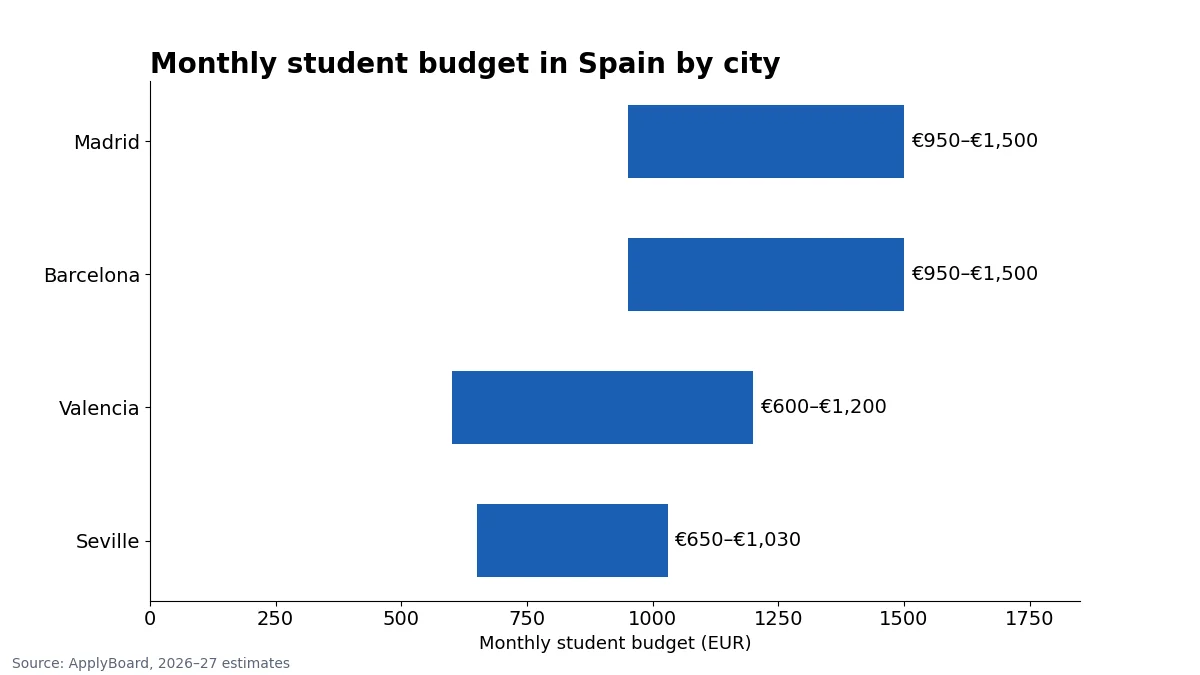
Living costs by city
| City | Shared room | Total per month | Known for |
|---|---|---|---|
| Madrid | €450–€750 | €950–€1,500 | Law, finance, public policy |
| Barcelona | €450–€800 | €950–€1,500 | Design, business, tech |
| Valencia | €300–€500 | €600–€1,200 | Health sciences, lower costs |
| Seville | €280–€480 | €650–€1,030 | Humanities, lowest rents |
Worked example: a 12-month public master’s in Valencia costs €1,000–€4,000 in tuition plus €600–€1,200 × 12 = €7,200–€14,400 to live, so about €8,200–€18,400 in total. The same course in Madrid is about €12,400–€22,000. To test your own numbers, enter them into the CalcSolver scientific calculator. Health insurance (about €30–€60 a month) is usually included in these living estimates; confirm this with your insurer.
Visa Rules and Work Rights
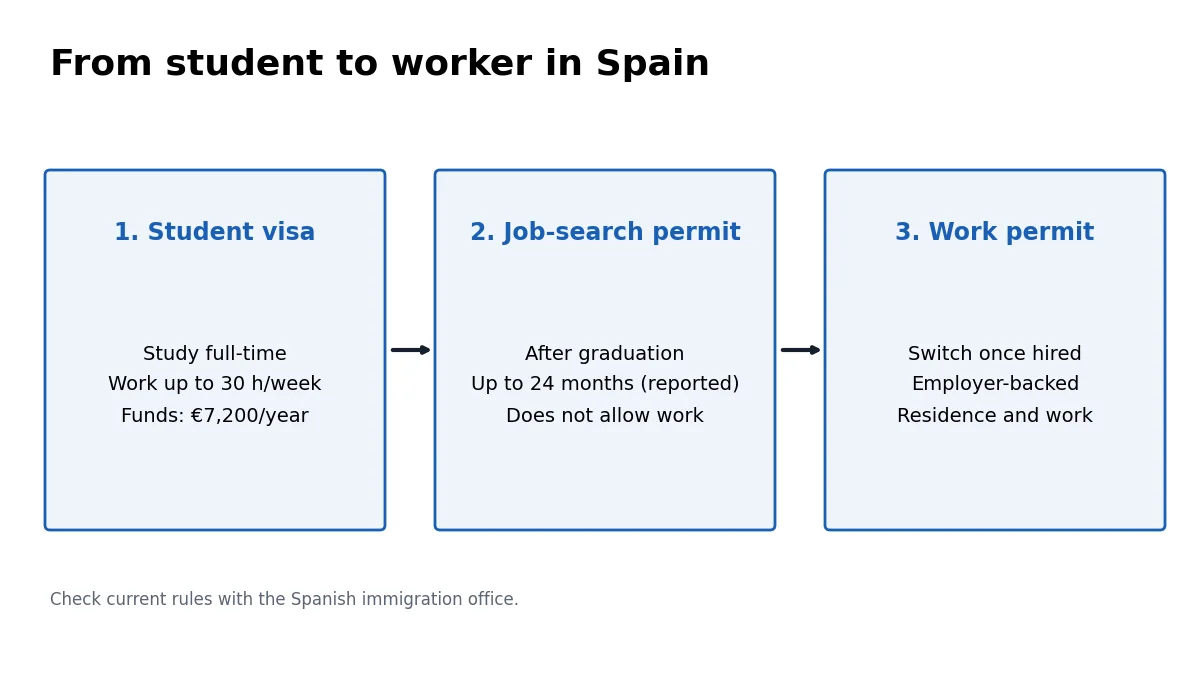
Spain’s new immigration regulation (Royal Decree 1155/2024) took effect on 20 May 2025. It made student work rights automatic for higher-education students.
| Requirement | What to know |
|---|---|
| Funds | 100% of IPREM: €600 a month, so €7,200 for 12 months |
| Health insurance | Private policy valid in Spain, with no co-payments |
| Admission | Letter from an accredited institution |
| Criminal record | Certificate needed for stays over 180 days |
| Work | Up to 30 hours a week, if compatible with classes |
Insurance problems are a common cause of rejection, and funds moved into your account just before applying can raise questions. Part-time pay, typically €7–€12 an hour, cannot replace the funds you must show up front. For quick budget checks, the percentage calculator helps you split income and costs.
How to Apply, Step by Step
- Choose the programme and language. Confirm it is an official degree and check the teaching language.
- Recognise your credentials. Non-EU bachelor’s applicants usually need homologación of their school diploma, and many public universities use the UNEDasiss system. Master’s admission often does not require homologating your bachelor’s degree, but this depends on the university.
- Apply early. In 2024/25, public universities received nearly twice as many applications as places.
- Prepare visa documents. Gather the admission letter, funds proof, insurance and record certificate.
- Register on arrival. Get your foreigner card (TIE) and register your address with the town hall.
After Graduation
Graduates can apply for a residence authorisation to look for work or start a business, reported as up to 24 months. It does not itself allow employment, so you must switch to a work permit once hired. Sources differ on the exact length for each route, so confirm with the immigration office before you plan around it.
Is Spain Right for You?
A good fit if you want a lower total cost, an English-taught master’s, and a city with an international feel. Look elsewhere if your field is only taught in Spanish at the schools you want, or you need a degree tied to a specific US or UK employer pipeline. Also note that public universities are under pressure, while private universities now host half of all master’s students and often cost more.
FAQ
How much money do I need for a Spanish student visa?
Non-EU students must show €600 per month of study, which is €7,200 for a full year, plus valid private health insurance.
Can international students work in Spain?
Yes. Higher-education students can generally work up to 30 hours a week if the job does not clash with classes.
Is Spain cheaper than the US or UK?
Usually. Public master’s tuition is often €1,000–€4,000 a year, and living costs run about €600–€1,500 a month depending on the city.
Do I need to speak Spanish?
Not for every programme. About 40% of master’s degrees are in English, but most public bachelor’s degrees are in Spanish.
Ready to run your own budget? Open the CalcSolver calculator and add up tuition, rent and visa funds in seconds.
Sources
- ICEF Monitor: Inside Spain’s growing appeal for international students (12 Feb 2026)
- Institute of International Education: Open Doors, 2023/24 data
- ApplyBoard: Cost of Studying in Spain 2026–27
- Royal Decree 1155/2024 (BOE-A-2024-24099)
- UNEDasiss: admission FAQs for international students
Rules and fees change, so verify with the university and your Spanish consulate before you apply.
Check your working in seconds
Type any problem from this guide into the free CalcSolver calculator and see the answer, with fractions, instantly.