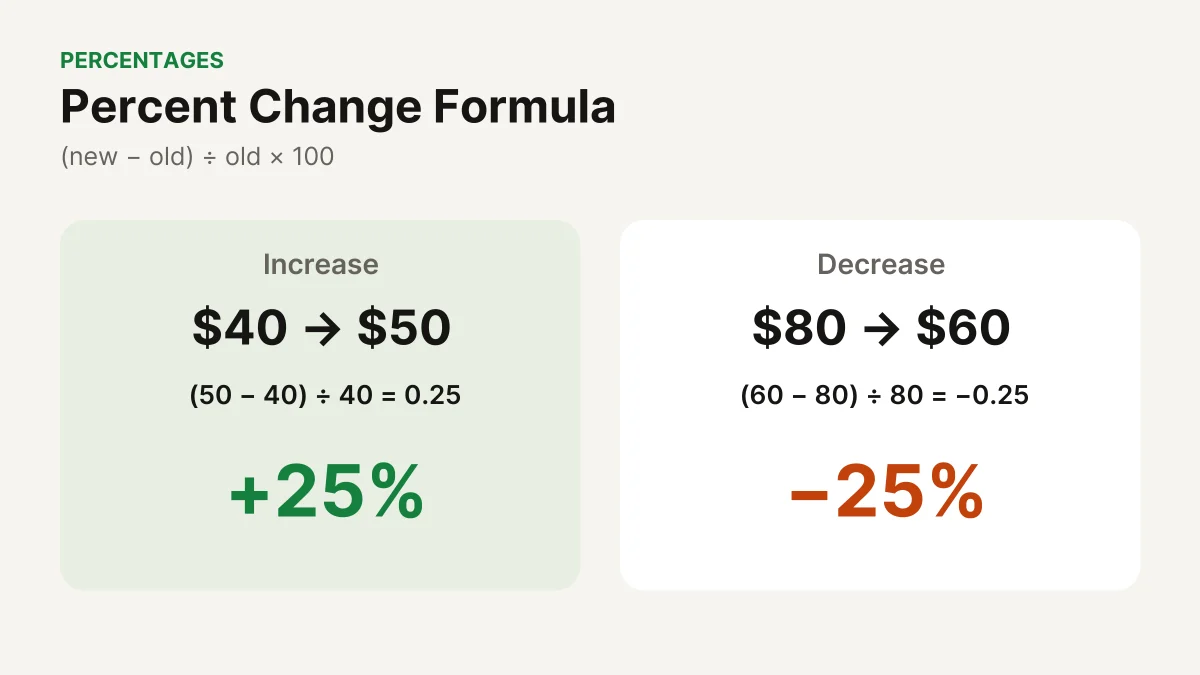
Percent change = (new value − old value) ÷ old value × 100. A positive answer is a percentage increase and a negative answer is a percentage decrease. If a price goes from $40 to $50, the change is 10, and 10 ÷ 40 × 100 = a 25% increase.
In short: Subtract old from new, divide by the old value, multiply by 100. $40 → $50 = +25%. $80 → $60 = −25%. Always divide by the starting (old) value.
In this guide
The Percent Change Formula
Percent change = (new − old) ÷ old × 100
The old value is the starting point, also called the base or reference value. The sign of the answer tells you the direction: plus for an increase, minus for a decrease.
How to Calculate a Percentage Increase
- Find the increase: new − old.
- Divide the increase by the old value.
- Multiply by 100 and add the % sign.
Example: Rent rises from $1,200 to $1,500. Increase = 300. 300 ÷ 1,200 = 0.25, so the rent went up 25%.
Example: A test score goes from 68 to 85. Increase = 17. 17 ÷ 68 = 0.25, a 25% increase.
How to Calculate a Percentage Decrease
Use the same formula. The answer will be negative; you can also say “a 20% decrease” instead of “−20%”.
Example: A shirt is cut from $30 to $24. Change = −6. −6 ÷ 30 = −0.2, so the price fell 20%.
Why +20% Then −20% Is Not Zero
Each percent is taken from a different starting value. Start at 100, increase 20% to get 120, then decrease 20% of 120 (24) to get 96, not 100. You end 4% lower.
The same reason makes changes look uneven: 50 → 40 is a 20% decrease, but 40 → 50 is a 25% increase.
Percent Change vs Percentage Points
When the numbers are already percents, be careful. If an interest rate goes from 4% to 5%, it rose 1 percentage point, but the percent change is (5 − 4) ÷ 4 × 100 = 25%. News reports often mean percentage points.
How to Find the Original Value (Reverse Percentage)
If you know the new value and the percent change, divide by the multiplier (1 + the change as a decimal).
Example: After a 15% increase, a price is $92. Original = 92 ÷ 1.15 = $80.
Example: After a 20% discount, a jacket costs $64. Original = 64 ÷ 0.80 = $80.
Do not just subtract 15% of $92; that gives $78.20, which is wrong because the 15% was taken from the original price.
How to Increase or Decrease a Number by a Percent
| Task | Multiply by | Example |
|---|---|---|
| Increase by 12% | 1.12 | 250 × 1.12 = 280 |
| Decrease by 12% | 0.88 | 250 × 0.88 = 220 |
| Increase by 20% | 1.20 | $2.50 × 1.20 = $3.00 |
Percent Change vs Percent Difference
Percent change has a clear “before” and “after”. Percent difference compares two values with no order, so it divides by their average: for 40 and 50, the difference 10 ÷ 45 × 100 ≈ 22.22%.
Negative and Zero Starting Values
If the old value is 0, percent change is undefined, because you cannot divide by zero. If the old value is negative, divide by its absolute value so the sign still shows the direction: from −20 to 10 is a change of 30, and 30 ÷ 20 × 100 = a 150% increase.
Percent Change in Excel and Google Sheets
With the old value in A2 and the new value in B2, type =(B2-A2)/A2 and format the cell as a percentage. On a calculator, type (50-40)/40*100; the bracket makes sure the subtraction happens first.
Try it
Choose the “% increase or decrease” tab, enter the old and new values, and see the percent change with steps.
Common Mistakes
- Dividing by the new value. Always divide by the old (starting) value.
- Forgetting to multiply by 100. 0.25 is 25%, not 0.25%.
- Adding percents across steps. +20% then −20% does not cancel out.
- Mixing up percent and percentage points when the values are already percents.
Practice Problems (With Answers)
1. A value goes from 60 to 75. What is the percent change?
15 ÷ 60 × 100 = 25% increase.
2. A value drops from 200 to 150. What is the percent change?
−50 ÷ 200 × 100 = 25% decrease.
3. Increase 120 by 15%.
120 × 1.15 = 138.
4. After a 25% discount, an item costs $45. What was the original price?
45 ÷ 0.75 = $60.
5. A stock goes from $18 to $27. What is the percent change?
9 ÷ 18 × 100 = 50% increase.
FAQ
What is the formula for percent change?
Percent change = (new − old) ÷ old × 100. From 40 to 50, it is 10 ÷ 40 × 100 = 25%.
How do you calculate a percentage decrease?
Subtract the new value from the old value, divide by the old value and multiply by 100. From 80 to 60, it is 20 ÷ 80 × 100 = 25% decrease.
Can percent change be more than 100%?
Yes. If a value more than doubles, the increase is over 100%. From 10 to 30 is a 200% increase. A decrease can never be more than 100% for positive values.
What is the difference between percent change and percentage points?
Percentage points are the plain difference between two percents. A rate going from 4% to 5% rose 1 percentage point, which is a 25% change.
How do I find the original number before a percent increase?
Divide the new number by 1 plus the increase as a decimal. After a 15% rise to 92, the original was 92 ÷ 1.15 = 80.
Sources and Further Reading
- OpenStax, Prealgebra, Section 6.2: Solve General Applications of Percent, Rice University.
- OpenStax, Elementary Algebra 2e, Section 3.2: Solve Percent Applications.
Related: how to calculate a percentage, fractions to decimals and percents, mean, median, mode and range and all free math calculators.
Check your working in seconds
Type any problem from this guide into the free CalcSolver calculator and see the answer, with fractions, instantly.