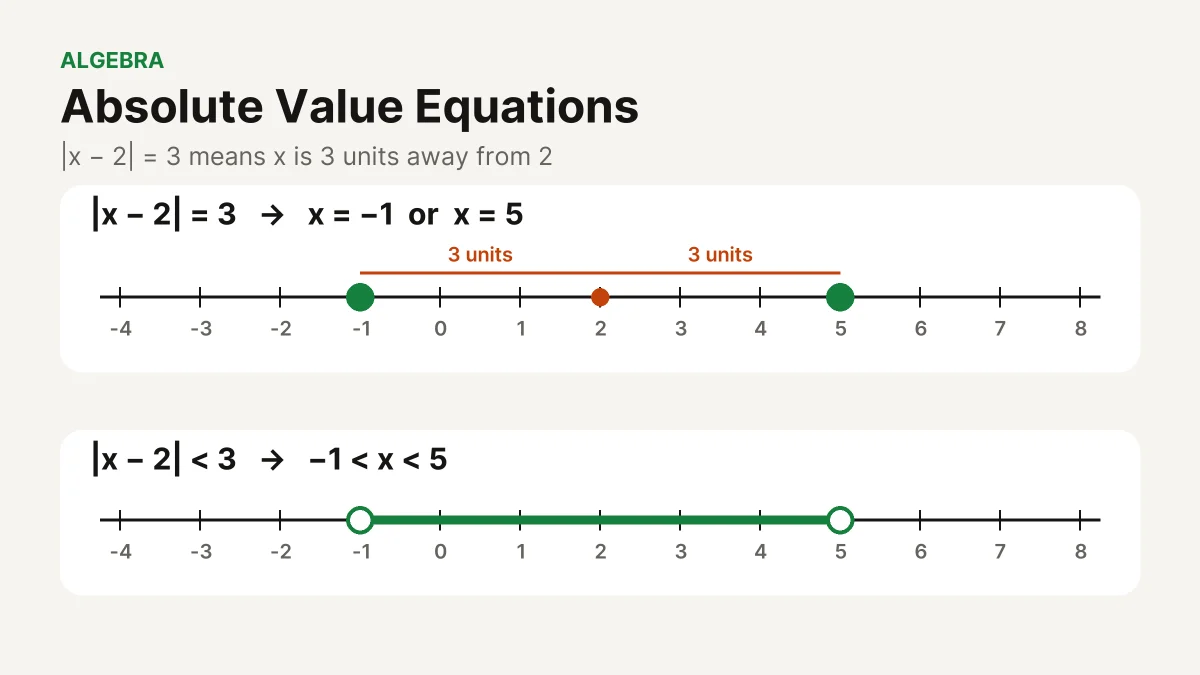
To solve an absolute value equation |ax + b| = c, first get the absolute value alone, then split it into two equations: ax + b = c and ax + b = −c. For |x − 2| = 3, x − 2 = 3 gives x = 5 and x − 2 = −3 gives x = −1. If c is negative there is no solution, because an absolute value is never negative.
In short: Absolute value is distance from zero, so |x − 2| = 3 means “x is 3 units from 2”. That gives two answers: 5 and −1.
In this guide
What Absolute Value Means
The absolute value |x| is the distance of x from 0 on the number line, so it is never negative: |5| = 5 and |−5| = 5. In general, |x − a| is the distance between x and a.
How to Solve an Absolute Value Equation, Step by Step
- Isolate the absolute value: get |…| alone on one side.
- Look at the other side. If it is negative, stop: there is no solution. If it is 0, solve one equation.
- Split into two equations: inside = positive number, and inside = negative number.
- Solve each one, the same way you solve for x.
- Check both answers in the original equation.
Worked Examples
Example: Basic: |2x + 1| = 7. So 2x + 1 = 7, giving x = 3, or 2x + 1 = −7, giving x = −4. Answer: x = 3 or x = −4. Check: |7| = 7 ✓ and |−7| = 7 ✓.
Example: Isolate first: 3|x − 4| + 2 = 14. Subtract 2: 3|x − 4| = 12. Divide by 3: |x − 4| = 4. So x − 4 = 4 or x − 4 = −4: x = 8 or x = 0.
Zero, One or Two Solutions
| After isolating | Number of solutions | Example |
|---|---|---|
| |…| = positive number | Two | |x − 2| = 3 → x = −1 or 5 |
| |…| = 0 | One | |x + 5| = 0 → x = −5 |
| |…| = negative number | None | |3x − 1| = −2 → no solution |
Absolute Value on Both Sides
If |A| = |B|, then either A = B or A = −B.
Example: |x − 3| = |2x + 1|. Case 1: x − 3 = 2x + 1, so x = −4. Case 2: x − 3 = −(2x + 1), so 3x = 2 and x = 2/3. Answer: x = −4 or x = 2/3. Check x = −4: |−7| = 7 and |−7| = 7 ✓.
Checking for False (Extraneous) Answers
When x appears outside the absolute value too, one of your answers may not work. Always check.
Example: |x + 1| = 2x − 4. Case 1: x + 1 = 2x − 4, so x = 5. Check: |6| = 6 and 2(5) − 4 = 6 ✓. Case 2: x + 1 = −(2x − 4), so 3x = 3 and x = 1. Check: |2| = 2 but 2(1) − 4 = −2 ✗. The only answer is x = 5.
Absolute Value Inequalities
Inequalities follow the same distance idea. Remember: less than means “between” (and), and greater than means “outside” (or). The rules for flipping the sign are the same as in linear inequalities.
| Inequality | Rewrite as | Example |
|---|---|---|
| |A| < c | −c < A < c | |x − 2| < 3 → −1 < x < 5 |
| |A| ≤ c | −c ≤ A ≤ c | |x + 3| ≤ 5 → −8 ≤ x ≤ 2 |
| |A| > c | A < −c or A > c | |3x + 2| > 7 → x < −3 or x > 5/3 |
| |A| ≥ c | A ≤ −c or A ≥ c | |2x − 1| ≥ 5 → x ≤ −2 or x ≥ 3 |
Example: |2x − 1| ≥ 5. Split: 2x − 1 ≤ −5, so x ≤ −2; or 2x − 1 ≥ 5, so x ≥ 3. Answer: x ≤ −2 or x ≥ 3.
If c is negative: |x| < −1 has no solution, and |x| > −1 is true for every number.
Real-Life Example: Tolerance
A factory makes bolts 50 mm long, allowed to be off by at most 0.4 mm. The allowed lengths L satisfy |L − 50| ≤ 0.4, which means −0.4 ≤ L − 50 ≤ 0.4, so 49.6 ≤ L ≤ 50.4 mm.
Common Mistakes
- Splitting before isolating. In 3|x − 4| + 2 = 14, remove the 3 and the 2 first.
- Writing only one answer. |…| = positive number usually has two answers.
- Solving |…| = negative. Stop: there is no solution.
- Mixing up “and” and “or”. Less than gives one interval between two numbers; greater than gives two separate pieces.
- Not checking. When x is also outside the bars, one answer can be false.
Practice Problems (With Answers)
1. Solve |x + 4| = 9.
x + 4 = 9 or x + 4 = −9: x = 5 or x = −13.
2. Solve |4x − 2| = 10.
4x − 2 = 10 gives x = 3; 4x − 2 = −10 gives x = −2. x = 3 or x = −2.
3. Solve 2|x + 1| − 3 = 7.
2|x + 1| = 10, so |x + 1| = 5: x = 4 or x = −6.
4. Solve |x + 3| ≤ 5.
−5 ≤ x + 3 ≤ 5, so −8 ≤ x ≤ 2.
5. Solve |3x + 2| > 7.
3x + 2 < −7 gives x < −3; 3x + 2 > 7 gives x > 5/3. x < −3 or x > 5/3.
FAQ
How do you solve an absolute value equation?
Isolate the absolute value, then set the inside equal to the positive and the negative of the other side. |x − 2| = 3 gives x − 2 = 3 or x − 2 = −3, so x = 5 or x = −1.
Why do absolute value equations have two answers?
Absolute value is distance from zero, and two numbers have the same distance: |5| = |−5| = 5. So the inside can be positive or negative.
When does an absolute value equation have no solution?
When, after isolating it, the absolute value equals a negative number, such as |3x − 1| = −2. Absolute values are never negative.
How do you solve absolute value inequalities?
For less than, write one three-part inequality: |x − 2| < 3 becomes −1 < x < 5. For greater than, write two inequalities joined by "or": |2x − 1| ≥ 5 gives x ≤ −2 or x ≥ 3.
What is an extraneous solution in absolute value equations?
An answer from your working that does not satisfy the original equation. In |x + 1| = 2x − 4, x = 1 fails because the right side is −2, so only x = 5 works.
Sources and Further Reading
- OpenStax, Intermediate Algebra, Section 2.7: Solve Absolute Value Inequalities, Rice University.
- OpenStax, College Algebra 2e, Section 2.7: Linear Inequalities and Absolute Value Inequalities.
Related: linear inequalities, how to solve for x, systems of equations, logarithm rules, the math glossary and all free math calculators.
Check your working in seconds
Type any problem from this guide into the free CalcSolver calculator and see the answer, with fractions, instantly.