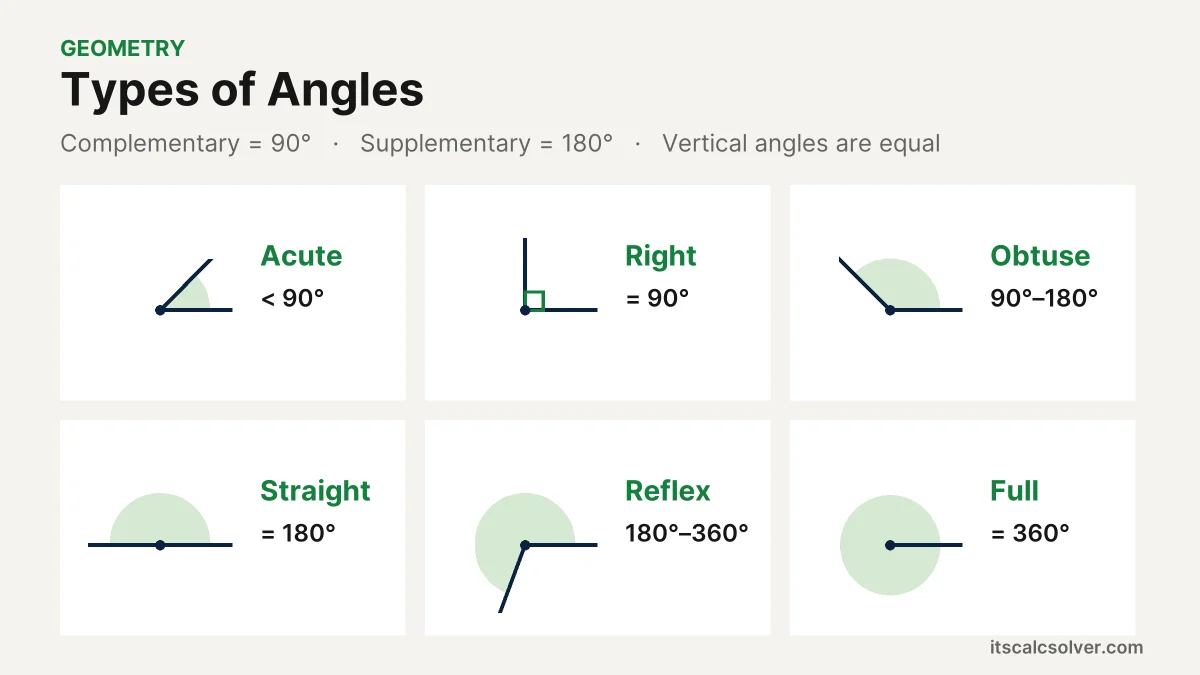
There are six types of angles by size: acute (less than 90°), right (exactly 90°), obtuse (between 90° and 180°), straight (exactly 180°), reflex (between 180° and 360°) and full (360°). Angles also come in pairs: complementary angles add up to 90°, supplementary angles add up to 180°, and vertical (opposite) angles are always equal.
In short: Acute < 90° · Right = 90° · Obtuse 90°–180° · Straight = 180° · Reflex 180°–360°. Angles on a line add to 180°, around a point to 360°, and in a triangle to 180°.
In this guide
The 6 Types of Angles
| Type | Size | Example |
|---|---|---|
| Acute angle | More than 0° and less than 90° | 30°, 45°, 89° |
| Right angle | Exactly 90° | The corner of a page |
| Obtuse angle | More than 90° and less than 180° | 100°, 135° |
| Straight angle | Exactly 180° | A straight line |
| Reflex angle | More than 180° and less than 360° | 200°, 270° |
| Full angle (complete turn) | Exactly 360° | One full rotation |
A right angle is marked with a small square in the corner. The two lines that make a right angle are called perpendicular.
Angle Pairs
| Pair | Rule | Example |
|---|---|---|
| Complementary | Add up to 90° | 35° and 55° |
| Supplementary | Add up to 180° | 112° and 68° |
| Adjacent | Share a vertex and a side, no overlap | ∠ABC and ∠CBD |
| Vertical (vertically opposite) | Equal | Both 70° where two lines cross |
| Linear pair | Adjacent and supplementary (on a straight line) | 50° and 130° |
| Explementary (conjugate) | Add up to 360° | 250° and 110° |
Complementary and Supplementary Angles
To find the complement, subtract from 90°. To find the supplement, subtract from 180°. A memory trick: C comes before S in the alphabet, and 90 comes before 180.
Example: The complement of 35° is 90° − 35° = 55°. The supplement of 112° is 180° − 112° = 68°.
Only acute angles have a complement; an angle of 90° or more cannot. Any angle below 180° has a supplement.
Vertical Angles and Linear Pairs
When two straight lines cross, the opposite angles are equal (vertical angles), and the angles next to each other add up to 180° (a linear pair). These two facts let you set up an equation and solve for x.
Example: Vertical angles measure 3x + 10 and 5x − 30. They are equal, so 3x + 10 = 5x − 30, which gives 2x = 40 and x = 20. Each angle is 3(20) + 10 = 70°, and the other two angles are 180° − 70° = 110°.
Example: A linear pair measures x and 2x + 30. They add to 180°: 3x + 30 = 180, so x = 50. The angles are 50° and 130°.
Parallel Lines Cut by a Transversal
When a line (the transversal) crosses two parallel lines, it makes eight angles with only two different sizes.
| Pair | Relationship | Shape to spot |
|---|---|---|
| Corresponding angles | Equal | “F” shape |
| Alternate interior angles | Equal | “Z” shape |
| Alternate exterior angles | Equal | Outside the lines, opposite sides |
| Co-interior (same-side interior) angles | Add up to 180° | “C” or “U” shape |
Example: If one angle is 65°, its corresponding and alternate angles are also 65°, and its co-interior angle is 180° − 65° = 115°.
Angle Rules for Lines, Points and Shapes
| Rule | Total |
|---|---|
| Angles on a straight line | 180° |
| Angles around a point | 360° |
| Angles in a triangle | 180° |
| Angles in a quadrilateral | 360° |
| Exterior angles of any polygon | 360° |
Example: Around a point, the angles are 90°, 130° and x. So x = 360° − 90° − 130° = 140°.
Example: A triangle has angles 48° and 67°. The third angle is 180° − 48° − 67° = 65°.
Example: An isosceles triangle has a top angle of 40°. The two base angles are equal: (180° − 40°) ÷ 2 = 70° each.
To find unknown sides from angles in a right triangle, use SOHCAHTOA, or let the triangle calculator solve every side and angle.
Angles in Polygons
The interior angles of a polygon with n sides add up to (n − 2) × 180°. In a regular polygon all angles are equal, so divide by n. Each exterior angle of a regular polygon is 360° ÷ n.
| Polygon | Sides | Sum of interior angles | Each angle (regular) | Each exterior angle (regular) |
|---|---|---|---|---|
| Triangle | 3 | 180° | 60° | 120° |
| Quadrilateral | 4 | 360° | 90° | 90° |
| Pentagon | 5 | 540° | 108° | 72° |
| Hexagon | 6 | 720° | 120° | 60° |
| Octagon | 8 | 1080° | 135° | 45° |
| Decagon | 10 | 1440° | 144° | 36° |
Interior and exterior angles at each corner form a linear pair, so they add to 180°: for a regular octagon, 135° + 45° = 180°.
Degrees and Radians
Angles can also be measured in radians, which scientific calculators and higher maths use. A full turn is 360° = 2π radians, so 180° = π radians.
| Degrees | Radians |
|---|---|
| 30° | π/6 |
| 45° | π/4 ≈ 0.7854 |
| 90° | π/2 |
| 180° | π |
| 360° | 2π |
| ≈ 57.30° | 1 radian |
To convert, multiply degrees by π/180, or radians by 180/π. If a calculator gives a strange answer for sin or cos, check whether it is in degree or radian mode.
Angles on a Clock
The minute hand moves 6° per minute. The hour hand moves 30° per hour plus 0.5° per minute.
Example: At 4:20 the hour hand is at 4 × 30 + 20 × 0.5 = 130° and the minute hand at 20 × 6 = 120°. The angle between them is 10°, an acute angle. At 3:00 it is exactly 90°, a right angle.
How to Measure an Angle With a Protractor
- Put the centre point of the protractor on the vertex (the corner) of the angle.
- Line up the zero line of the protractor with one arm of the angle.
- Read the scale where the other arm crosses it, using the scale that starts at 0 on your first arm.
- Check the answer makes sense: an acute angle must read under 90°.
For a reflex angle, measure the smaller angle and subtract it from 360°.
Common Mistakes
- Mixing up complementary (90°) and supplementary (180°).
- Reading the wrong scale on a protractor, so 50° is read as 130°.
- Assuming lines are parallel when the question does not say so; the transversal rules only work for parallel lines.
- Using n × 180° instead of (n − 2) × 180° for the angles in a polygon.
- Leaving a calculator in radian mode when the question uses degrees.
Practice Problems
1. Two complementary angles are x and x + 40. Find both.
2x + 40 = 90, so x = 25. The angles are 25° and 65°.
2. Two supplementary angles are 2x and 3x + 5. Find both.
5x + 5 = 180, so x = 35. The angles are 70° and 110°.
3. A right triangle has one angle of 38°. Find the third angle.
180° − 90° − 38° = 52°.
4. What is each interior angle of a regular decagon?
(10 − 2) × 180° = 1440°, and 1440° ÷ 10 = 144°.
5. A quadrilateral has angles 120°, 85° and 95°. Find the fourth.
360° − 120° − 85° − 95° = 60°.
6. Classify 200°.
Reflex angle, because it is between 180° and 360°.
FAQ
What are the 6 types of angles?
Acute (under 90°), right (90°), obtuse (between 90° and 180°), straight (180°), reflex (between 180° and 360°) and full (360°).
What is the difference between complementary and supplementary angles?
Complementary angles add up to 90°; supplementary angles add up to 180°. 30° and 60° are complementary; 30° and 150° are supplementary.
Are vertical angles always equal?
Yes. When two straight lines cross, each pair of opposite angles is equal.
What do the angles in a triangle add up to?
180°. In a quadrilateral they add up to 360°, and in any polygon with n sides they add up to (n − 2) × 180°.
Is a 90° angle acute or obtuse?
Neither. An angle of exactly 90° is a right angle.
Sources and Further Reading
- OpenStax Contemporary Mathematics, Section 10.2: Angles.
- OpenStax Prealgebra 2e, Section 9.3: Use Properties of Angles, Triangles, and the Pythagorean Theorem.
- LibreTexts K12 Geometry: Angle Properties and Theorems.
Related: SOHCAHTOA, Pythagorean theorem, triangle calculator, area and perimeter formulas, volume formulas, the math glossary and all free math calculators.
Check your working in seconds
Type any problem from this guide into the free CalcSolver calculator and see the answer, with fractions, instantly.