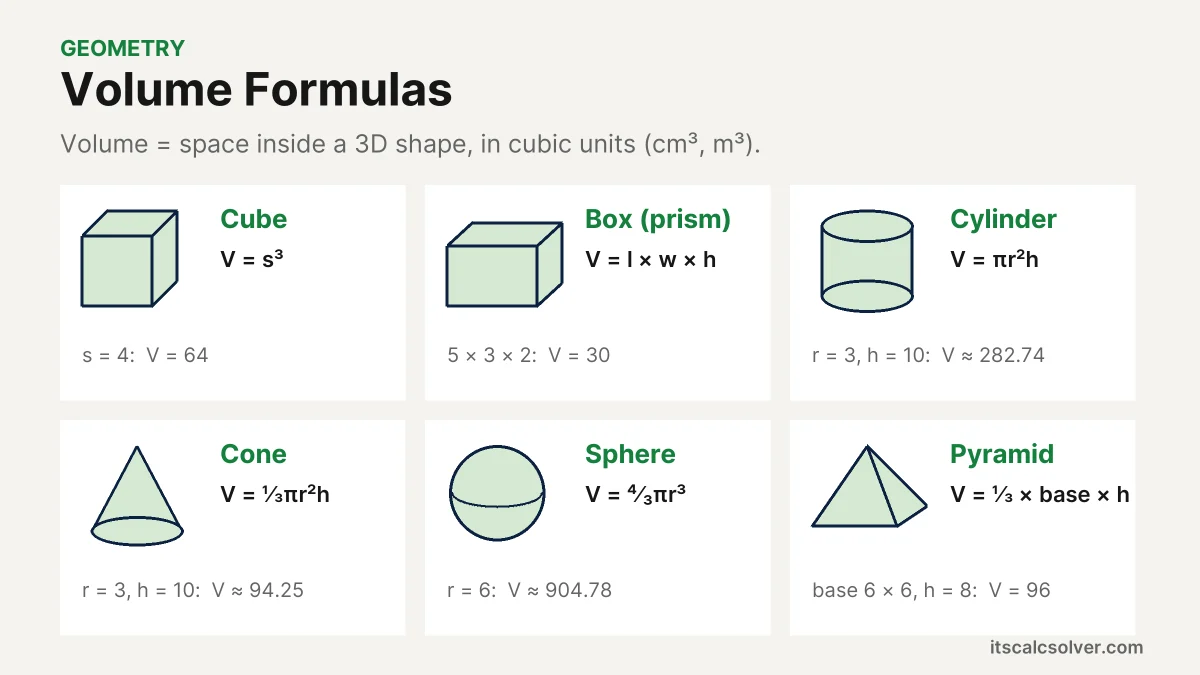
Volume is the amount of space inside a 3D shape, measured in cubic units such as cm³ or m³. For a box (rectangular prism), volume = length × width × height, so a 5 cm × 3 cm × 2 cm box holds 30 cm³. A cylinder is V = πr²h, a cone is ⅓πr²h, and a sphere is ⁴⁄₃πr³.
In short: Prisms and cylinders: base area × height. Cones and pyramids: one third of that. Spheres: ⁴⁄₃πr³. 1 cm³ = 1 mL, and 1,000 cm³ = 1 litre.
In this guide
Volume Formulas for Every 3D Shape
| Shape | Volume formula | Example | Answer |
|---|---|---|---|
| Cube (side s) | V = s³ | s = 4 | 64 |
| Rectangular prism (box) | V = l × w × h | 5 × 3 × 2 | 30 |
| Cylinder | V = πr²h | r = 3, h = 10 | ≈ 282.74 |
| Cone | V = ⅓πr²h | r = 3, h = 10 | ≈ 94.25 |
| Sphere | V = ⁴⁄₃πr³ | r = 6 | ≈ 904.78 |
| Hemisphere | V = ⅔πr³ | r = 6 | ≈ 452.39 |
| Square pyramid | V = ⅓ × base² × h | base 6, h = 8 | 96 |
| Triangular prism | V = ½ × b × h × length | b = 4, h = 3, length 10 | 60 |
Every prism and cylinder follows one idea: volume = area of the base × height. If you know the area formulas for flat shapes, you can find the volume of any prism.
Volume of a Cube and a Rectangular Prism
Example: Cube with side 4 cm: V = 4³ = 4 × 4 × 4 = 64 cm³.
Example: Box 5 cm long, 3 cm wide and 2 cm high: V = 5 × 3 × 2 = 30 cm³. You could fit 30 one-centimetre cubes inside it.
Volume of a Cylinder
The base is a circle with area πr², so V = πr²h. If you are given the diameter, halve it first to get the radius.
Example: Cylinder with radius 3 cm and height 10 cm: V = π × 3² × 10 = 90π ≈ 282.74 cm³.
Volume of a Cone and a Pyramid
A cone holds exactly one third of the cylinder with the same base and height, and a pyramid holds one third of the matching prism.
Example: Cone with radius 3 cm and height 10 cm: V = ⅓ × π × 3² × 10 = 30π ≈ 94.25 cm³, one third of the cylinder above.
Example: Square pyramid with a 6 m by 6 m base and height 8 m: V = ⅓ × 36 × 8 = 96 m³.
Use the perpendicular height (straight up from the base to the tip), not the slant height along the side. If you only know the slant height, find the height with the Pythagorean theorem.
Volume of a Sphere and a Hemisphere
Example: Sphere with radius 6 cm: V = ⁴⁄₃ × π × 6³ = 288π ≈ 904.78 cm³.
Example: Hemisphere (half a sphere) with radius 6 cm: V = ⅔ × π × 6³ = 144π ≈ 452.39 cm³.
Volume of a Triangular Prism
The base is a triangle, so first find its area (½ × base × height), then multiply by the length of the prism.
Example: A tent-shaped prism with a triangle 4 m wide and 3 m tall, 10 m long: V = ½ × 4 × 3 × 10 = 60 m³.
Volume Units: cm³, Litres and Gallons
| Unit | Equals |
|---|---|
| 1 cm³ | 1 millilitre (mL) |
| 1,000 cm³ | 1 litre (L) |
| 1 m³ | 1,000 litres = 1,000,000 cm³ |
| 1 ft³ | 1,728 in³ ≈ 7.48 US gallons |
Because volume has three dimensions, a length conversion is cubed: 1 m = 100 cm, so 1 m³ = 100³ = 1,000,000 cm³. Convert all lengths to the same unit before you multiply.
Finding a Missing Length From the Volume
- Cube with volume 125 cm³: s = ∛125 = 5 cm. See cube roots for numbers that are not perfect cubes.
- Cylinder with volume 500 cm³ and radius 5 cm: h = V ÷ (πr²) = 500 ÷ (25π) ≈ 6.37 cm.
- Box with volume 30 cm³, length 5 and width 3: h = 30 ÷ 15 = 2 cm.
Each is a one-step rearrangement; our guide to solving for x explains the method.
What Happens to Volume When You Double the Size?
If every length is doubled, the volume becomes 2³ = 8 times bigger. A cube with side 4 has volume 64; a cube with side 8 has volume 512 = 8 × 64. Tripling every length multiplies the volume by 27.
Volume vs Surface Area
| Volume | Surface area | |
|---|---|---|
| Measures | Space inside | Total area of the outside faces |
| Units | cm³, m³, litres | cm², m² |
| Cube with side 4 | 4³ = 64 cm³ | 6 × 4² = 96 cm² |
| Use it for | How much a tank holds | How much paint or wrapping you need |
Real-Life Volume Examples
- Fish tank 60 cm × 30 cm × 40 cm: 72,000 cm³ = 72 litres of water.
- Round water tank with radius 0.5 m and height 1.2 m: π × 0.5² × 1.2 ≈ 0.94 m³ ≈ 942 litres.
- Ice-cream cone or a funnel: use the cone formula, ⅓πr²h.
Common Mistakes
- Using the diameter instead of the radius in πr²h, which makes the answer 4 times too big.
- Forgetting the ⅓ for cones and pyramids.
- Using slant height instead of perpendicular height.
- Writing cm² for a volume; volume is always cubic (cm³).
- Mixing units, such as metres for the radius and centimetres for the height.
Practice Problems
1. Find the volume of a cube with side 7 cm.
7³ = 343 cm³.
2. A box is 8 cm by 5 cm by 3 cm. What is its volume in litres?
8 × 5 × 3 = 120 cm³ = 0.12 litres.
3. Find the volume of a cylinder with radius 2 m and height 10 m.
π × 2² × 10 = 40π ≈ 125.66 m³.
4. Find the volume of a sphere with radius 3 cm.
⁴⁄₃ × π × 27 = 36π ≈ 113.1 cm³.
5. A cone has radius 2 cm and height 9 cm. Find its volume.
⅓ × π × 2² × 9 = 12π ≈ 37.7 cm³.
6. A square pyramid has a 10 m by 10 m base and height 6 m. Find its volume.
⅓ × 100 × 6 = 200 m³.
FAQ
What is the formula for volume?
It depends on the shape. For a box, V = length × width × height. For any prism or cylinder, V = base area × height. Cones and pyramids are one third of that, and a sphere is ⁴⁄₃πr³.
How do you find the volume of a cylinder?
Multiply π by the radius squared and then by the height: V = πr²h. For radius 3 and height 10, V ≈ 282.74.
What is the volume of a sphere?
V = ⁴⁄₃πr³. A sphere with radius 6 cm has a volume of about 904.78 cm³.
How many litres are in a cubic metre?
1 cubic metre is 1,000 litres, and 1 litre is 1,000 cm³.
What is the difference between volume and capacity?
Volume is the space an object takes up; capacity is how much a container can hold. They use the same numbers, for example a 72,000 cm³ tank holds 72 litres.
Sources and Further Reading
- OpenStax Prealgebra, Section 9.6: Volume and Surface Area.
- OpenStax Contemporary Mathematics, Section 10.7: Volume and Surface Area.
- NIST: Unit Conversion (SI and US customary units).
Related: area and perimeter formulas, Pythagorean theorem, square roots and cube roots, exponent rules, the math glossary and all free math calculators.
Check your working in seconds
Type any problem from this guide into the free CalcSolver calculator and see the answer, with fractions, instantly.