The distributive property says a(b + c) = ab + ac: multiply the number outside the brackets by every term inside, then add the results. For example, 3(4 + 5) = 3·4 + 3·5 = 12 + 15 = 27, the same as 3 × 9. It works with subtraction too, a(b − c) = ab − ac, so 4(x + 7) = 4x + 28 and −2(3x − 5) = −6x + 10.
In short: Multiply the outside term by each inside term and keep the signs. Use it to remove brackets (expand), to pull out a common factor (factor) and to multiply in your head: 7 × 46 = 7 × 40 + 7 × 6 = 322.
In this guide
- What is the distributive property?
- Why it works: the area model
- How to use it in 3 steps
- Worked examples
- Negatives and subtraction
- Fractions and decimals
- Two brackets: (a + b)(c + d)
- Mental math
- Factoring: the property in reverse
- Solving equations
- When it does not apply
- Common mistakes
- Practice problems
- FAQ
What Is the Distributive Property?
The distributive property connects multiplication with addition and subtraction. “Distribute” means hand out: the factor outside the brackets is handed out to every term inside.
| Form | Rule | Example |
|---|---|---|
| Addition | a(b + c) = ab + ac | 5(x + 2) = 5x + 10 |
| Subtraction | a(b − c) = ab − ac | 6(2x − 3) = 12x − 18 |
| Factor on the right | (b + c)a = ba + ca | (x + 6)·3 = 3x + 18 |
| Three or more terms | a(b + c + d) = ab + ac + ad | 5(x + 2y − 3) = 5x + 10y − 15 |
| Two brackets | (a + b)(c + d) = ac + ad + bc + bd | (x + 3)(x + 5) = x² + 8x + 15 |
The word for the left side is the factored form and the right side is the expanded form. Going left to right is called expanding or distributing; going right to left is factoring. It is one of the core basic algebra formulas, together with the commutative and associative properties.
Why It Works: The Area Model
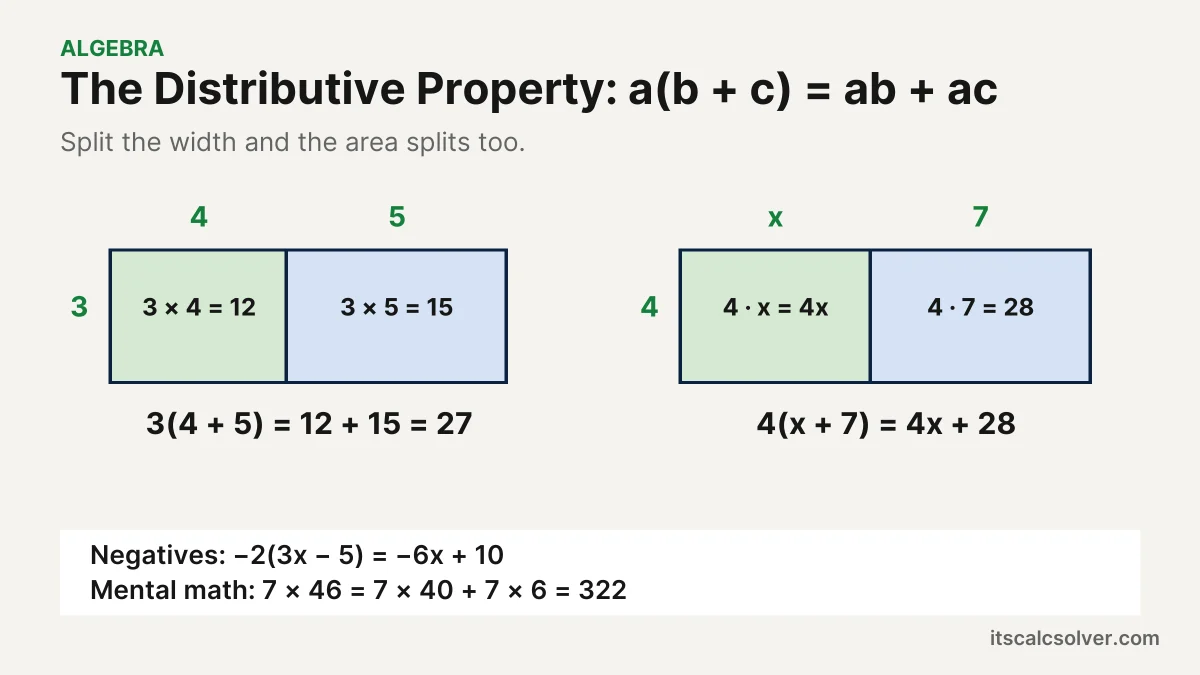
Picture a rectangle 3 units tall and 4 + 5 = 9 units wide. Its area is 3 × 9 = 27. Now split the width into a 4 part and a 5 part. The two smaller rectangles have areas 3 × 4 = 12 and 3 × 5 = 15, and together they still cover 27. So 3(4 + 5) = 3·4 + 3·5. The same picture works with a letter: a rectangle 4 tall and x + 7 wide has area 4x + 28.
How to Use the Distributive Property in 3 Steps
- Multiply the outside term by the first term inside. Include its sign.
- Multiply the outside term by every other term inside. Do not stop after the first one.
- Simplify. Combine like terms if there are any, as in simplifying algebraic expressions.
Example: 2(x + 3) + 4(x − 1) = 2x + 6 + 4x − 4 = 6x + 2.
Distributive Property Examples
| Expression | Distribute | Answer |
|---|---|---|
| 3(4 + 5) | 3·4 + 3·5 | 27 |
| 4(x + 7) | 4·x + 4·7 | 4x + 28 |
| 6(2x − 3) | 6·2x − 6·3 | 12x − 18 |
| 2x(3x + 4) | 2x·3x + 2x·4 | 6x² + 8x |
| 5(x + 2y − 3) | 5·x + 5·2y − 5·3 | 5x + 10y − 15 |
| (x + 6)·3 | x·3 + 6·3 | 3x + 18 |
When the outside term has a variable, use the product rule for exponents: 2x · 3x = 6x², because x · x = x².
Distributive Property With Negatives and Subtraction
The sign in front of the outside term goes with it. A negative times a negative gives a positive.
| Expression | Work | Answer |
|---|---|---|
| −2(3x − 5) | (−2)(3x) + (−2)(−5) | −6x + 10 |
| −(x − 4) | (−1)(x) + (−1)(−4) | −x + 4 |
| 3(x + 4) − (x − 2) | 3x + 12 − x + 2 | 2x + 14 |
| 5 − 2(x + 3) | 5 − 2x − 6 | −2x − 1 |
A minus sign in front of brackets means −1 times the brackets, so every sign inside flips.
Distributive Property With Fractions and Decimals
| Expression | Work | Answer |
|---|---|---|
| ½(8x + 6) | ½·8x + ½·6 | 4x + 3 |
| ⅔(9x − 12) | ⅔·9x − ⅔·12 | 6x − 8 |
| 0.3(10x − 20) | 0.3·10x − 0.3·20 | 3x − 6 |
Multiply the fraction by each term the usual way; see how to multiply fractions if you need a refresher.
Two Brackets: (a + b)(c + d)
With two brackets, distribute twice: every term in the first bracket multiplies every term in the second. The FOIL method (First, Outer, Inner, Last) is just this rule for two terms each.
| Product | Each pair | Answer |
|---|---|---|
| (x + 3)(x + 5) | x² + 5x + 3x + 15 | x² + 8x + 15 |
| (2x − 1)(x + 4) | 2x² + 8x − x − 4 | 2x² + 7x − 4 |
This is how quadratics are built, and undoing it is factoring polynomials.
Using the Distributive Property for Mental Math
Break one number into an easy sum or difference, then multiply each part.
| Problem | Split | Answer |
|---|---|---|
| 7 × 46 | 7 × 40 + 7 × 6 = 280 + 42 | 322 |
| 8 × 99 | 8 × 100 − 8 × 1 = 800 − 8 | 792 |
| 6 × 10⁵ | 6 × 100 + 6 × 5 = 600 + 30 | 630 |
| 4 × 2.25 | 4 × 2 + 4 × 0.25 = 8 + 1 | 9 |
More shortcuts like this are in our mental math tricks guide.
Factoring: The Distributive Property in Reverse
Factoring reads the rule from right to left: ab + ac = a(b + c). Find the greatest common factor (GCF) of the terms, write it outside, and divide each term by it.
| Expanded | GCF | Factored |
|---|---|---|
| 6x + 15 | 3 | 3(2x + 5) |
| 12x² − 8x | 4x | 4x(3x − 2) |
| 10x − 25y + 5 | 5 | 5(2x − 5y + 1) |
Check a factoring answer by distributing it back: 3(2x + 5) = 6x + 15.
Solving Equations With the Distributive Property
Remove the brackets first, then solve as usual.
Example: Solve 3(x − 4) = 2x + 5. Distribute: 3x − 12 = 2x + 5. Subtract 2x: x − 12 = 5. Add 12: x = 17. Check: 3(17 − 4) = 39 and 2(17) + 5 = 39.
For more practice, see how to solve for x or check your answer with the solve for x calculator, which shows the distributing step.
When the Distributive Property Does Not Apply
- Multiplication inside the brackets: 3(4 × 5) is 3 × 20 = 60, not (3 × 4)(3 × 5) = 180. Distribute only over + and −.
- Dividing by a sum: (8 + 4) ÷ 2 = 8 ÷ 2 + 4 ÷ 2 = 6 works, because it is the same as multiplying by ½. But 12 ÷ (4 + 2) = 2, not 12 ÷ 4 + 12 ÷ 2 = 9.
- Powers: (a + b)² is not a² + b². Write it as (a + b)(a + b) and distribute: a² + 2ab + b².
Common Mistakes
- Multiplying only the first term: 4(x + 7) is 4x + 28, not 4x + 7.
- Dropping the negative: −2(3x − 5) is −6x + 10, not −6x − 10.
- Subtracting first: in 5 − 2(x + 3), multiply before subtracting (order of operations), so the answer is −2x − 1, not 3(x + 3).
- Forgetting to flip every sign after a minus: −(x − 4) = −x + 4.
Practice Problems
1. Expand 5(2x + 3).
10x + 15
2. Expand −4(x − 6).
−4x + 24
3. Expand 3a(a − 2b).
3a² − 6ab
4. Work out 9 × 10² in your head.
9 × 100 + 9 × 2 = 900 + 18 = 918
5. Factor 14x + 21.
7(2x + 3)
6. Solve 4(x + 2) = 28.
4x + 8 = 28, so 4x = 20 and x = 5.
7. Expand (x − 2)(x + 7).
x² + 7x − 2x − 14 = x² + 5x − 14
FAQ
What is the distributive property in simple words?
Multiplying a number by a group of numbers added together is the same as multiplying it by each one separately and then adding: a(b + c) = ab + ac.
What is an example of the distributive property?
3(4 + 5) = 3 × 4 + 3 × 5 = 12 + 15 = 27. With a variable: 4(x + 7) = 4x + 28.
How do you use the distributive property with negative numbers?
Keep the sign with the outside number and multiply it by every term. −2(3x − 5) = −6x + 10, because −2 × −5 = +10.
Does the distributive property work for division?
Only when the sum is being divided: (8 + 4) ÷ 2 = 4 + 2. It does not work when you divide by a sum: 12 ÷ (4 + 2) is 2, not 9.
What is the difference between distributing and factoring?
Distributing removes brackets (3(2x + 5) becomes 6x + 15). Factoring puts them back by taking out the common factor (6x + 15 becomes 3(2x + 5)).
Sources and Further Reading
- OpenStax Prealgebra 2e, Section 7.3: Distributive Property.
- Lumen Learning: Simplifying Expressions Using the Distributive Property.
- Open Up Resources, Grade 7 Lesson 19: Expanding and Factoring.
- OpenStax Elementary Algebra 2e, Section 6.3: Multiply Polynomials.
Related: algebra basics, algebraic expressions, basic algebra formulas, factoring polynomials, linear inequalities, the math glossary and all free math calculators.
Check your working in seconds
Type any problem from this guide into the free CalcSolver calculator and see the answer, with fractions, instantly.