Perimeter is the distance around a shape, so you add the lengths of its sides. Area is the space inside it, measured in square units. For a rectangle, perimeter = 2(length + width) and area = length × width. A rectangle 8 cm long and 5 cm wide has a perimeter of 2(8 + 5) = 26 cm and an area of 8 × 5 = 40 cm².
In short: Perimeter: add the outside edges (units: cm, m, ft). Area: count the squares inside (units: cm², m², ft²). Circles use π: circumference = 2πr and area = πr².
In this guide
- Area vs perimeter
- All the formulas in one table
- Squares and rectangles
- Triangles
- Parallelograms, trapezoids and rhombuses
- Circles and semicircles
- Regular polygons
- L-shapes and composite shapes
- Finding a missing side
- Same perimeter, different area
- Units and conversions
- Real-life examples
- Common mistakes
- Practice problems
- FAQ
Area vs Perimeter: What Is the Difference?
| Perimeter | Area | |
|---|---|---|
| What it measures | The length of the boundary | The surface inside the boundary |
| How to find it | Add all side lengths | Multiply dimensions (count unit squares) |
| Units | cm, m, in, ft | cm², m², in², ft² |
| Everyday use | Fencing, border, skirting board, frame | Carpet, paint, tiles, land |
A quick way to remember: peri means “around” and meter means “measure”, so perimeter is the measure around.
Area and Perimeter Formulas for Every Shape
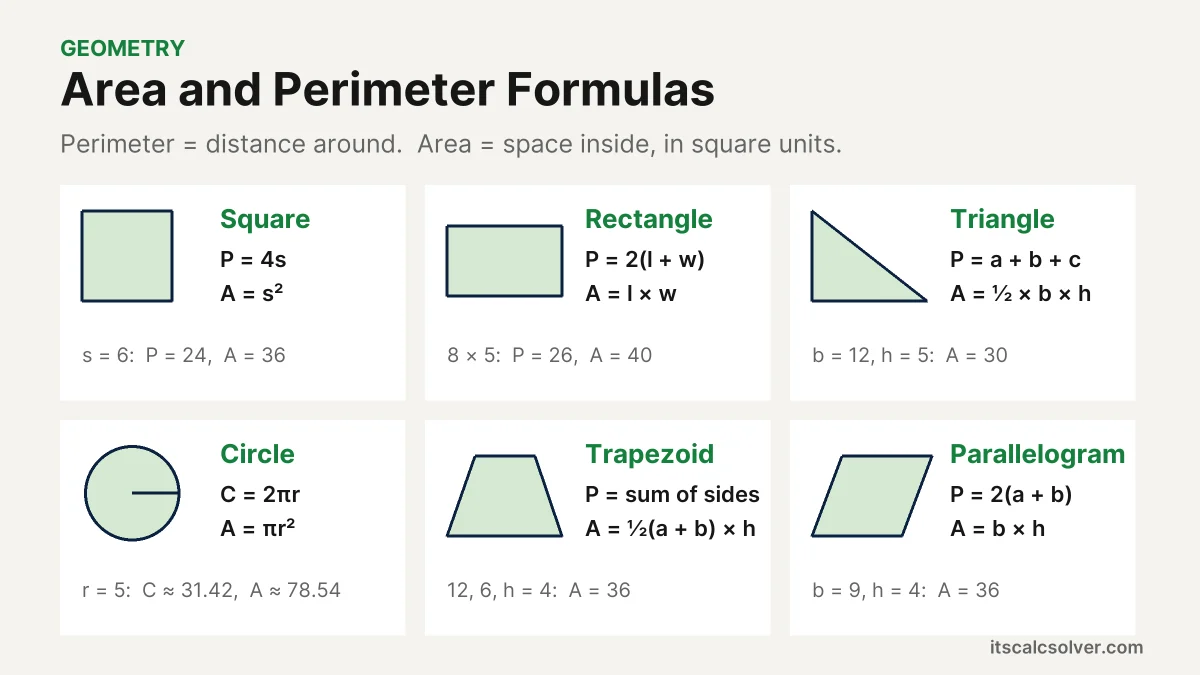
| Shape | Perimeter | Area |
|---|---|---|
| Square (side s) | P = 4s | A = s² |
| Rectangle (length l, width w) | P = 2(l + w) | A = l × w |
| Triangle (sides a, b, c; base b, height h) | P = a + b + c | A = ½ × b × h |
| Parallelogram (base b, side a, height h) | P = 2(a + b) | A = b × h |
| Trapezoid (parallel sides a, b; height h) | Add all four sides | A = ½(a + b) × h |
| Rhombus (side s, diagonals d₁, d₂) | P = 4s | A = ½ × d₁ × d₂ |
| Circle (radius r) | C = 2πr = πd | A = πr² |
| Semicircle (radius r) | P = πr + 2r | A = ½πr² |
| Regular hexagon (side s) | P = 6s | A = (3√3 ⁄ 2)s² |
Area and Perimeter of Squares and Rectangles
Example: A square with side 6 m: perimeter = 4 × 6 = 24 m; area = 6² = 36 m².
Example: A rectangle 8 cm by 5 cm: perimeter = 2(8 + 5) = 26 cm; area = 8 × 5 = 40 cm².
Area and Perimeter of a Triangle
Perimeter is always the three sides added. For area, use the base and the perpendicular height, the straight-up distance from the base to the opposite corner, not the sloping side.
Example: A right triangle with sides 5, 12 and 13 cm: perimeter = 5 + 12 + 13 = 30 cm. The two short sides meet at a right angle, so base 12 and height 5 give area = ½ × 12 × 5 = 30 cm².
Example: A triangle with sides 13, 14 and 15 and no height given: use Heron’s formula. s = (13 + 14 + 15) ÷ 2 = 21, and area = √(21 × 8 × 7 × 6) = √7056 = 84. Perimeter = 42.
If you know two sides of a right triangle, find the third with the Pythagorean theorem. If you know angles, use SOHCAHTOA, or let the triangle calculator find every side, angle, the area and the perimeter.
Parallelograms, Trapezoids and Rhombuses
Example: Parallelogram with base 9, slanted side 5 and height 4: area = 9 × 4 = 36; perimeter = 2(9 + 5) = 28. The height (4) is used for area, the slanted side (5) for perimeter.
Example: Trapezoid with parallel sides 12 and 6, height 4 and two slanted sides of 5: area = ½(12 + 6) × 4 = 36; perimeter = 12 + 6 + 5 + 5 = 28.
Example: Rhombus with diagonals 6 and 8: area = ½ × 6 × 8 = 24. The diagonals cut it into right triangles with legs 3 and 4, so each side is 5 and the perimeter = 4 × 5 = 20.
Circumference and Area of a Circle
A circle’s perimeter is called its circumference. Use π ≈ 3.14159, and watch whether you are given the radius r or the diameter d = 2r.
Example: Circle with radius 5 cm: circumference = 2π × 5 ≈ 31.42 cm; area = π × 5² ≈ 78.54 cm².
Example: Semicircle with radius 4: area = ½π × 4² ≈ 25.13; perimeter = curved edge πr + straight edge 2r = 12.57 + 8 ≈ 20.57.
Example: Circumference 31.4 m, find the area: r = 31.4 ÷ 2π ≈ 5.00 m, so area ≈ π × 5² ≈ 78.46 m² (78.54 if you round r to 5 first).
Regular Polygons
A regular polygon has equal sides, so its perimeter is the number of sides times the side length. A regular hexagon with side 4 has perimeter 6 × 4 = 24 and area (3√3 ⁄ 2) × 4² ≈ 41.57. For any regular polygon, area = ½ × perimeter × apothem (the distance from the centre to the middle of a side).
Area and Perimeter of L-Shapes and Composite Shapes
Split the shape into rectangles (or subtract the missing piece), find each area, then add or subtract. For the perimeter, walk around the outside edge only.
Example: A 10 m by 8 m rectangle with a 4 m by 3 m corner cut out (an L-shape): area = 10 × 8 − 4 × 3 = 80 − 12 = 68 m². Perimeter = 36 m, the same as the full rectangle, because the two edges of the notch replace the two pieces that were cut away.
Finding a Missing Side
- Rectangle with area 48 cm² and length 8 cm: width = 48 ÷ 8 = 6 cm, so the perimeter is 2(8 + 6) = 28 cm.
- Rectangle with perimeter 30 m and length 9 m: length + width = 30 ÷ 2 = 15, so width = 6 m and area = 9 × 6 = 54 m².
- Square with area 81: side = √81 = 9, so perimeter = 36. See square roots if the area is not a perfect square.
Each of these is a one-step equation; our guide to solving for x covers the method.
Same Perimeter, Different Area
Shapes with the same perimeter can have very different areas. Here are rectangles with whole-number sides and a perimeter of 20:
| Length × width | Perimeter | Area |
|---|---|---|
| 9 × 1 | 20 | 9 |
| 8 × 2 | 20 | 16 |
| 7 × 3 | 20 | 21 |
| 6 × 4 | 20 | 24 |
| 5 × 5 | 20 | 25 |
The closer the rectangle is to a square, the bigger the area. That is why a square pen gives the most room for a fixed length of fencing.
Units and Conversions
Area units are squared, so the conversion factor is squared too.
| Length | Area |
|---|---|
| 1 m = 100 cm | 1 m² = 10,000 cm² |
| 1 ft = 12 in | 1 ft² = 144 in² |
| 1 yd = 3 ft | 1 yd² = 9 ft² |
Always convert every length to the same unit before you multiply.
Real-Life Examples
- Painting a wall 4 m wide and 2.5 m high with a 1.2 m by 1 m window: 4 × 2.5 − 1.2 × 1 = 8.8 m² to paint.
- Fencing a garden 12 m by 7 m: 2(12 + 7) = 38 m of fence.
- Carpet for a room 5 m by 4 m: 20 m² of carpet, plus a little extra for cutting.
Common Mistakes
- Using the slanted side instead of the height for the area of a triangle or parallelogram.
- Forgetting the ½ in the triangle and trapezoid area formulas.
- Using the diameter where the formula needs the radius: for d = 10, r = 5.
- Writing area in cm instead of cm², or mixing metres and centimetres in one sum.
- Adding inside edges of a composite shape to the perimeter.
Practice Problems
1. Find the perimeter and area of a 7 cm by 3 cm rectangle.
Perimeter = 2(7 + 3) = 20 cm; area = 7 × 3 = 21 cm².
2. A triangle has base 9 and height 6. What is its area?
½ × 9 × 6 = 27 square units.
3. Find the area and circumference of a circle with radius 3 m.
Area = π × 3² ≈ 28.27 m²; circumference = 2π × 3 ≈ 18.85 m.
4. A trapezoid has parallel sides 8 and 4 and height 5. Find its area.
½(8 + 4) × 5 = 30 square units.
5. A square has a perimeter of 36 cm. What is its area?
Side = 36 ÷ 4 = 9 cm, so area = 9² = 81 cm².
6. A round table has a diameter of 14 dm. Find its area and circumference.
r = 7 dm. Area = π × 7² ≈ 153.94 dm²; circumference = π × 14 ≈ 43.98 dm.
FAQ
What is the difference between area and perimeter?
Perimeter is the distance around a shape, found by adding its sides, in units like cm. Area is the space inside, found by multiplying, in square units like cm².
What is the formula for the area and perimeter of a rectangle?
Area = length × width and perimeter = 2(length + width). A 8 by 5 rectangle has area 40 and perimeter 26.
How do you find the area of a triangle?
Multiply the base by the perpendicular height and halve it: A = ½ × b × h. If you only know the three sides, use Heron’s formula.
Can the area and perimeter of a shape be equal?
The numbers can match, though the units differ. A 4 by 4 square has perimeter 16 and area 16, a 3 by 6 rectangle has 18 and 18, and a 5-12-13 right triangle has 30 and 30.
What is the perimeter of a circle called?
The circumference. It equals 2πr, or π times the diameter.
Moving from flat shapes to 3D? See volume formulas for cubes, cylinders, cones and spheres.
To work with the corners of these shapes, see the types of angles and the angle rules for triangles and polygons.
Sources and Further Reading
- OpenStax Prealgebra 2e, Section 9.4: Use Properties of Rectangles, Triangles, and Trapezoids.
- OpenStax Prealgebra 2e, Section 9.5: Circles and Irregular Figures.
- Maricopa Open Textbook, College Mathematics: Section G.2 Area.
- Arizona State University, MAT 142 notes: Perimeter and Area.
Related: Pythagorean theorem, SOHCAHTOA, triangle calculator, square roots and cube roots, basic algebra formulas, the math glossary and all free math calculators.
Check your working in seconds
Type any problem from this guide into the free CalcSolver calculator and see the answer, with fractions, instantly.