To convert a fraction to a decimal, divide the numerator (top) by the denominator (bottom). For example, 3/4 = 3 ÷ 4 = 0.75. Some fractions give a decimal that stops, like 0.75; others give one that repeats forever, like 1/3 = 0.333…. To turn the decimal into a percent, multiply by 100.
In short: Divide top by bottom. If the bottom can be made into 10, 100 or 1000, use that shortcut instead. Multiply the decimal by 100 to get a percent.
In this guide
Method 1: Divide the Numerator by the Denominator
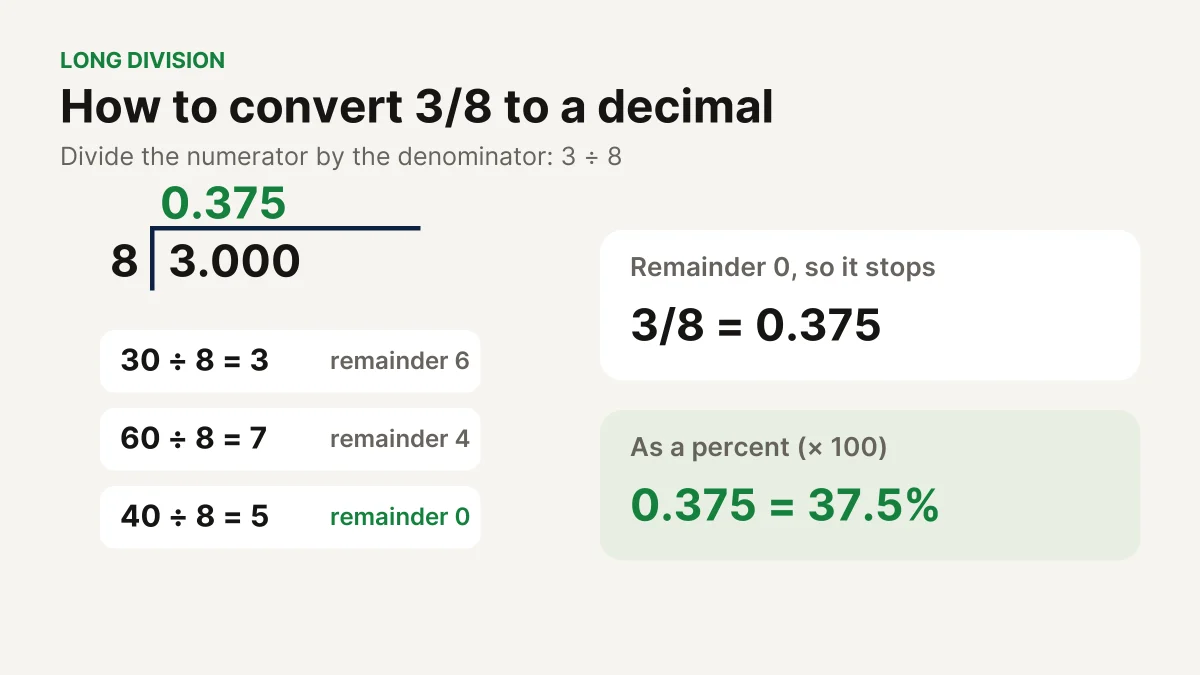
- Set up the division: numerator ÷ denominator. For 3/8, that is 3 ÷ 8.
- Write a decimal point and zeros after the numerator: 3.000.
- Divide as usual, bringing down a zero each time, until the remainder is 0 or the digits start to repeat.
Example: 3/8 as a decimal. 8 does not go into 3, so write 0. Then 30 ÷ 8 = 3 remainder 6, 60 ÷ 8 = 7 remainder 4, and 40 ÷ 8 = 5 remainder 0. So 3/8 = 0.375.
Method 2: Make the Denominator 10, 100 or 1000
If you can multiply the denominator to get 10, 100 or 1000, multiply the top by the same number and read off the decimal. This works when the denominator only has the prime factors 2 and 5.
| Fraction | Multiply by | Power of 10 | Decimal |
|---|---|---|---|
| 3/5 | 2 | 6/10 | 0.6 |
| 7/20 | 5 | 35/100 | 0.35 |
| 9/25 | 4 | 36/100 | 0.36 |
| 3/8 | 125 | 375/1000 | 0.375 |
Repeating Decimals
If a remainder comes back that you have already seen, the digits will repeat forever. Write a bar over the repeating digits: 1/3 = 0.3 and 5/6 = 0.83.
Example: 5/6 as a decimal. 50 ÷ 6 = 8 remainder 2, then 20 ÷ 6 = 3 remainder 2, and the remainder 2 repeats. So 5/6 = 0.8333… = 0.83, about 0.83.
Quick test: a fraction in simplest form gives a repeating decimal when its denominator has a prime factor other than 2 or 5. 7/12 repeats because 12 = 2 × 2 × 3; 7/16 stops because 16 = 2 × 2 × 2 × 2.
Mixed Numbers
Keep the whole number and convert only the fraction part. 2 3/5 = 2 + 0.6 = 2.6. For an improper fraction such as 11/4, divide: 11 ÷ 4 = 2.75.
Converting a Fraction to a Percent
A percent means “out of 100”. Turn the fraction into a decimal, then multiply by 100, which moves the decimal point two places to the right.
Example: 7/8 as a percent. 7 ÷ 8 = 0.875, and 0.875 × 100 = 87.5%. See the full guide: 7/8 as a percent and decimal.
More on percents: how to calculate a percentage.
Try it
Type any fraction to see the decimal, the percent and every long division step.
Converting a Decimal Back to a Fraction
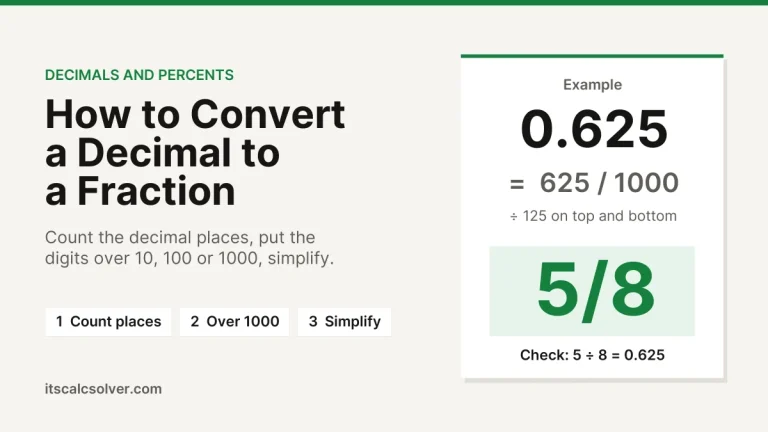
- Terminating decimal: write the digits over 10, 100 or 1000 and simplify. 0.625 = 625/1000 = 5/8.
- Repeating decimal: let x be the decimal, multiply to line up the repeats and subtract. For 0.444…: 10x = 4.444…, so 9x = 4 and x = 4/9.
Simplify the result with the greatest common factor, or see how to simplify fractions. For more worked examples, including repeating decimals and mixed numbers, read how to convert a decimal to a fraction.
Common Fractions as Decimals and Percents
| Fraction | Decimal | Percent | Type |
|---|---|---|---|
| 1/2 | 0.5 | 50% | Terminating |
| 1/3 | 0.3 | ≈ 33.33% | Repeating |
| 2/3 | 0.6 | ≈ 66.67% | Repeating |
| 1/4 | 0.25 | 25% | Terminating |
| 3/4 | 0.75 | 75% | Terminating |
| 1/5 | 0.2 | 20% | Terminating |
| 2/5 | 0.4 | 40% | Terminating |
| 3/5 | 0.6 | 60% | Terminating |
| 4/5 | 0.8 | 80% | Terminating |
| 1/6 | 0.16 | ≈ 16.67% | Repeating |
| 5/6 | 0.83 | ≈ 83.33% | Repeating |
| 1/7 | 0.142857 | ≈ 14.29% | Repeating |
| 1/8 | 0.125 | 12.5% | Terminating |
| 3/8 | 0.375 | 37.5% | Terminating |
| 5/8 | 0.625 | 62.5% | Terminating |
| 7/8 | 0.875 | 87.5% | Terminating |
| 1/9 | 0.1 | ≈ 11.11% | Repeating |
| 1/10 | 0.1 | 10% | Terminating |
| 1/12 | 0.083 | ≈ 8.33% | Repeating |
| 1/16 | 0.0625 | 6.25% | Terminating |
Common Mistakes
- Dividing the wrong way round. 3/8 is 3 ÷ 8 = 0.375, not 8 ÷ 3.
- Rounding a repeating decimal too early. Keep the bar or several digits until the end: 2/3 is 0.666…, so it rounds to 0.67, not 0.66.
- Forgetting the whole number. 1 3/4 is 1.75, not 0.75.
- Moving the point the wrong way for percents. 0.35 = 35%, not 0.0035%.
Practice Problems (With Answers)
1. Write 3/5 as a decimal.
0.6, because 3/5 = 6/10.
2. Write 7/20 as a decimal and a percent.
0.35 = 35%, because 7/20 = 35/100.
3. Write 1/6 as a decimal.
0.16 = 0.1666…, about 0.17.
4. Write 2 3/8 as a decimal.
2.375, because 3/8 = 0.375.
5. Write 0.45 as a fraction in simplest form.
9/20, because 45/100 ÷ 5/5 = 9/20.
For tape measures and drill sizes, use the inch fraction to decimal chart with mm.
FAQ
How do you convert a fraction to a decimal?
Divide the numerator by the denominator. For example, 3/4 = 3 ÷ 4 = 0.75.
What is 3/8 as a decimal?
3/8 = 0.375, which is 37.5%.
What is 2/3 as a decimal?
2/3 = 0.666… with the 6 repeating forever. Rounded to two places it is 0.67.
Which fractions give terminating decimals?
Fractions in simplest form whose denominator has no prime factors other than 2 and 5, such as 1/4, 3/8 and 7/20.
How do you change a decimal to a percent?
Multiply by 100. 0.875 × 100 = 87.5%.
Sources and Further Reading
- OpenStax, Prealgebra, Section 5.3: Decimals and Fractions, Rice University.
- OpenStax, Prealgebra, Section 6.1: Understand Percent.
- Common Core Grade 7: The Number System (7.NS.A.2d).
Convert any fraction instantly with the fraction to decimal calculator. Worked guides: 1/2, 1/3, 1/4, 1/5, 1/8, 3/4, 3/5, 5/6, 5/8, 6/7, 7/8, 7/10, 11/13.
Check your working in seconds
Type any problem from this guide into the free CalcSolver calculator and see the answer, with fractions, instantly.